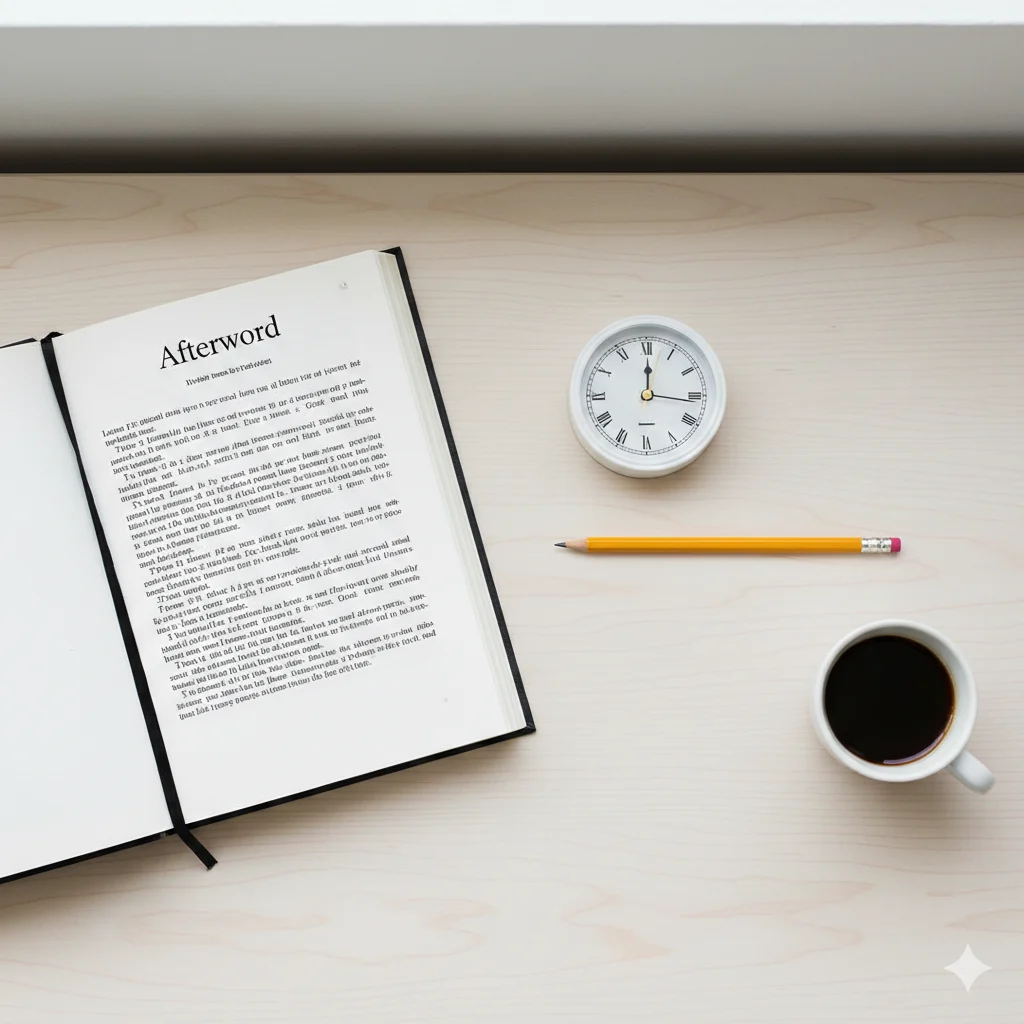
Afterward refers to a time that comes later, while afterword is a written section found at the end of a book.
Although these two words sound almost identical, afterward and afterword have completely different meanings and uses. This similarity often causes confusion among English learners, leading to incorrect usage in writing and exams.
Afterward is an adverb used to describe something that happens later in time, whereas an afterword is a concluding section written by the author or editor, usually placed at the end of a book. Using one in place of the other can change the meaning of a sentence and make writing appear unclear or unprofessional.
In this article, you will learn the exact meanings, clear examples, common mistakes to avoid, and simple tips to remember the difference, so you can use afterward and afterword correctly and confidently.
Afterward or Afterword meanings
The quick answer is that “afterward” and “afterword” are different words with different meanings.
- Afterward (or Afterwards) is an adverb meaning “at a later time” or “following an event.”
- Example: “We had lunch and afterward went for a walk.”
- Example: “He felt fine afterwards.”
- Afterword is a noun meaning a concluding section in a book, often written by someone other than the author.
- Example: “The special edition includes an afterword by the author’s daughter.”
The spelling afterwards is simply a variant of the adverb afterward. The choice between them often depends on regional preference.
The Origin of Afterward and Afterword
Understanding the origin of these words makes it easier to remember the difference. Both words naturally evolved from Old English, but down distinct paths.
Afterward comes from the Old English “æfterweard,” a combination of “æfter” (after) and “-weard” (directed toward). It originally meant “behind” or “in the back,” but over centuries, its meaning shifted to the temporal sense we use today: “in a later time.” The “-ward” suffix is common in English adverbs denoting direction (e.g., forward, backward, toward).
Afterword, on the other hand, is a much more modern construction. It is a direct compound of the preposition “after” and the noun “word.” It was formed by analogy with foreword (a short introductory essay in a book). A foreword comes before the main text; an afterword comes after it. This logical pairing helps anchor its meaning firmly in the context of books and literary additions.
The spelling confusion exists purely because they are homophones—words that sound the same. When writing quickly, it’s easy to choose the wrong one if you’re not thinking about the specific meaning.

British English vs. American English Spelling
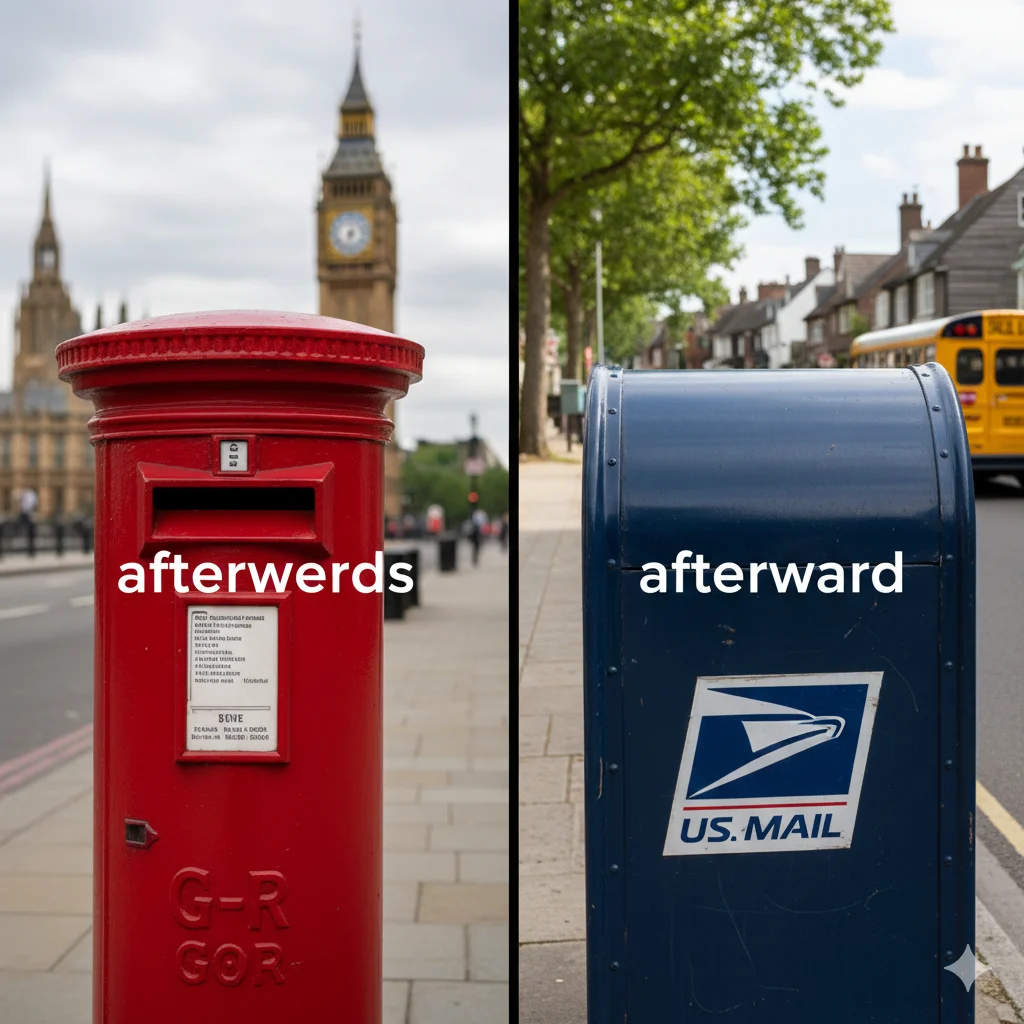
The primary spelling difference lies in the adverb, not between “afterward” and “afterword,” but between afterward and afterwards.
- American English: Strongly prefers afterward. This follows a common pattern where American English often drops the ‘s’ from directional adverbs (e.g., toward vs. towards, forward vs. forwards). Major style guides like the AP Stylebook and Chicago Manual of Style recommend afterward.
- British and Commonwealth English: Predominantly uses afterwards. The ‘s’ ending is standard in U.K., Australian, and Canadian English for these adverbial forms.
Both “afterward” and “afterwards” are grammatically correct and identical in meaning. The noun afterword is spelled the same in all English variants.
| Variant | Part of Speech | Preferred in US English | Preferred in UK/Commonwealth English | Example |
|---|---|---|---|---|
| Afterward | Adverb | Yes | Less Common | “Let’s discuss this afterward.” |
| Afterwards | Adverb | Less Common | Yes | “Let’s discuss this afterwards.” |
| Afterword | Noun | Yes | Yes | “The book’s afterword provides context.” |
Which Spelling Should You Use?
Your audience should guide your choice. This is a key principle for clear, professional communication.
- For a U.S. Audience: Use afterward for the adverb. It aligns with American English conventions and is preferred by U.S. editors, publishers, and educators. Always use afterword for the book section.
- For a U.K./Commonwealth/International Audience: Use afterwards for the adverb. It will look most natural to readers in the U.K., Australia, Canada, and other regions influenced by British English. Again, use afterword for the book section.
- For Global or Online Content: Consistency is king. Choose one adverbial form (afterward or afterwards) and stick with it throughout your document. If writing for a global website, afterward is increasingly understood everywhere, but afterwards is also perfectly acceptable. The most important rule is to never use “afterword” when you mean “later in time.”
Common Mistakes with Afterward and Afterword
The most frequent error is using the noun afterword when the adverb afterward(s) is intended. This mistake can confuse readers and make writing seem careless.
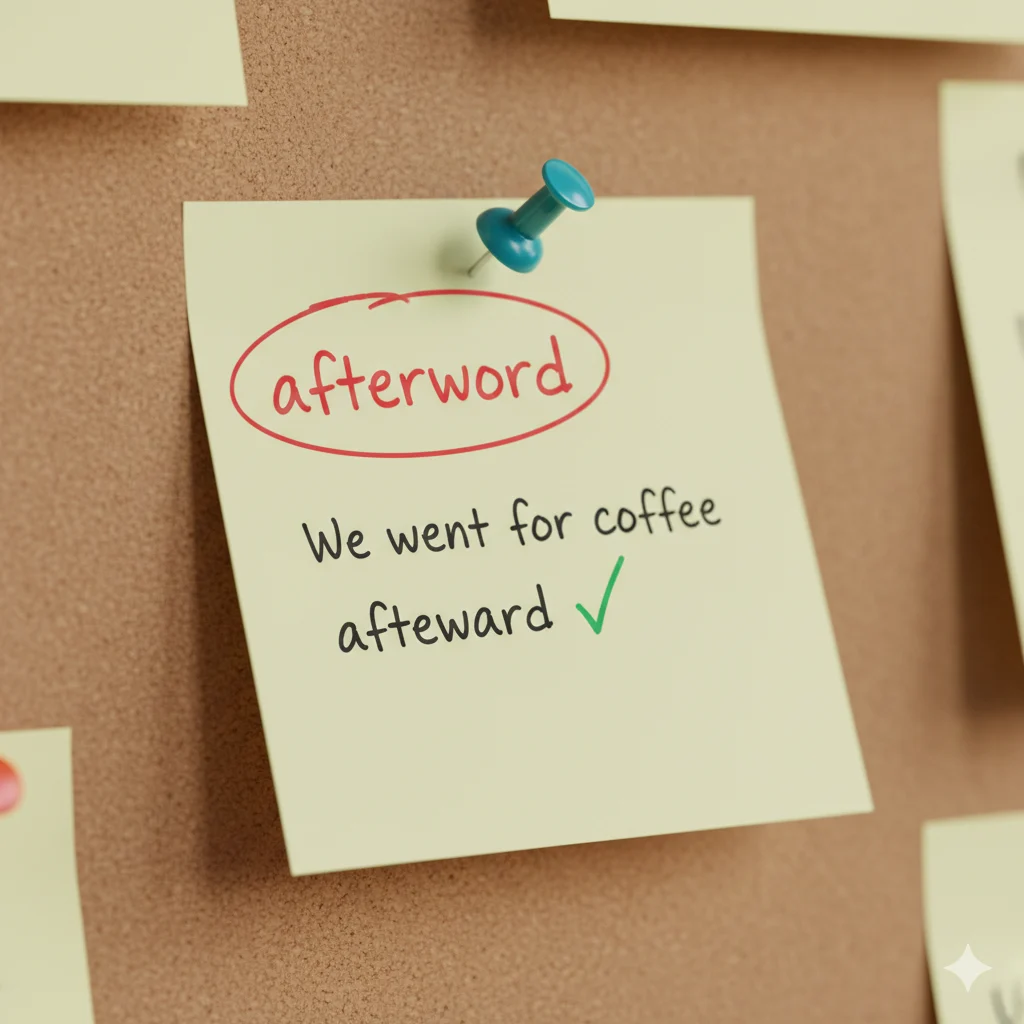
- Incorrect: “We went to the meeting and had coffee in the afterword.”
- Correct: “We went to the meeting and had coffee afterward.”
Another common mix-up is with afterward and afterwards. While not a critical error, using the variant less common for your audience can make your writing seem less polished.
- Less Polished in US: “The contract was signed afterwards.” (Use afterward)
- Less Polished in UK: “She left shortly afterward.” (Use afterwards)
Remember, you cannot add an ‘s’ to the noun: afterwords is incorrect unless you are speaking of multiple concluding sections (which is very rare).
Afterward or Afterword in Everyday Examples
Seeing these words in context solidifies their correct use.
- Email (Professional US): “Thank you for the presentation. Please send the slides afterward so I can share them with the team.”
- News Headline: “The law passed, but afterwards, significant logistical challenges emerged.”
- Social Media (Casual): “Great concert! Got to meet the band afterwards. #bestnightever”
- Formal Writing / Academic: “The experiment yielded initial results; afterward, the data was analyzed for long-term trends.”
- Publishing Context: “The anniversary edition features a poignant afterword reflecting on the novel’s impact over the last decade.”
Afterward or Afterword – Google Trends & Usage Data
Analyzing search data reveals clear patterns in user confusion and regional preference. Searches for “afterward vs afterword” and “is it afterward or afterwards” remain consistently high in English-speaking countries, peaking during academic seasons. This indicates ongoing user intent to resolve this grammar question quickly.
Geographically, the United States shows a higher relative search volume for the simpler spelling “afterward.” In contrast, the United Kingdom, Australia, and Canada show more searches for “afterwards.” Searches for “afterword meaning” spike around literary award seasons and major book releases, when new editions with supplementary content are promoted. This data confirms that the core confusion is between the adverb and the noun, a confusion the Google algorithm recognizes and serves with featured snippets defining each term. Writing content that clearly distinguishes them satisfies this search intent directly.
FAQs: Afterward or Afterword?
1. Is it afterward or afterword?
Use afterward (or afterwards) to mean “at a later time.” Use afterword only to refer to a concluding section in a book.
2. What does an afterword mean?
An afterword is a noun. It is a short essay or note at the end of a book, often written by the author or another person, that provides commentary, context, or updates on the work.
3. How to use afterwards?
Use “afterwards” exactly like “afterward,” as an adverb. It often comes at the end of a clause: “We saw the film and went for dinner afterwards.”
4. When should I use afterwards?
Use “afterwards” when writing for a British, Australian, Canadian, or other Commonwealth audience. It’s the standard adverbial form in those variants of English.
5. What is the AP Style for afterward?
The AP Stylebook, the standard for U.S. journalism, mandates the use of afterward (without the ‘s’).
6. Can I use afterward and afterwards interchangeably?
Yes, but not effectively. They mean the same thing, but your choice should be guided by your primary audience’s regional spelling norms for polished writing.
7. Is afterwards a word?
Absolutely. Afterwards is a perfectly correct word and the standard spelling of the adverb in British and Commonwealth English.
Conclusion
Mastering the difference between afterward and afterword is a small but significant step toward more precise and professional writing. The core takeaway is straightforward: afterword is exclusively a noun for a book’s concluding section.
Afterward and afterwards are adverb variants meaning “later,” with the choice depending largely on geography. For American English, afterward is preferred; for British and Commonwealth English, afterwards is standard. The best practice is to know your audience and be consistent.
By applying this simple guidance, you eliminate a common error, enhance the clarity of your communication, and demonstrate a strong command of language nuances. Whether you’re drafting an email, writing a report, or publishing a novel, using the correct word builds credibility and ensures your message is received exactly as intended. Remember, if you’re talking about time, think “-ward” (direction in time). If you’re talking about a book, think “word” (a section of writing).

Carys Davies is a Welsh short story writer and novelist known for her sharp storytelling and unexpected twists. Her work blends imagination, irony, and dark humor — perfect for readers who love smart surprises. Carys turns small moments into clever, witty tales that leave a lasting smile long after the punchline fades.