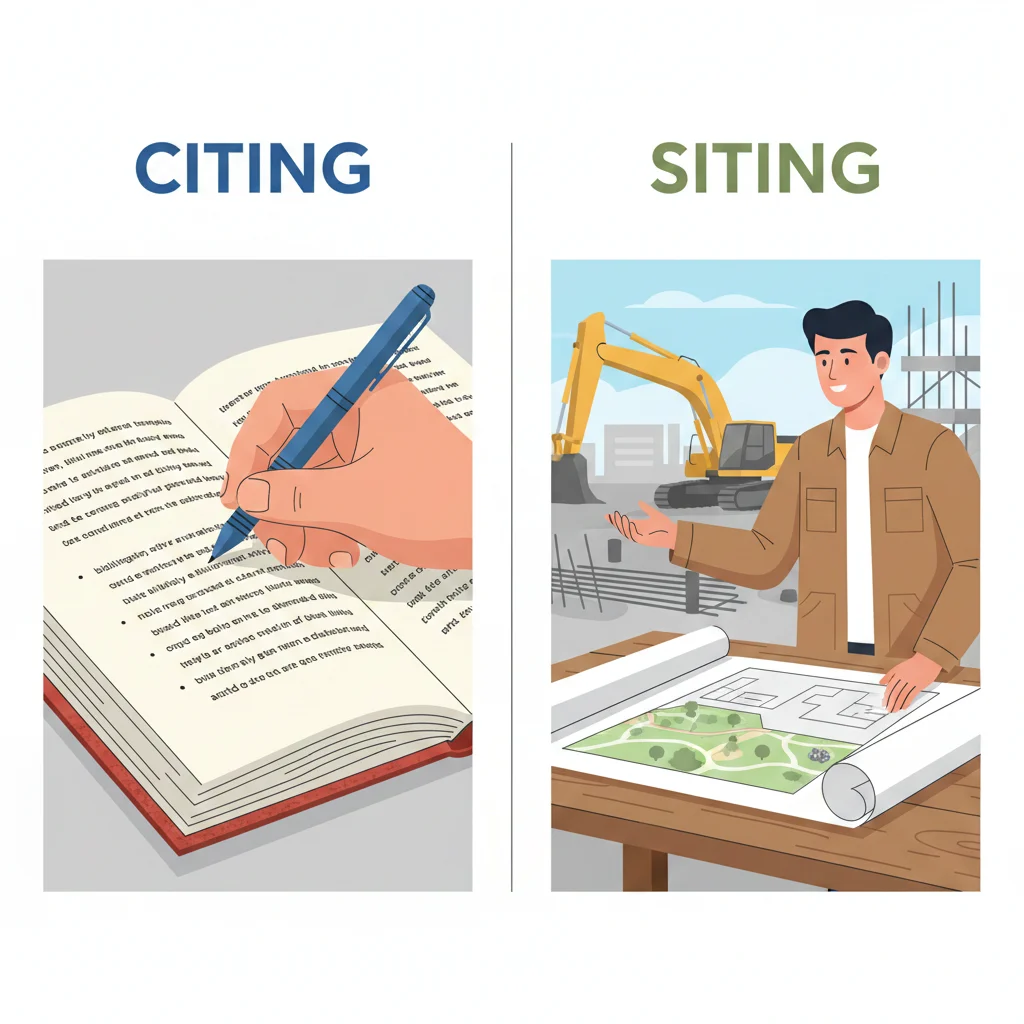
Citing means referencing a source, while siting means choosing a location or positioning something.”
Still mixing up ‘citing’ and ‘siting’? Don’t worry — you’re not alone. These two words sound alike but have very different meanings. Citing is used when you reference a source, quote, or evidence in writing or research.
For example: “She is citing a famous study in her essay.” On the other hand, siting refers to choosing a location or placing something. For instance: “The siting of the new park was carefully planned.”
Understanding this difference is crucial for academic writing, professional communication, and everyday clarity. In this article, you’ll find a complete, easy-to-follow guide to citing vs siting, with clear examples, common mistakes to avoid, and tips for proper usage, so you never mix them up again.
Citing or Siting meanings
The quick answer is that citing and siting are two different words with distinct meanings.
- Citing refers to quoting a source, referencing an author, or mentioning something as proof. It comes from the word “citation.”
- Example: “Make sure you are citing your sources in the bibliography.”
- Siting refers to the act of placing or locating something in a specific position. It comes from the word “site,” meaning a location.
- Example: “The committee is siting the new school near the park.”
If you are talking about giving credit to a book or a person, use citing. If you are talking about where to put a physical object, use siting.
The Origin of Citing and Siting
To understand why we have these two words, we have to look back at the history of the English language. Both words ultimately trace back to Latin, but they took very different paths to become the homophones we know today.
The word citing comes from the Old French word citer, which itself comes from the Latin citare, meaning “to summon” or “to call.” In the 15th century, it evolved in English to mean “to quote as an authority.” You are essentially “summoning” the words of an expert to support your own argument.
On the other hand, siting comes from the word site. The word site comes from the Latin situs, meaning “position” or “location.” It entered English in the late 14th century, originally referring to the position of a town or building. So, siting is simply the modern verb form of placing something in a physical location. The spelling differences exist simply because the words evolved from different roots, even though their modern pronunciations have converged.

British English vs American English Spelling
Here is the good news: citing and siting are spelled the same way in both British and American English. The confusion is not about regional spelling variations (like color vs colour), but about the meaning of the words themselves.
However, things get slightly more complicated when we look at the word sighting. While siting is about placing something, sighting (with a ‘gh’) is about seeing something. This is a common point of confusion across all English dialects.
To make it crystal clear, here is a comparison table of the variations:
| Word | Part of Speech | Definition | British English Example | American English Example |
|---|---|---|---|---|
| Citing | Verb | Referencing or quoting a source. | The barrister is citing a previous case. | The student is citing three academic journals. |
| Siting | Verb | Placing or locating something. | They are siting the new wind farm offshore. | The city is siting the dump away from homes. |
| Sighting | Verb/Noun | Seeing or observing something. | There was a sighting of a rare bird. | The UFO sighting made the news. |
Which Spelling Should You Use?
Choosing the correct word depends entirely on your audience and what you are trying to say. Since the spelling doesn’t change between countries, you need to focus on context.
- Academic or Professional Writing (US, UK, Commonwealth): If you are writing a paper, report, or email where you are referencing data or people, citing is your word. “Remember to include a bibliography when citing your sources.”
- Construction, Urban Planning, or Architecture: If your work involves deciding where to put a building, a park, or a piece of infrastructure, you are siting things. “The engineers are siting the bridge to avoid geological faults.”
- General or Creative Writing: If you are describing an event where someone saw something unusual (a celebrity, an animal, a ship), you want the word sighting. “The sighting of the deer in the garden was a magical moment.”
If your global audience is simply reading for clarity, using the wrong word creates a grammatical error that can make you look unprofessional. Always match the word to the action: citing for quotes, siting for locations.
Common Mistakes with Citing and Siting
Because these words are homophones, spell-checkers often miss the error. The sentence is spelled correctly, but the meaning is wrong. Here are the most frequent mistakes and how to correct them.
- Mistake: “The report is siting data from 2022.”
- Correction: “The report is citing data from 2022.” (Unless the report is physically placing the data somewhere, this is wrong).
- Mistake: “They are citing the new factory near the river.”
- Correction: “They are siting the new factory near the river.” (They are choosing a location).
- Mistake: “He filed a police report about a siting of a mountain lion.”
- Correction: “He filed a police report about a sighting of a mountain lion.” (He saw it, he didn’t place it there).
- Confusion:“Out of site or sight?”
- The correct phrase is “out of sight.” It means something is too far away to be seen. “The plane is now out of sight.” “Out of site” would mean something is not part of a website or location, which is rarely the intended meaning.
- Confusion:“Beautiful sight or site?”
- If you are looking at a sunset, it is a beautiful sight. If you are looking at a piece of land where a house will be built, it is a beautiful site.

Citing or Siting in Everyday Examples
Seeing words used in context is the best way to internalize their meaning. Here is how these words appear in different types of writing and speech.
- In Emails:
- “I am citing your previous email to clarify the deadline.”
- “We are currently siting the new equipment in the warehouse.”
- In News Headlines:
- “Senator faces backlash for citing false statistics.”
- “Controversy erupts over siting of homeless shelter in residential area.”
- “Rare sighting of snowy owl delights birdwatchers.”
- On Social Media:
- “Just citing a tweet from @NASA about the moon landing!” (X/Twitter)
- “Beautiful sight at the beach today! #sunset” (Instagram/Facebook)
- “Does anyone have tips on siting a vegetable garden for maximum sun?” (Facebook Gardening Group)
- In Formal Writing:
- “This paper will analyze the data while citing peer-reviewed studies.”
- “The feasibility study focuses on siting the infrastructure to minimize environmental impact.”

Citing vs. Siting – Usage Data
While both words are used frequently, their contexts are vastly different. Citing is far more common in text due to the nature of academic, legal, and news writing, where referencing sources is standard practice. Siting is a niche term, heavily used in government documents, environmental impact reports, and construction plans.
The confusion between sighting and siting is also common. If you search for “bird siting,” search engines will often correct you to “bird sighting” because the data shows that the intent is almost always about seeing, not placing.
The word site is overwhelmingly popular in digital contexts (website), while sight is popular in sensory contexts (line of sight, sightseeing). When choosing between citing or siting, remember that citing usually involves words and ideas, while siting involves maps and physical locations.
Frequently Asked Questions
1. What do you mean by citing?
Citing means quoting, referencing, or mentioning a source, such as a book, author, or document, as authority or proof for an argument or statement. For example, if you write a paper and mention where you got your facts, you are citing that source.
2. Is it sighting or citing a document?
It is citing a document. To cite a document means to refer to it. “Sighting” means seeing something, so if you “sighted a document,” it would mean you saw it in the distance, which is not the correct phrase for referencing paperwork.
3. What is the difference between sited and sighted?
Sited (past tense of siting) means placed or located. Example: “The statue was sited in the town square.” Sighted (past tense of sighting) means seen or observed. Example: “The ship was sighted off the coast.”
4. What is the difference between sighting and siting?
Sighting is the act of seeing or observing something. Siting is the act of choosing or placing something in a specific location. A wildlife photographer might have a sighting of an eagle, while a construction crew is siting a new observation tower.
5. How do you use site and sight in a sentence?
- Site (Location): “They chose a hilltop as the site for the new castle.”
- Sight (Vision): “The sunset was a glorious sight.”
- Both in one sentence: “From this building site, you have a perfect sight of the mountains.”
6. What does “out of sight” mean?
The phrase is “out of sight.” It means something is not visible because it is too far away or hidden. It is also used as slang to mean excellent or incredible.
7. Is there a trick to remembering citing vs siting?
Yes! Think of the letter ‘C’. Citing starts with a ‘C’, just like Citation and Cite. If you are referencing something, you need a ‘C’. Siting starts with an ‘S’, just like Site and Space. If you are talking about a physical Space or location, use ‘S’.
Conclusion:
Understanding the difference between citing and siting is a small but significant step toward mastering English grammar and professional communication. We have established that while they sound identical, their purposes are worlds apart. Citing connects you to the world of ideas, research, and intellectual honesty. Siting anchors you to the physical world of geography, construction, and placement. And don’t forget sighting, which captures the act of perception.
The key takeaway is to always consider the context of your sentence. Ask yourself: Am I referencing a source? Use citing. Am I deciding on a location? Use siting. Am I describing an observation? Use sighting. By applying this simple rule, you can avoid common mistakes, enhance your credibility, and ensure your writing is clear and precise. Next time you type one of these words, you can do so with absolute confidence.

Carys Davies is a Welsh short story writer and novelist known for her sharp storytelling and unexpected twists. Her work blends imagination, irony, and dark humor — perfect for readers who love smart surprises. Carys turns small moments into clever, witty tales that leave a lasting smile long after the punchline fades.