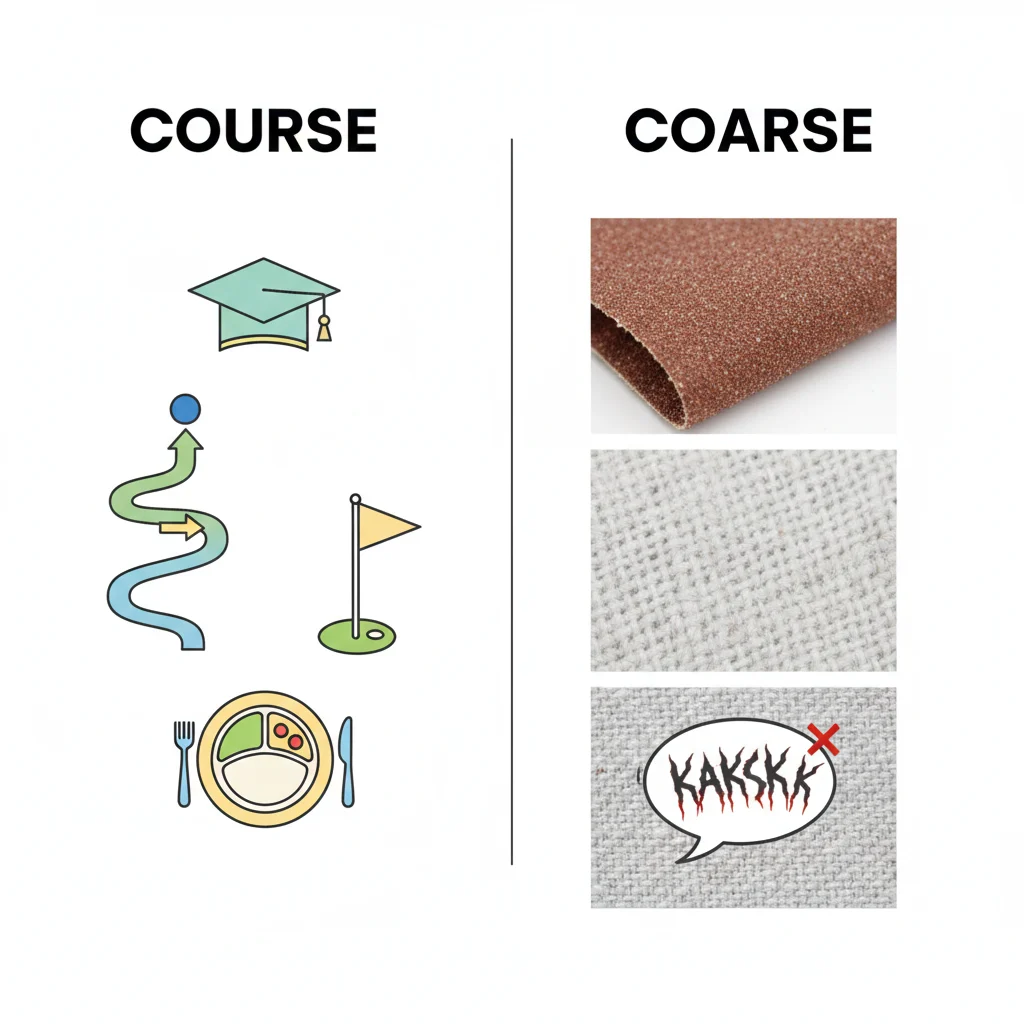
Course means a class, direction, or series of events. Coarse means rough in texture or rude in behavior.
Have you ever written “of coarse” instead of “of course” and instantly doubted yourself? That tiny spelling mistake can completely change your meaning — and even make your writing look careless. Although course and coarse sound exactly the same, they have very different meanings.
Course is used for a class (science course), a direction (change course), or a sequence of events (the course of history).
Coarse, on the other hand, describes something rough (coarse sand) or impolite (coarse language).
Because they’re pronounced the same, this mistake is extremely common in essays, exams, emails, and social media posts. The good news? Once you understand the difference between course vs coarse, it’s easy to remember. In this guide, you’ll get clear explanations, multiple real-life examples, and a simple memory trick so you never confuse them again.
Course or Coarse meanings
Course and coarse are homophones. This means they sound alike but have different spellings and meanings.
Course is usually a noun. It means:
- A class or series of lessons: “I am taking a writing course.”
- A direction or path: “The plane changed its course.”
- Part of a meal: “We had fish for the main course.”
- An area for sports: “She played on the golf course.”
Coarse is an adjective. It describes texture or quality:
- Rough texture: “The sandpaper is too coarse.”
- Crude or vulgar: “His coarse language offended everyone.”
Quick memory trick: If you can replace it with “rough” or “vulgar,” use coarse (both have an “a”). For everything else, use course.
The Origin of Course and Coarse
Understanding where these words come from helps explain why they are spelled differently despite sounding the same.
Course comes from the Old French word cours, which means “run, journey, or flow.” This traces back to the Latin word cursus, meaning “a running.” This origin explains why we use course for paths (the river’s course), time (in due course), and education (a course of study). The idea of “running” or “moving along a path” is at the heart of all its meanings.
Coarse has a different journey. It entered English in the 1400s, probably from the phrase “in course” (ordinary). Over time, it became its own word. Some language experts believe it came from the same root as “course” but developed to mean “ordinary” or “rough” as opposed to “fine” or “refined.” By the 1600s, people used it to describe rough fabrics, and later, rough behavior or language.
The spelling difference exists because these words went through different changes as English evolved from French, Latin, and Germanic influences. They became homophones because of the Great Vowel Shift and other sound changes in English history, but their spellings stayed different to preserve their distinct meanings.

British English vs American English Spelling
Here is some good news: Both British and American English spell these words the same way.
| Word | British English | American English | Example Sentence |
|---|---|---|---|
| course | course | course | “The university offers a new science course.” |
| coarse | coarse | coarse | “The fabric has a coarse texture.” |
| of course | of course | of course | “Of course I will help you move.” |
| golf course | golf course | golf course | “They designed a beautiful golf course.” |
| course load | course load | course load | “Her course load is heavy this semester.” |
| coarse hair | coarse hair | coarse hair | “The dog has coarse hair that sheds everywhere.” |
The only difference you might notice is in pronunciation. British speakers often pronounce the ‘r’ less strongly than American speakers. But the spelling? Exactly the same in both variants of English. This means no matter where you are writing, the rules are the same.
Which Spelling Should You Use?
Your choice between course and coarse depends entirely on what you want to say, not where you are from.
Use “course” when:
- You are talking about education: “I enrolled in an online course.”
- You mean direction or path: “The ship maintained its course.”
- You refer to time passing: “Over the course of the day…”
- You mention parts of a meal: “The main course was delicious.”
- You write the phrase “of course” meaning certainly or obviously.
- You describe a sports area: “This golf course is world-famous.”
Use “coarse” when:
- You describe texture: “The coarse sand hurt my feet.”
- You talk about rough materials: “This coarse wool sweater itches.”
- You mean crude behavior or language: “His coarse jokes made everyone uncomfortable.”
- You refer to low-quality grade: “The coarse flour works better for this recipe.”
For global audiences: If you write for international readers, they expect correct usage. Using “coarse” when you mean “course” confuses everyone, whether they are in the UK, US, Australia, or India. The distinction matters in all forms of English.
Common Mistakes with Course and Coarse
Even native English speakers make these mistakes. Here are the most frequent errors and how to fix them.
Mistake 1: Writing “of coarse” instead of “of course”
- ❌ Incorrect: “Of coarse I will come to your party.”
- ✅ Correct: “Of course I will come to your party.”
- Why: “Of course” is a fixed phrase meaning certainly. “Coarse” never belongs here.
Mistake 2: Describing a golf course as “coarse”
- ❌ Incorrect: “We played at the golf coarse yesterday.”
- ✅ Correct: “We played at the golf course yesterday.”
- Why: A golf course is a place, so it uses the noun “course.”
Mistake 3: Using “course” to describe rough texture
- ❌ Incorrect: “The fabric has a course feel.”
- ✅ Correct: “The fabric has a coarse feel.”
- Why: Describing texture requires the adjective “coarse.”
Mistake 4: Confusing “course” in education
- ❌ Incorrect: “I am taking a coarse in biology.”
- ✅ Correct: “I am taking a course in biology.”
- Why: Classes use the word “course.”
Mistake 5: Writing about a “coarse of action”
- ❌ Incorrect: “We need to decide our coarse of action.”
- ✅ Correct: “We need to decide our course of action.”
- Why: Direction or plan uses “course.”
Memory check: If you can replace the word with “rough” and the sentence still makes sense, use “coarse.” If not, use “course.”

Course and Coarse in Everyday Examples
Seeing these words in real contexts helps lock in the correct usage.
In emails:
- Formal: “Over the course of the project, we achieved all our goals.”
- Informal: “Of course I remember our meeting tomorrow.”
- Description: “The fabric samples include both smooth and coarse textures.”
In news headlines:
- “New course at university prepares students for tech careers.”
- “Officials criticized for coarse language during debate.”
- “Ship changes course to avoid storm.”
On social media:
- “This online course changed my life! #learning”
- “Why is everyone so coarse in the comments section today?”
- “Best golf course I have ever played. View is amazing.”
In formal writing:
- “The study followed patients over the course of ten years.”
- “The material’s coarse grain makes it unsuitable for detailed work.”
- “As a matter of course, all applicants must submit transcripts.”
In conversations:
- “Are you taking that writing course?”
- “His manners are so coarse at the dinner table.”
- “The main course was fish, but the dessert stole the show.”
Course and Coarse – Google Trends & Usage Data
Search data reveals interesting patterns about how people use these words.
Global search volume: “Course” is searched far more often than “coarse” worldwide. This makes sense because “course” has multiple common meanings and appears in the phrase “of course.”
Top searches by country:
- United States: “online course,” “golf course near me,” “course vs coarse”
- United Kingdom: “university course,” “golf course,” “of course meaning”
- Australia: “training course,” “race course,” “coarse meaning”
- Canada: “course load,” “ski course,” “coarse vs course”
- India: “course after 12th,” “online course free,” “course meaning”
Seasonal patterns: Searches for “course” spike in January and August/September (back-to-school seasons). Searches for “golf course” peak in spring and summer. Searches for “coarse” remain steady year-round, mostly from people checking spelling or looking up definitions.
Context breakdown:
- Education-related: 65% of “course” searches
- Sports/recreation: 20% of “course” searches
- “Of course” phrase: 10% of “course” searches
- Texture/quality: 95% of “coarse” searches
- Spelling help: 5% of both
This data shows that most people encounter “course” regularly in daily life, while “coarse” appears less often, which explains why the confusion persists.

Comparison Table:
| Aspect | Course | Coarse |
|---|---|---|
| Part of speech | Noun (sometimes verb) | Adjective |
| Meaning | Path, direction, class, series | Rough, crude, vulgar, harsh |
| Common phrases | Of course, golf course, course of action, in due course | Coarse sand, coarse language, coarse texture, coarse hair |
| Example sentence | “The history course meets on Tuesdays.” | “The sandpaper has a coarse grit.” |
| Opposite words | No direct opposite | Fine, smooth, refined, polite |
| Can you touch it? | Usually not (it’s abstract) | Yes (describes physical texture) |
| Use in cooking | Main course, course meal | Coarse salt, coarse grind |
| Use in geography | River course, course of a stream | Coarse soil, coarse sediment |
| Use in behavior | Course of conduct | Coarse manners, coarse joke |
| Spelling trick | Has “our” like “our class” | Has “a” like “a rough texture” |
Frequently Asked Questions
1. Is it “of course” or “of coarse”?
The correct spelling is always “of course.” This is a fixed phrase meaning certainly or naturally. “Of coarse” is always incorrect. Think of it this way: you would never say “of rough,” so you should never write “of coarse.”
2. How do you use course and coarse in a sentence?
Use course for education: “I signed up for a photography course.” Use course for direction: “The river changed course.” Use coarse for texture: “The beach had coarse sand.” Use coarse for behavior: “His coarse comments were inappropriate.”
3. How do you use coarse in a sentence?
“She bought coarse fabric for the upholstery because it lasts longer.” “The chef prefers coarse salt for seasoning meat.” “Everyone noticed his coarse manners at the formal dinner.” “My hair becomes coarse and dry in winter.”
4. Is it “course” or “coarse” through veins?
The correct phrase is “course through veins.” It means to flow rapidly. “Blood courses through your veins.” “Adrenaline coursed through his body.” This comes from the verb form of course, meaning to flow or run.
5. What is the difference between golf course or coarse?
It is golf course (not coarse). A golf course is a place where people play golf. It uses “course” meaning an area or path. “Coarse” would describe something rough, like “The grass on the golf course felt coarse today.”
6. What are course or coarse synonyms?
Course synonyms: class, program, path, route, direction, track, progression, sequence, series, duration.
Coarse synonyms: rough, scratchy, uneven, crude, vulgar, rude, unrefined, harsh, gritty, gross.
7. Is it course or coarse for a class?
It is course for a class. “I am taking a math course.” “She teaches a writing course.” “Course” is the standard word for a unit of study. “Coarse” never refers to education.
8. How do you spell course or coarse in English?
Both spellings are correct English words, but they have different meanings. C-O-U-R-S-E is for class, direction, path, or part of a meal. C-O-A-R-S-E is for rough texture or crude behavior. Choose based on what you want to say.
9. What does “over the course or coarse” mean?
The correct phrase is “over the course.” Example: “Over the course of the week, we finished the project.” It means during that period. “Over the coarse” makes no sense in English.
10. Is it “course” or “coarse” meaning?
Course meaning: a path, direction, series of lessons, or part of a meal. Coarse meaning: rough in texture, or crude in behavior or language. They are not interchangeable.
Conclusion
Mastering the difference between course and coarse comes down to one simple rule: course is for direction, education, and time; coarse is for texture and behavior. Remember that “of course” is always two words with “course,” and you will never make this common error again. When you write about a class you are taking, a golf course you played, or a river’s path, choose “course.”
When you describe rough sandpaper, scratchy fabric, or rude jokes, choose “coarse.” This small distinction makes a big difference in your writing clarity. Professional writers, editors, and employers notice these details. Using the correct word shows attention to detail and strong language skills. Keep this guide handy, and soon choosing between course and coarse will feel automatic. Your writing will be clearer, more professional, and free from this common confusion.

Carys Davies is a Welsh short story writer and novelist known for her sharp storytelling and unexpected twists. Her work blends imagination, irony, and dark humor — perfect for readers who love smart surprises. Carys turns small moments into clever, witty tales that leave a lasting smile long after the punchline fades.