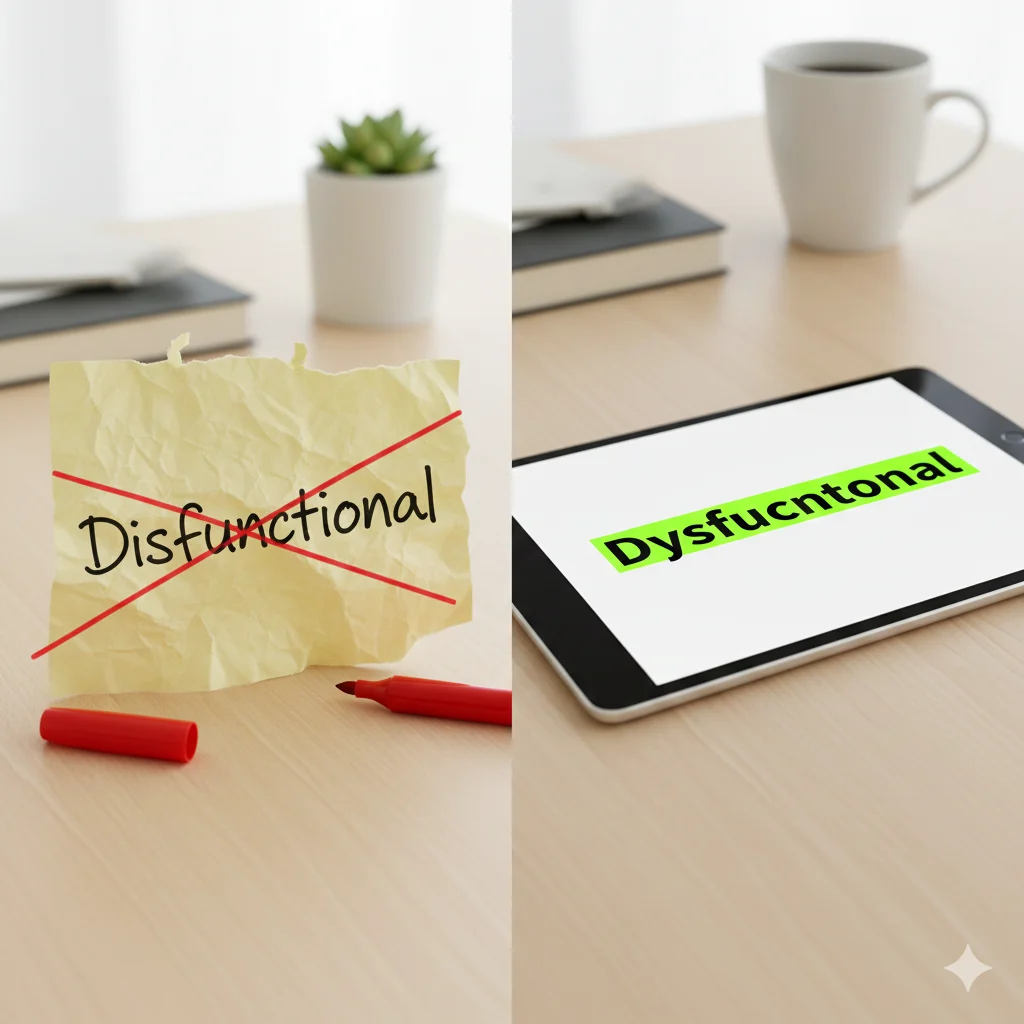
“Dysfunctional” is the correct spelling. “Disfunctional” is incorrect because the word uses the prefix “dys-,” meaning abnormal or impaired—not “dis-.”
If you’re unsure whether to write disfunctional or dysfunctional, you’re not alone. The confusion happens because many English words begin with “dis-,” such as disagree or disappear. However, “dysfunctional” does not use the “dis-” prefix. It comes from the Greek prefix “dys-,” which means bad, difficult, impaired, or abnormal.
The word “dysfunctional” describes something that does not operate or behave normally—for example, a dysfunctional relationship, a dysfunctional team, or a dysfunctional system. The spelling “disfunctional” is simply a common typo and is not recognized in standard dictionaries or formal writing.
Using the correct spelling is especially important in academic papers, professional communication, articles, and exams, where accuracy affects credibility. In this guide, you’ll learn the correct meaning, sentence examples, pronunciation clarity, and an easy memory trick to confidently distinguish disfunctional vs dysfunctional every time you write.
Dysfunctional meanings
The quick answer is that dysfunctional is the correct spelling. The version “disfunctional” is a common misspelling.
Dysfunctional is an adjective used to describe something that is not operating normally or properly. It literally means “impaired or abnormal functioning.”
Examples of correct usage:
- “The family had a dysfunctional communication pattern.”
- “After the spill, the company’s safety protocols became dysfunctional.”
- “He grew up in a dysfunctional home environment.”
If you see “disfunctional,” it is a mistake. Think of it this way: the opposite of “functional” is “dysfunctional,” just as the opposite of “happy” is “unhappy”—you change the prefix, not the root word.
The Origin of Dysfunctional
To understand why we spell it “dysfunctional,” we have to look at the history of the word and its parts.
The word is a combination of two main elements: the prefix “dys-” and the word “functional.”
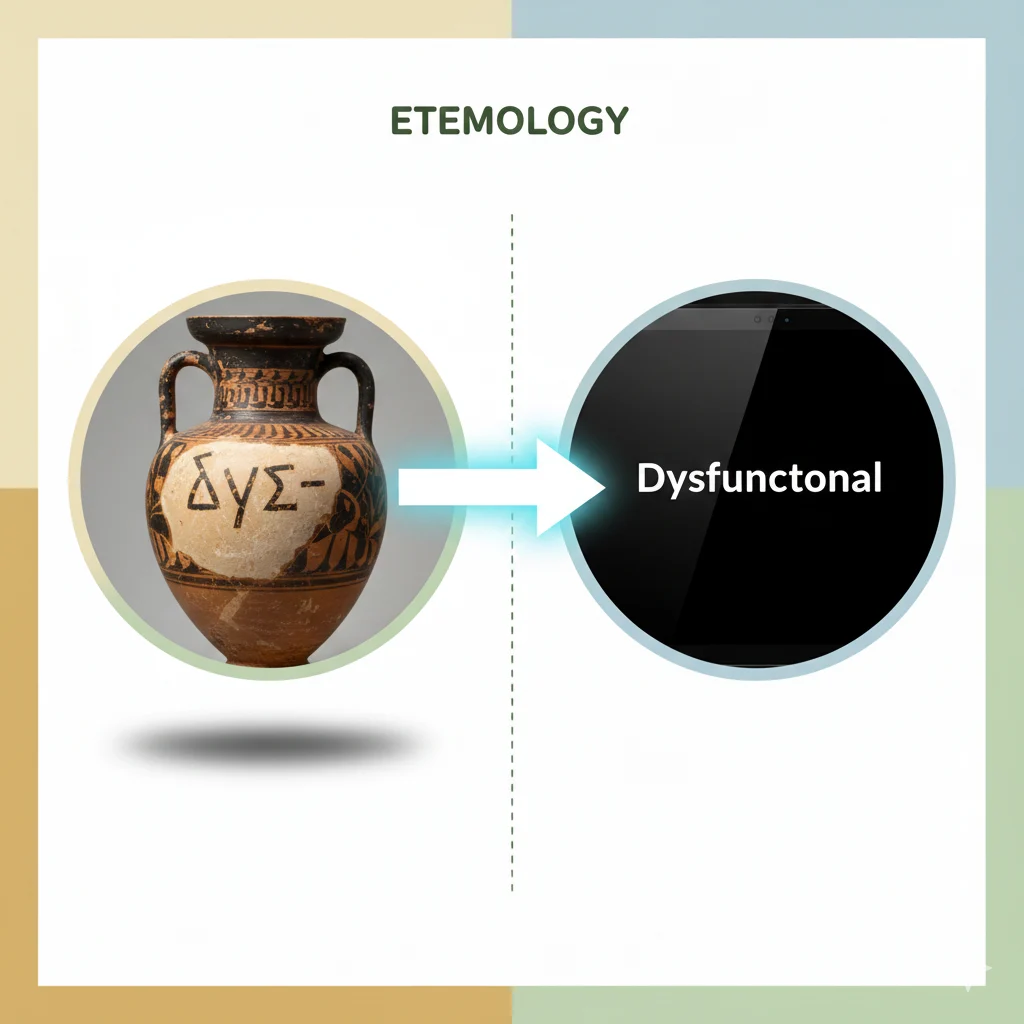
- The Prefix “Dys-“: This prefix comes from the Ancient Greek word “dus-,” which meant “bad,” “abnormal,” or “difficult.” In English, we use “dys-” in many medical and scientific terms to indicate something is wrong. Think of words like dyslexia (difficulty with words), dyspepsia (bad digestion), or dysfunction (abnormal function). The Greek root is firmly established with a ‘y’.
- The Word “Functional”: This comes from the Latin “functio,” meaning “to perform.” It simply refers to how something works.
The confusion with “disfunctional” arises because people mistakenly substitute the prefix with “dis-.” The prefix “dis-” also comes from Latin and means “apart” or “not” (like in disagree or disconnect). While it seems logical to use “dis-” to mean “not functional,” the correct historical and medical term is built on the Greek root dys- to specifically imply “bad” or “abnormal” function, rather than just a simple negation.
British English vs American English Spelling
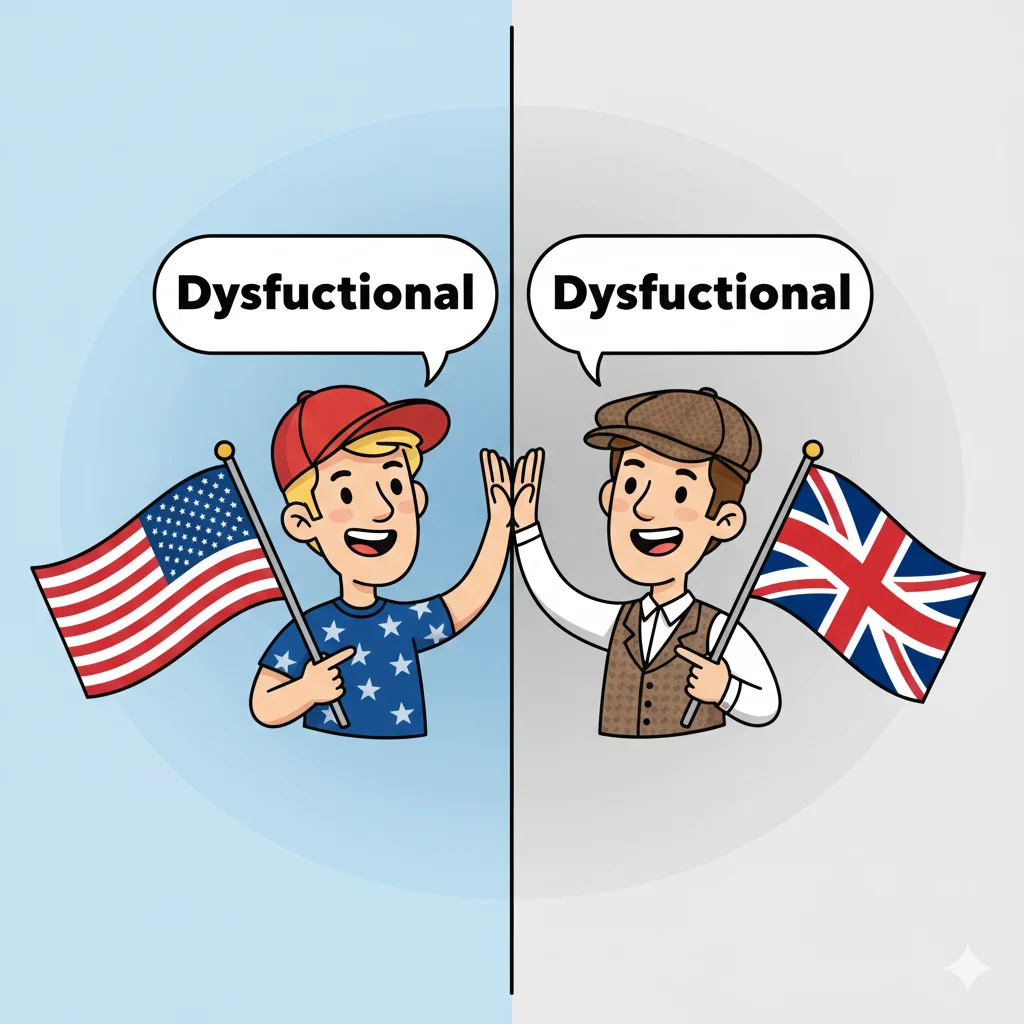
This is where it gets interesting. While dysfunctional is the standard spelling in both major dialects, the confusion between “dysfunctional” and “disfunctional” exists equally on both sides of the Atlantic.
However, the spelling of related words can differ slightly between British and American English, which might add to the confusion. For example, the verb forms can have different conventions. But when it comes to the specific adjective dysfunctional, the spelling is consistent.
Here is a comparison table to illustrate the standard usage:
| Term | American English | British English | Commonality |
|---|---|---|---|
| dysfunctional | Preferred and correct | Preferred and correct | Universally accepted |
| disfunctional | Incorrect / Misspelling | Incorrect / Misspelling | Never correct in formal writing |
| dysfunction (noun) | Preferred and correct | Preferred and correct | Universally accepted |
| disfunction (noun) | Very rare / Incorrect | Very rare / Incorrect | Considered a spelling error |
As the table shows, whether you are writing for a US audience in Chicago or a UK audience in London, the correct spelling is always dysfunctional.
Which Spelling Should You Use?
Choosing the correct spelling is not about geography; it’s about following standard English conventions. Here is simple, audience-based advice:
- For a US Audience (American English): Always use dysfunctional. This is the only spelling recognized by major US dictionaries like Merriam-Webster.
- For a UK / Commonwealth Audience (British English): Always use dysfunctional. This is the only spelling accepted by the Oxford English Dictionary and Cambridge Dictionary.
- For a Global Audience (International English): Again, use dysfunctional. Since it is the standard in both major dialects, it is the safest and most professional choice for any international publication, website, or academic paper.
Using “disfunctional” will immediately mark you as an unconfident or careless writer. To maintain credibility, stick with the correct form.
Common Mistakes with Dysfunctional
Even though the correct spelling is clear, mistakes happen frequently. Here are the most common errors and how to correct them.
- Mistake #1: The “Dis-” Substitution
- Incorrect: “Their communication system was completely disfunctional.”
- Correct: “Their communication system was completely dysfunctional.”
- Why it happens: Writers confuse the Latin prefix “dis-” (meaning not) with the Greek prefix “dys-” (meaning bad/abnormal). Since “dis-” is more common in English, the brain defaults to it.
- Mistake #2: Mispronunciation Leading to Misspelling
- Incorrect: “The project failed due to a disfunctional team.”
- Correct: “The project failed due to a dysfunctional team.”
- Why it happens: In fast speech, the difference between the short “i” sound (as in “dish”) and the short “y” sound (as in “myth”) can be very subtle, leading people to write what they think they hear.
- Mistake #3: Overthinking the Noun vs. Adjective
- Incorrect: “There is a lot of disfunctional in that office.” (Using the adjective form as a noun)
- Correct: “There is a lot of dysfunction in that office.” (Using the correct noun form)
- Correct: “The office culture is dysfunctional.” (Using the correct adjective form)
- Why it happens: People forget that the noun is dysfunction and the adjective is dysfunctional. They are not interchangeable.
Dysfunctional in Everyday Examples
Seeing a word used in context is the best way to understand its proper application. Here is how dysfunctional appears in different types of writing.
- In an Email (Informal):“Hey Mark, I’m going to be late this morning. My printer is being completely dysfunctional again. Hopefully, restarting it three times will do the trick.”
- In a News Report (Formal):“The committee’s report described a dysfunctional school board, plagued by infighting and a lack of clear leadership.”
- On Social Media (Informal):“Just watched a reality TV marathon. Wow, those families are the definition of dysfunctional. #cantlookaway”
- In a Psychology Textbook (Academic/Formal):“A dysfunctional family is one where conflict, misbehavior, and often abuse occur continually, leading other members to accommodate such actions.”
Dysfunctional – Google Trends & Usage Data
When we look at the data, the preference for dysfunctional is overwhelming. Using tools that analyze search trends and language patterns, we see a clear picture.
- Global Popularity: Dysfunctional is the dominant spelling in every English-speaking country, including the United States, the United Kingdom, Canada, Australia, and New Zealand. Searches for “disfunctional” are so low that they often don’t register on the charts.
- Contextual Usage: The word dysfunctional is most commonly associated with human relationships and systems. The top related searches are “dysfunctional family,” “dysfunctional relationships,” and “dysfunctional workplace.” This confirms that while the word can describe a broken machine, it is most powerful when describing flawed human interactions.
- The “Disfunctional” Anomaly: Searches for “disfunctional” are almost always from people asking if that spelling is correct. In other words, it is a “search for help” keyword, not a term people use in their own writing. This data confirms that the primary user intent is to confirm the correct spelling, which is dysfunctional.
Dysfunctional vs. Disfunctional: A Side-by-Side Comparison
For a final, clear visual, here is a comparison table of the two variations.
| Feature | Dysfunctional (Correct) | Disfunctional (Incorrect) |
|---|---|---|
| Spelling | Starts with DYS- | Starts with DIS- |
| Prefix Origin | Greek (“dys-“: bad, abnormal) | Latin (“dis-“: apart, not) |
| Dictionary Status | Listed in all major dictionaries | Not listed / considered an error |
| Grammar Checkers | Accepted | Flagged as a mistake |
| Professional Usage | Standard in all formal writing | Unprofessional / Avoid |
| Meaning | Impaired or abnormal functioning | (No standard meaning) |
Frequently Asked Questions
1. Which is correct, disfunctional or dysfunctional?
Dysfunctional is the only correct spelling. The version starting with “dis-” is a common misspelling and should not be used.
2. What is the difference between disfunction and dysfunction?
The difference is spelling and acceptance. Dysfunction (with a ‘y’) is the correct noun form, meaning an abnormality or impairment of function. “Disfunction” is a misspelling and is not considered a proper word in standard English.
3. What is the meaning of a dysfunctional person?
A dysfunctional person is someone who behaves in ways that are not normal, healthy, or socially appropriate. They may struggle to form healthy relationships, manage their emotions, or cope with everyday life. The term implies that their personal “functioning” is impaired.
4. Why is it dysfunctional and not disfunctional?
It is dysfunctional because the word is built on the Greek prefix “dys-,” which means “bad” or “abnormal.” This prefix is used in many English words (like dyslexia) to indicate that something is wrong. The Latin prefix “dis-,” while similar, has a different origin and meaning.
5. What is a dysfunctional family?
A dysfunctional family is a family unit where conflicts, misbehavior, and often neglect or abuse are constant and regular. In such a family, the emotional needs of the children are frequently not met, and they may have to adapt to unhealthy patterns of behavior just to cope.
6. Can you use “dysfunctional” in a sentence?
Yes. For example: “After the software update, my computer became completely dysfunctional and kept crashing.”
7. What is a good synonym for dysfunctional?
Depending on the context, good synonyms include unhealthy, broken, impaired, maladjusted, or non-functioning. For a family or relationship, you might use troubled or chaotic.
Conclusion
To summarize the journey from confusion to clarity: when faced with the choice between disfunctional or dysfunctional, there is only one correct answer. Dysfunctional is the proper spelling, rooted in the Greek prefix “dys-,” and is the standard form in both American and British English.
The common error of using “disfunctional” likely stems from the more familiar Latin prefix “dis-,” but it is important to remember that this version is not accepted in dictionaries or professional writing. Whether you are describing a broken appliance, a troubled relationship, or a complex family situation, using the correct spelling demonstrates a command of the language and ensures your writing is taken seriously. Keep this simple guide in mind, and you will always choose the right word.

Chuck Winkman is a master of wordplay and timing — the kind of writer who can make even grammar funny. His humor dances between clever and ridiculous, and his jokes always hit with a mix of intellect and silliness. Chuck’s goal? To make the world laugh one pun at a time. If sarcasm had a superhero, it would definitely wear a cape named Chuck Winkman.