Both “gaslighted” and “gaslit” are correct past tense forms of “gaslight,” but “gaslit” is far more common and preferred in modern English (both American and British).
Are you wondering if “gaslighted” sounds wrong or if “gaslit” is the only correct option? Here’s the clear explanation. The verb gaslight has two accepted past tense forms. “Gaslighted” follows the regular verb pattern (verb + -ed), while “gaslit” follows an irregular pattern similar to light → lit.
Although both forms are grammatically correct, “gaslit” is overwhelmingly preferred in modern usage, especially in media, academic writing, and everyday conversation across the US and UK.
“Gaslighted” is not incorrect, but it is less common and may sound slightly awkward to some readers. In this guide, you’ll learn exactly which form to use, why “gaslit” is usually the better choice, and how to avoid sounding unnatural in your writing.
Gaslighted or Gaslit meanings
Both gaslighted and gaslit are accepted as the past tense of the verb “to gaslight,” which means to manipulate someone psychologically into questioning their own sanity or perception of reality.
- Gaslit is currently the more popular and preferred form in modern usage, especially in American English and informal contexts.
- Gaslighted is also correct and follows the standard rule of adding “-ed” to form the past tense of a verb.
Examples:
- Gaslit: “Looking back, I realize he gaslit me throughout our entire relationship.”
- Gaslighted: “She felt she was being gaslighted by her colleagues who denied saying things she clearly heard.”
While both are acceptable, choosing one over the other can affect the tone of your writing. “Gaslit” feels sharper and more immediate, while “gaslighted” can sometimes sound slightly more formal or awkward.
The Origin of Gaslighted or Gaslit
To understand why we have two spellings, we have to look at the origin of the word itself. The term “gaslight” comes from a 1938 play called Gas Light (known as Angel Street in the US) by British playwright Patrick Hamilton. It was later adapted into two famous films, the most notable being the 1944 film Gaslight starring Ingrid Bergman.
In the story, a husband systematically manipulates his wife to make her think she is going alternative. One of his tricks is to dim the gas lights in their home and then insist the lights haven’t changed when she points it out. This act of psychological manipulation became so iconic that the title of the play transformed into a verb.
When the play first appeared, writers naturally used the standard English conjugation to describe the action: gaslighted. For example, “He gaslighted her by dimming the lights.” This was the standard form for decades.
The shift toward gaslit began much later, as the term entered common vernacular in the late 20th and early 21st centuries. People began treating it like other irregular verbs. For instance, we don’t say “lighted” a candle very often; we usually say “lit” a candle. Because the word “gaslight” ends in “light,” it started to follow the same pattern. So, just as “light” becomes “lit,” “gaslight” naturally began to become “gaslit.”

British English vs American English Spelling
One of the main reasons for the confusion is the difference in spelling conventions between British and American English. While neither country exclusively uses one form, data suggests a clear preference.
In American English, gaslit is overwhelmingly preferred. It aligns with the tendency to use the more concise, irregular form. It has become the standard in journalism, social media, and everyday conversation across the US.
In British English, the usage is more divided. While gaslit is gaining ground rapidly, especially among younger generations and in media, gaslighted is still used more frequently than in the US. British writers sometimes prefer the regular “-ed” ending for newer verbs.
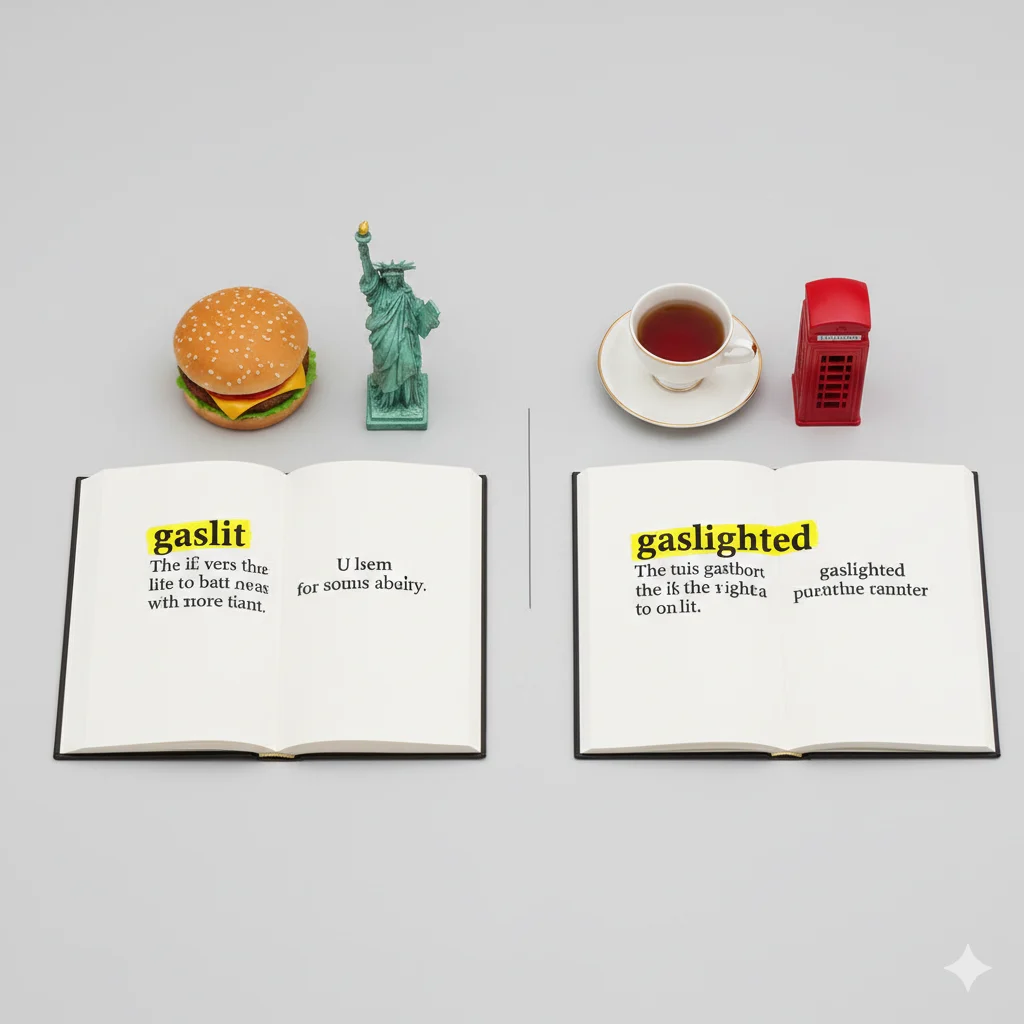
Here is a comparison table to illustrate the subtle differences:
| Feature | Gaslit | Gaslighted |
|---|---|---|
| Primary Usage | Informal, modern, journalistic | Formal, traditional, legal/clinical |
| Region | Preferred in American English | Used more in British/Commonwealth English |
| Grammar Rule | Irregular verb conjugation (like light/lit) | Regular verb conjugation (add -ed) |
| Sound/Flow | Short, punchy, contemporary | Slightly longer, can feel clunky |
| Example Sentence | “The public felt gaslit by the politician’s denials.” | “The court heard how the victim was systematically gaslighted.” |
Which Spelling Should You Use?
Choosing between “gaslighted” and “gaslit” doesn’t have to be stressful. Your decision should be based on your audience and the context of your writing.
- If your audience is primarily American: Use gaslit. It is the modern standard and will sound most natural to your readers. For example, in a blog post for a US audience, you would write: “He gaslit his friends into thinking they had lost the bet.”
- If your audience is British or International: You have more flexibility. You can safely use gaslit, as it is widely understood. However, if you are writing a very formal document for a UK institution, gaslighted might be the safer, more traditional choice.
- For a Global Audience (like social media or Reddit): Gaslit is the best choice. It is shorter, more modern, and has become the dominant form in online communities. A Reddit user is far more likely to post: “My boss gaslit me about the deadline” than “My boss gaslighted me.”
Common Mistakes with Gaslighted or Gaslit
Because this is a relatively new verb, people make several common mistakes when trying to use its past tense.
- Using “Gaslighted” Exclusively: Some writers think only “gaslighted” is correct because it follows the standard rule. As we have learned, this is not true. Both are acceptable, but using only “gaslighted” can make your writing sound dated.
- Hyphenating the Word: You might see it written as “gas-lighted” or “gas-lit.” This is incorrect. The verb is a closed compound word: gaslight. Therefore, its past tense forms are also closed: gaslit and gaslighted.
- Confusing it with the Noun: Remember that “gaslight” is also a noun (the actual light fixture). Using the past tense incorrectly with the noun form can cause confusion. For example, “The house was gaslit” could mean the house was illuminated by gas lamps. Context is key.
- Using “Gaslighted” as an Adjective: While “gaslit” works perfectly as an adjective (e.g., “the gaslit victim”), “gaslighted” sounds odd in this role. It is better to stick with “gaslit” for descriptive purposes.
Gaslighted or Gaslit in Everyday Examples
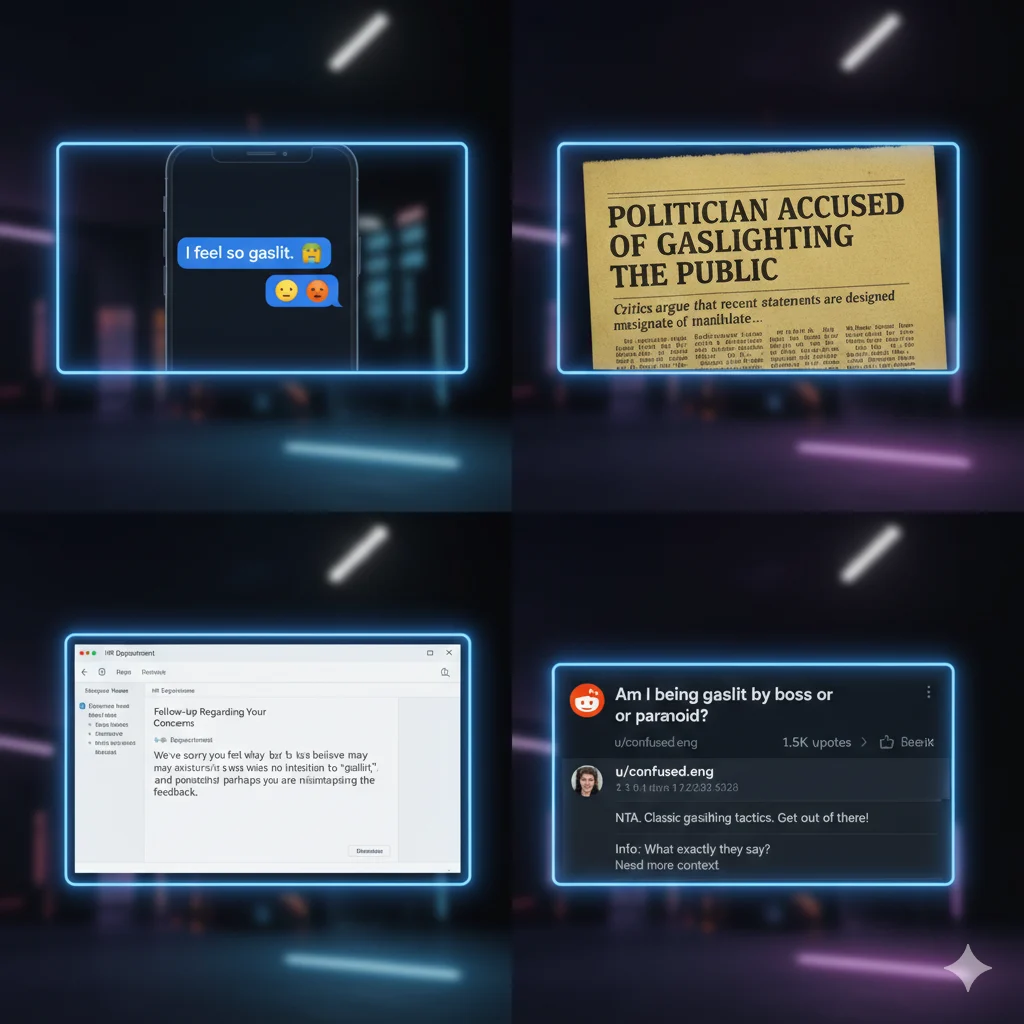
Seeing how these words are used in different contexts can help solidify your understanding. Here are examples across various platforms:
In a Text Message / Social Media:
“I can’t believe I fell for his lies again. I feel so gaslit.”
In a News Headline:
“Survivors of the cult claim they were gaslit for decades by its leader.”
In a Formal Email / Workplace Complaint:
“I am writing to formally document that I feel I have been repeatedly gaslighted by management regarding the safety protocols.”
In a Book Review / Literary Analysis:
“The protagonist is systematically gaslit by her husband, a process the author depicts with chilling precision. He gaslighted her until she no longer trusted her own memory.”
In a Psychological Report:
“The patient describes a history of being gaslighted by a parental figure during childhood.”
Gaslighted or Gaslit – Google Trends & Usage Data
Analyzing real-world data shows a clear winner in the battle of “gaslighted or gaslit.” According to search trends and corpus data, “gaslit” has seen a massive surge in popularity since and has overtaken “gaslighted” in almost every English-speaking country.
- United States: “Gaslit” is used approximately 5 times more often than “gaslighted.”
- United Kingdom: While “gaslighted” was once more common, “gaslit” has now pulled ahead, especially in online media and social discussions.
- Australia & Canada: Follow the American trend, with “gaslit” being the dominant form.
The data suggests that the word has completed its evolution. While both technically remain correct, the English-speaking world has voted with its keyboards, and “gaslit” is now the standard.
Here is a quick comparison table of the keyword variations:
| Keyword Variation | Search Intent | Common Usage |
|---|---|---|
| gaslighted or gaslit | Informational / Comparison | Users trying to decide which one to use. |
| is it gaslighted or gaslit | Informational / Direct Question | Users seeking a definitive answer. |
| gaslighted or gaslit meaning | Informational | Users checking if the meaning changes. |
| i was gaslighted or gaslit | Transactional / Personal Narrative | Users writing about their own experience. |
| gaslighted or gaslit reddit | Informal / Community Opinion | Users seeking real-world advice from peers. |
Frequently Asked Questions (FAQs)
1. Do you say gaslit or gaslighted?
You can say both, but gaslit is far more common in modern English, especially in the United States. Gaslighted is the older, traditional form and is still understood.
2. What does it mean to be gaslit?
To be gaslit means to be the victim of psychological manipulation. Someone is trying to make you doubt your own memory, perception, or sanity. For example, if you remember an event clearly and someone insists it never happened, they might be trying to gaslight you.
3. Why is it gaslighted and not gaslit?
Both are correct. “Gaslighted” follows the standard English rule of adding “-ed” to make a past tense verb. However, because the word ends in “light,” it has adopted the irregular conjugation of “light/lit,” making “gaslit” a popular and now dominant alternative.
4. Is gaslit one word?
Yes, gaslit is one word. It is the past tense of the closed compound verb “to gaslight.” It should never be hyphenated (gas-lit) or written as two words (gas lit).
5. Is “gaslighted” a real word?
Yes, “gaslighted” is a real and grammatically correct word. It is the regular past tense form of the verb “gaslight.” It was the standard form for many decades and is still used today.
6. What is a synonym for gaslit?
There is no perfect synonym, but words and phrases with similar meanings include: manipulated, deceived, brainwashed, psychologically abused, or led to doubt oneself. In context, you might say someone was “played” or “hoodwinked,” though these don’t carry the same psychological weight.
7. Can you use “gaslit” in formal writing?
Yes, you can. While “gaslighted” might have been preferred in the past, “gaslit” is now widely accepted even in formal writing, such as news articles and essays. It is the more contemporary and recognized term.
8. What is the present tense?
The present tense is gaslight. For example: “He tries to gaslight his employees by moving their things and denying it.”
Conclusion
The English language is constantly evolving, and the journey of “gaslight” from a play title to a common verb is a perfect example. The question of whether to use gaslighted or gaslit is a sign of this evolution in action. We have seen that both forms are grammatically valid, but they are not created equal in the eyes of modern users.
While gaslighted serves as the historically accurate and traditionally “correct” past tense, gaslit has won the war for popular usage. It is shorter, sharper, and aligns perfectly with the irregular conjugation of its root word, “light.” If you are writing for an American audience, posting on social media, or simply want to sound contemporary, gaslit is your best choice. For very formal, historical, or traditional British contexts, gaslighted remains a safe and correct option. Ultimately, understanding the subtle difference allows you to write with confidence, knowing that you can’t really go wrong—as long as you are aware of the tone you are setting.

Lola Giggles lives up to her name — laughter practically follows her everywhere. She’s all about finding joy in the smallest things and turning them into big laughs. Her writing sparkles with positivity, chaos, and charm, making her readers giggle like it’s a full-time job. Lola believes that one good laugh a day keeps reality away — and she’s here to deliver yours.