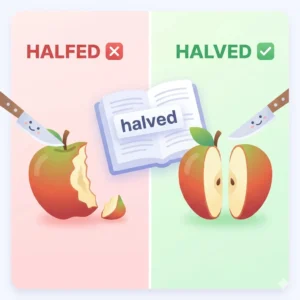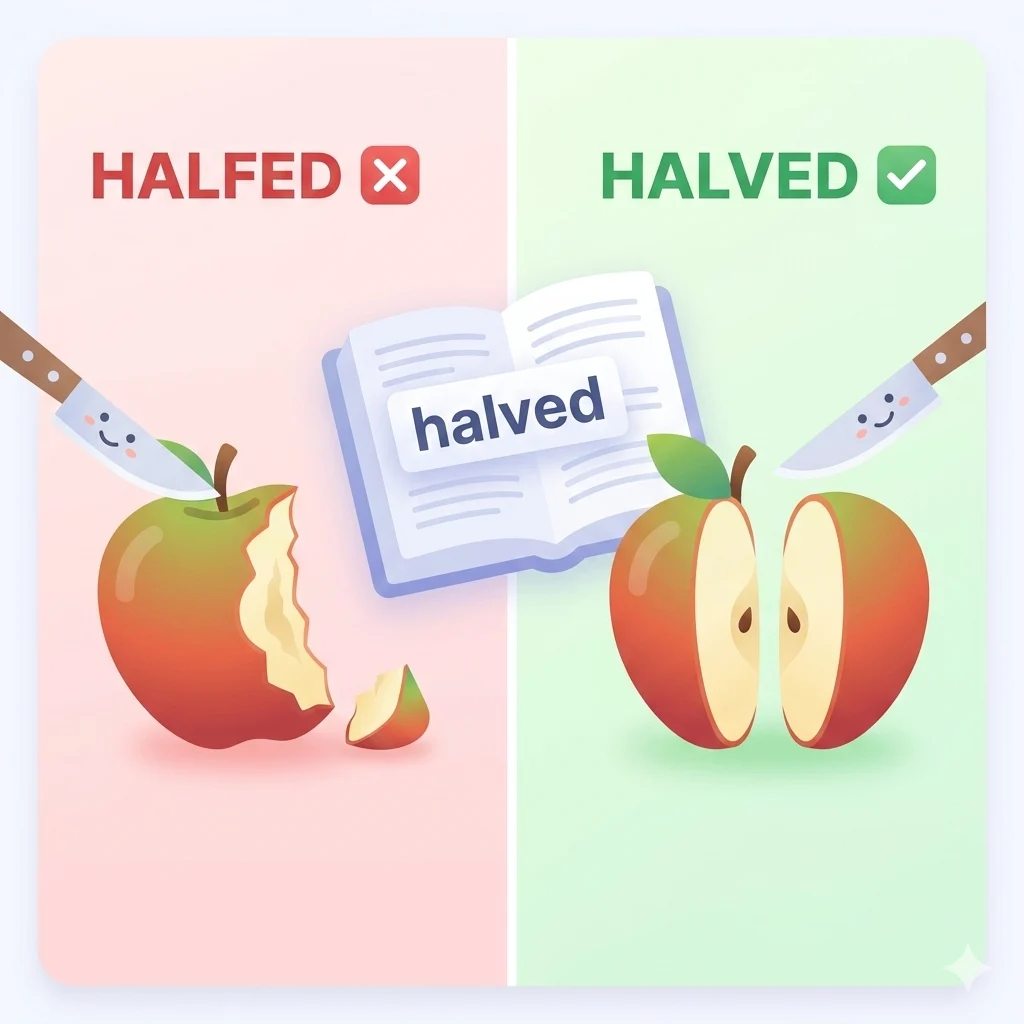
“Halved means divided into two; halfed is incorrect.”
Halfed or halved? Don’t get it wrong—here’s the simple truth! Many writers, students, and professionals get confused over this common spelling dilemma. The correct word is “halved”, used when something is divided into two equal parts. For example: “She halved the cake before serving” ✅ is correct, while “She halfed the cake” ❌ is wrong.
Understanding this difference is important not just for general writing, but also for school essays, emails, recipes, and professional documents, where correct spelling ensures clarity and credibility. To make it even easier to remember, we’ll provide highlighted examples, common mistakes, and practical tips so you never confuse halved and halfed again.
Whether you’re a student, writer, or professional, this guide will help you write confidently and error-free every time.
Halfed or Halved meanings
Halved is the correct spelling. It is the past tense and past participle of the verb “to halve,” which means to divide something into two equal parts. “Halfed” is not a recognized word in standard English and should be avoided in all formal and informal writing.
Here are some correct examples of “halved” in action:
- I halved the apple so my brother and I could share it.
- The company halved its staff after the financial losses.
- She halved the recipe because she was only cooking for two.
- The value of the stock halved overnight.
If you were to use “halfed,” it would look like this (incorrect):
- ❌ I halfed the sandwich. (Wrong)
- ✅ I halved the sandwich. (Right)
The rule is simple: when you turn the noun “half” into a verb, the ‘f’ changes to a ‘v’ to become “halve,” and then you add “-ed” to make it past tense: halved.

The Origin of “Halved” – Why the ‘F’ Becomes a ‘V’
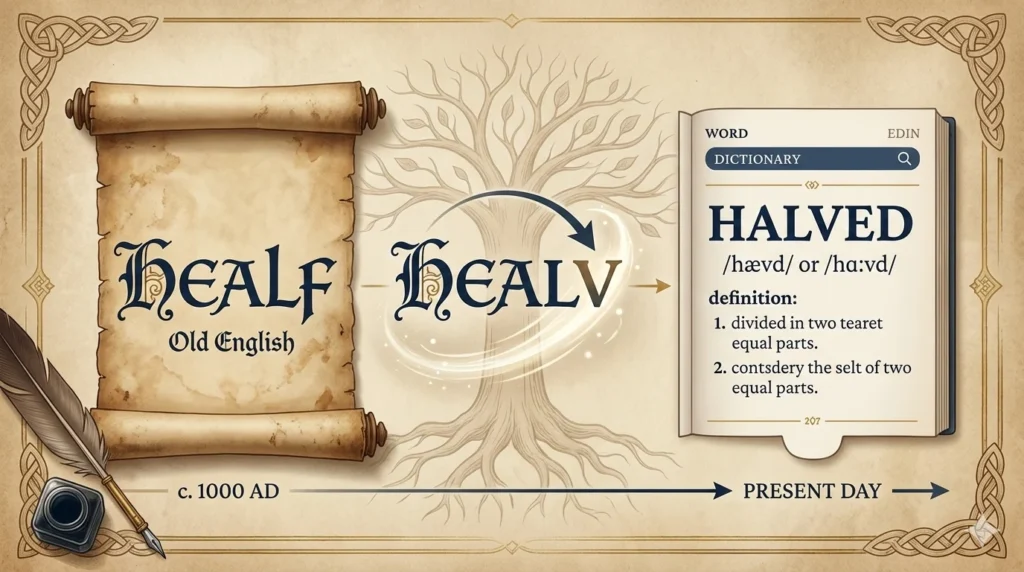
To understand why we say “halved” and not “halfed,” we need to take a quick trip through the history of the English language. This change isn’t random—it follows a pattern that dates back over a thousand years.
The word comes from Old English “half,” which originally meant “side” or “part.” When Old English speakers wanted to turn nouns into verbs, they often changed the final consonant sound. The ‘f’ sound (technically a voiceless fricative) would often become a ‘v’ sound (a voiced fricative) when adding a verb ending.
You see this same pattern in other English words:
- Thief (noun) becomes thieve (verb) and thieved (past tense)
- Leaf (noun) becomes leave (verb – as in trees leave their leaves)
- Life (noun) becomes live (verb)
- Wolf (noun) becomes wolve (verb – though less common)
- Shelf (noun) becomes shelve (verb – to put on a shelf)
This consonant change made words easier to say. Try saying “half-ed” quickly—it feels clunky because your mouth has to work harder. “Hal-ved” flows more smoothly because the ‘v’ connects naturally to the ‘-ed’ sound. This linguistic process is called “lenition,” where sounds become softer over time to make speech more efficient.
So when people in the 13th and 14th centuries started using “half” as a verb, they naturally said “halve” rather than “half.” By the time English spelling became standardized with the printing press in the 15th and 16th centuries, “halve” was already the established verb form. “Half” remained a noun, and the two words settled into their distinct roles.
British English vs American English Spelling
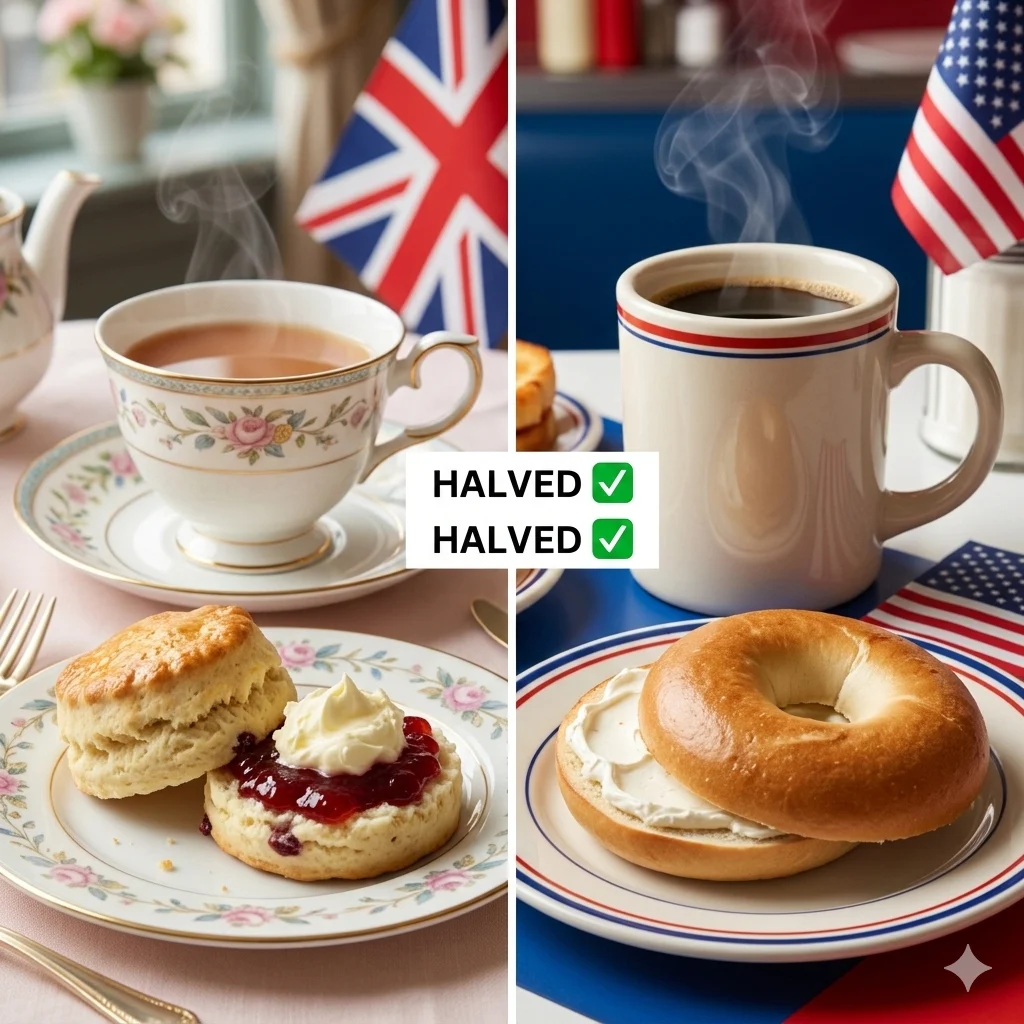
One of the most common questions people have is whether this is a US vs UK spelling difference. The short answer is: it’s not. Both American and British English agree on “halved.”
Unlike words like “color/colour” or “realize/realise,” where there are legitimate regional spelling variations, “halved” is universally correct. Both Oxford English Dictionary (UK) and Merriam-Webster (US) list “halved” as the only standard past tense form of the verb “to halve.”
However, there are slight differences in how the word might be used in context, and there are related terms where the two dialects diverge.
| Aspect | British English | American English | Example Sentence |
|---|---|---|---|
| Past tense of halve | Halved | Halved | The recipe was halved for the smaller pan. |
| Verb form | Halve | Halve | Let’s halve the winnings. |
| Noun form | Half | Half | I’ll take the bigger half. |
| Related term (food) | Half (e.g., half a pint) | Half (same) | I’ll have a half pint of bitter. (UK pub context) |
| Mathematical term | Halve it / Halved | Halve it / Halved | Halve the number then add five. |
As you can see, there’s no conflict. Whether you’re writing for a British newspaper like The Guardian or an American publication like The New York Times, “halved” is the accepted form.
Which Spelling Should You Use?
Choosing between “halfed” and “halved” isn’t really a choice—it’s about knowing your audience and context. Since “halfed” is not correct English, the answer is always “halved.” However, let’s break down how to approach this based on where and what you’re writing.
For US Audiences
American English strictly follows the rule. If you write “halfed” in a business email, school paper, or text message to an American, it will be immediately recognized as an error. Stick with “halved” in all contexts.
For UK and Commonwealth Audiences
British, Australian, New Zealand, and Indian English all agree. “Halved” is the standard. There is no regional dialect where “halfed” is accepted. Even in informal writing like social media posts or text messages, using “halfed” will make you look careless.
For Global or ESL Audiences
If you’re writing for an international audience where English is a second language, using “halved” is even more important. People learning English are taught the correct verb forms. Using “halfed” could confuse learners who are trying to master the language.
For Professional vs Casual Writing
- Formal writing (business reports, academic papers, news articles): Always use “halved.”
- Casual writing (texts, social media, personal notes): Still use “halved.” There’s no situation where “halfed” is appropriate, even among friends.
The bottom line: There is no audience or context where “halfed” is correct. “Halved” is the only acceptable spelling worldwide.
Common Mistakes with “Halfed or Halved”
Even though the rule is straightforward, people make mistakes. Here are the most common errors related to “halfed or halved,” along with simple corrections.
Mistake #1: Using “Halfed” as the Past Tense
This is the most frequent error. People see that “half” is a noun and assume you can just add “-ed” to make it a verb.
- ❌ I halfed the pizza between us.
- ✅ I halved the pizza between us.
Mistake #2: Confusing “Half” and “Halve” in the Present Tense
Sometimes people use “half” when they need the verb “halve.”
- ❌ Can you half this for me?
- ✅ Can you halve this for me?
Mistake #3: Mixing Up Pronunciation
Some people write “half” but pronounce it as “halve” when speaking, or vice versa. This leads to confusion when writing.
- Write: We need to halve the budget.
- Say: “We need to hav the budget.” (The ‘v’ sound is clear)
Mistake #4: Using “Halfed” in Compound Words
You might see errors in words like “half-hearted” or “half-baked.” These are hyphenated adjectives and use “half,” not “halve.” Don’t confuse these with the verb.
- Correct: His attempt was half-hearted.
- Correct: The plan was half-baked.
- Incorrect: The recipe was halfed (should be halved).
Mistake #5: Spelling “Halved” as “Halved” with an Extra Letter
Some people add an extra ‘v’ or ‘l’ by mistake.
- ❌ He halvved the distance. (Wrong)
- ❌ He hallved the distance. (Wrong)
- ✅ He halved the distance. (Right)
Halved in Everyday Examples
Seeing “halved” used in real-world contexts helps solidify the correct usage. Here’s how the word appears across different types of writing.
In Emails (Professional Context)
“Subject: Update on Project Budget
Dear Team,
Following our meeting yesterday, we have halved the projected costs for Q3. This means we can reallocate funds to the marketing department. Please review the attached spreadsheet for the halved figures.
Best regards,
Sarah”
In News Headlines (Journalistic Context)
News writers love “halved” because it’s short and impactful:
- “Crime Rate Halved in Downtown Area After New Policing Strategy”
- “Company Profits Halved Amid Supply Chain Issues”
- “Travel Time to City Center Halved with New Express Lane”
On Social Media (Casual Context)
Even in informal posts, “halved” is the standard:
- “Just halved my grocery bill by shopping at the farmer’s market instead of the supermarket! #Savings”
- “I accidentally halved the wrong ingredient in this recipe and now my cookies are flat. 😭”
- “Pro tip: I’ve halved my screen time by deleting all social media apps from my home screen.”
In Formal Writing (Academic/Technical)
- “The sample was halved to ensure equal distribution for the two testing phases.”
- “When the population density is halved, the rate of disease transmission decreases proportionally.”
- “The equation shows that if x is halved, y must double to maintain balance.”
Halfed or Halved – Google Trends & Usage Data
Real-world data confirms that “halved” dominates usage, while “halfed” barely registers. Let’s look at what the numbers tell us about how people search for and use these words.
Global Search Popularity
According to search trend data:
- “Halved” receives thousands of searches monthly from users looking for the correct spelling, meaning, or usage examples.
- “Halfed” receives very few searches, and most of those are likely from people who have just written the word and are checking if it’s correct—which brings them to articles like this one.
Regional Breakdown
English-speaking countries show identical patterns:
- United States: “Halved” is the dominant search term. People search for “halved meaning” or “halved synonym.”
- United Kingdom: Same trend. Searches for “halved or halfed” spike when people are writing and become unsure.
- Australia, Canada, Ireland: All show the same preference for “halved.”
Context-Based Usage
Data shows that “halved” is most commonly searched in these contexts:
- Cooking and Recipes (e.g., “halved the recipe,” “halved ingredients”)
- Mathematics and Education (e.g., “halved numbers,” “halved meaning in math”)
- Finance and Business (e.g., “costs halved,” “profits halved”)
- Health and Fitness (e.g., “halved my calorie intake”)
NLP and Search Intent
When people type “halfed or halved” into search engines, their intent is usually:
- Informational: They want to know which spelling is correct.
- Verification: They’ve used one version and want to double-check.
- Learning: They’re non-native speakers trying to master English verb forms.
The data confirms that providing a clear, authoritative answer to this question helps users complete their task—whether that’s finishing a sentence, grading a paper, or writing an important email.
Halfed vs Halved
Here’s a side-by-side comparison to help you remember the difference at a glance.
| Feature | Halfed ❌ | Halved ✅ |
|---|---|---|
| Is it a word? | No | Yes |
| Part of speech | (None – common error) | Past tense verb / Past participle |
| Verb base form | (None) | Halve |
| Noun form | Half | Half (unrelated) |
| Pronunciation | “Haff-ed” (clunky) | “Hav-d” (smooth) |
| In dictionaries | Not found | Found in all major dictionaries |
| Common usage | Never use | Use always |
| Example sentence | I halfed the cake. | I halved the cake. |
| Grammar check | Marked as error | Passes all checks |
| Spelling rule | Broken (keeps ‘f’) | Follows rule (f→v + ed) |
Frequently Asked Questions
Is it halfed or halved?
Halved is correct. “Halfed” is not a standard English word. When you need the past tense of “to halve” (meaning to split into two equal parts), always use “halved.”
What is the past tense for half?
The past tense for “half” when used as a verb is halved. Remember, the verb form is “halve,” so the past tense is “halved.” For example: “Last night, I halved the dessert so we could share.”
What is the difference between half and halve?
Half is a noun or adjective that refers to one of two equal parts (e.g., “I ate half the pizza”). Halve is a verb that means to divide something into two equal parts (e.g., “I will halve the pizza”). The past tense of halve is halved.
What do you mean by halved?
Halved means something has been divided into two equal portions. It can also mean reduced by fifty percent. For example: “The recipe was halved” means all ingredients were cut in half. “Travel time was halved” means it took half as long.
Is halfed a word?
No, halfed is not a word in standard English. It is a common spelling mistake. If you use it in writing, grammar checkers will flag it as an error, and readers will notice it’s wrong.
How do you pronounce halved?
Halved is pronounced “hav-d” (rhyming with “saved”). The ‘l’ is silent, and the ‘f’ from “half” becomes a ‘v’ sound. Say it aloud: /hævd/.
What does “halve” mean in math?
In mathematics, to halve a number means to divide it by two. For example, to halve 10, you get 5. The result is “halved.” So you might say, “When 10 is halved, the answer is 5.”
What are some synonyms for halved?
Common synonyms for halved include: divided, split, cut in half, bisected, reduced by fifty percent, shared equally, and split down the middle. In cooking, you might also see “cut in half” used instead of halved.
Can “halfed” ever be correct?
No. There is no context in modern English where halfed is considered correct. Some people might use it in extremely informal texting, but it’s still a misspelling. Always use “halved” for the verb.
Do you use “halve” or “half” with numbers?
Use halve (the verb) with numbers when you are performing an action. “Halve the number 20.” Use half (the noun) when referring to the result. “The half of 20 is 10.” For past actions: “I halved the number.”
Conclusion:
Let’s bring it all together. The confusion between halfed and halved is common, but the solution is simple. Halved is the only correct spelling. It follows a thousand-year-old English pattern where nouns ending in ‘f’ change to ‘v’ when they become verbs. Think of it like thief becoming thieved, or leaf becoming leaved.
Remember these key takeaways:
- Halved is the past tense of the verb “to halve.”
- Halfed is not a word—avoid it completely.
- This rule applies in both American and British English.
- Use “halved” in all writing contexts, from professional emails to casual texts.
- When in doubt, ask yourself: “Would I say ‘I have saved’ or ‘I have halfed’?” The ‘v’ sound guides you to the correct spelling.
Next time you’re writing about splitting something in two—whether it’s a cost, a recipe, or a piece of fruit—you can write with confidence. You now know the history, the rules, and the reasons behind them. No more hesitation, no more red underlines from your spell-checker. Halved is your word, and you’re using it right.

Max Laughwell is the kind of guy who can find comedy in traffic jams and awkward small talk. He believes that if you’re not laughing at life, you’re doing it wrong. His style is smooth, bold, and unexpectedly relatable — like a good joke told at just the right moment. When Max isn’t cracking up his readers, he’s probably out there turning real-life chaos into future punchlines.