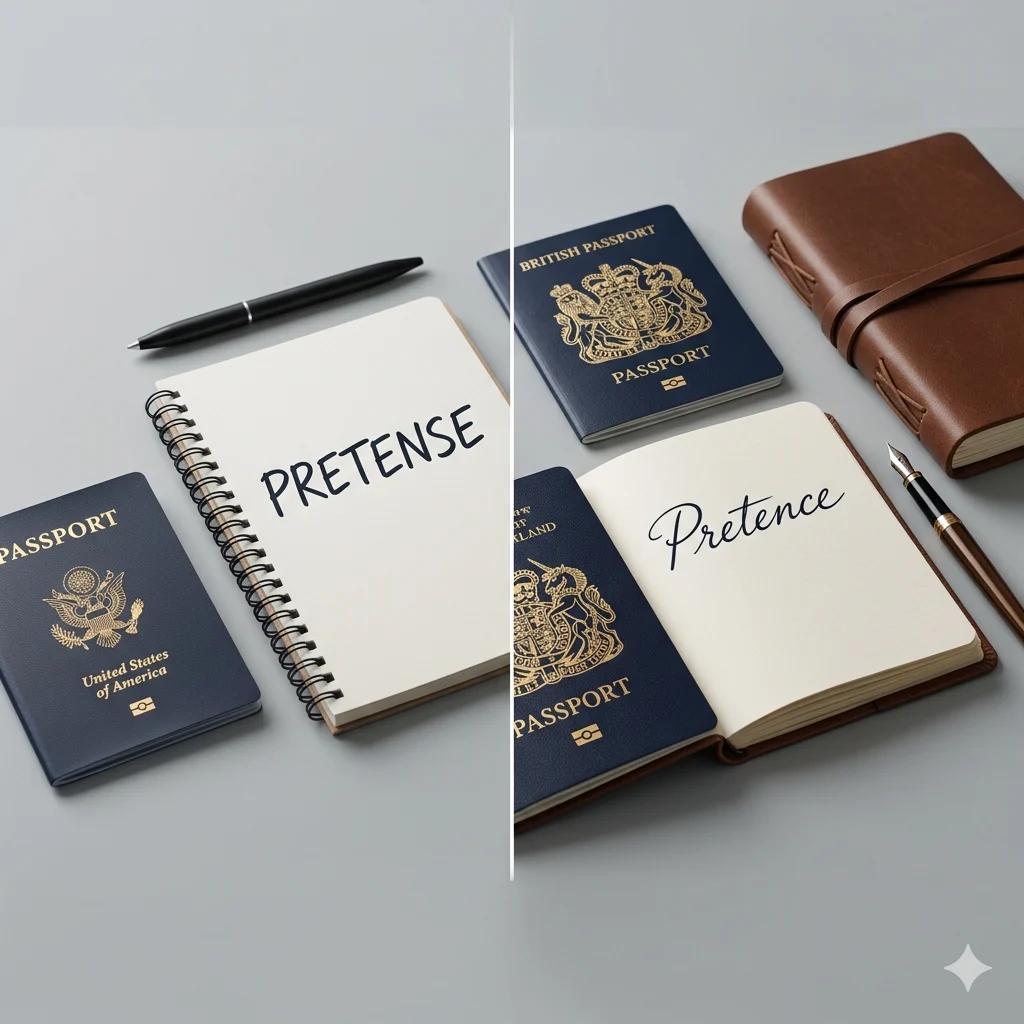
“Pretense (US) and pretence (UK) both mean a false show; choose the spelling that fits your audience.”
Confused between ‘pretense’ and ‘pretence’? Here’s the simple rule to never get it wrong! Both words mean a false show, claim, or act meant to appear real, but the difference lies in regional spelling.
Pretense is the standard in American English, while Pretence is preferred in British English. Whether you’re writing formally or casually, knowing which one to use ensures your writing is natural and polished.
For example:
- American English: “His friendliness was just a pretense.”
- British English: “Her confidence was merely a pretence.”
- Casual / conversational examples: “Don’t let your enthusiasm be just a pretense,” “The apology was nothing but a pretence.”
In this article, you’ll find clear examples, common mistakes, and tips to confidently use pretense vs pretence in any situation.
Pretense or Pretence meanings
Pretense (with an “s”) is the standard spelling in American English. Pretence (with a “c”) is the standard spelling in British English, as well as in Australia, New Zealand, and South Africa. Both words mean the same thing: an attempt to make something false appear true, or a false show of something.
- Example (US): She made a pretense of being interested in the conversation.
- Example (UK): His friendliness was merely a pretence to get what he wanted.
If you are writing for an American audience, use “pretense.” If you are writing for a British or international audience, use “pretence.”
The Origin of Pretense or Pretence
The word has a long journey through history. It comes from the Latin word praetendere, which means “to stretch forth” or “to claim.” The root breaks down into prae- (before) and tendere (to stretch). In Medieval Latin, praetensus became a past participle meaning “alleged” or “pretended.”
When the word entered Middle English through Old French (pretensse), it was already evolving. The spelling differences we see today began to take shape during the 16th and 17th centuries as English writers and printers started standardizing the language. The variation between “-se” and “-ce” endings for nouns is common in English. Words like “defense” (US) and “defence” (UK) follow the same pattern. This split happened because American English, influenced by Noah Webster, favored simpler, more phonetic spellings. Webster believed that “-se” endings looked cleaner and were more logical for words derived from Latin, which helped cement the American preference for “pretense.”

British English vs American English Spelling
This is the core of the confusion. English is a global language, but its two main branches have different rules. American English often simplifies spellings, while British English retains older, more French-influenced forms. The difference between pretense or pretence is a perfect example.
In the US, the suffix “-se” is used for nouns that can also be verbs. In the UK, the suffix “-ce” is often used for nouns to distinguish them from verbs.
Here is a comparison table to show the pattern:
| American English (US) | British English (UK/Commonwealth) |
|---|---|
| pretense | pretence |
| defense | defence |
| offense | offence |
| license (noun & verb) | licence (noun), license (verb) |
| practice (noun & verb) | practice (noun), practise (verb) |
The rule is simple: if your primary audience is in the United States, use pretense. If your audience is in the United Kingdom, Ireland, Australia, New Zealand, South Africa, or other Commonwealth nations, use pretence.
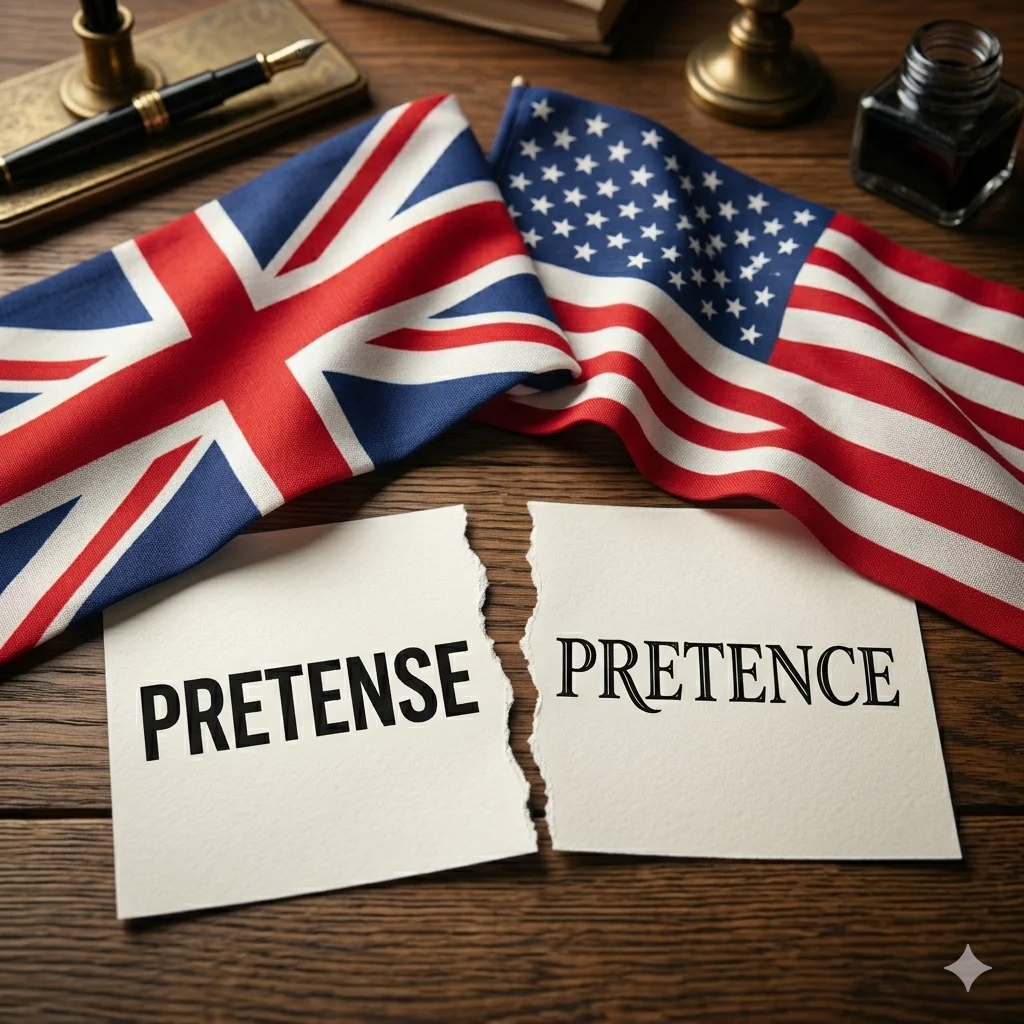
Which Spelling Should You Use?
Choosing the correct spelling depends entirely on your audience and the context of your writing. Here is straightforward advice based on who you are writing for:
- For American Readers (US English): Always use pretense. This is non-negotiable in American publishing, schools, and business. Using “pretence” in an American context will look like a typo.
- For British, Australian, or Canadian Readers (UK/Commonwealth English): Always use pretence. This is the accepted standard. While Canadians often mix US and UK conventions, official Canadian government writing and most educational institutions follow British spelling.
- For Global or International Audiences: If your writing will be read by people from both the US and the UK, choose one style and stick to it consistently throughout your document. A common professional approach is to use pretence because it is accepted in more countries. However, for global digital content where most users are American, pretense is often the safer choice.
- For Academic Writing: Follow your institution’s style guide. If you are writing for an American university, use “pretense.” For a UK university, use “pretence.”
Common Mistakes with Pretense or Pretence
Even experienced writers make mistakes with this word. Here are the most frequent errors and how to fix them:
- Mixing Spellings in One Document: This is the most common mistake. You cannot use “pretense” in one paragraph and “pretence” in another. It looks unprofessional.
- Incorrect: His pretense of anger was clear, but her pretence of joy was convincing.
- Correct: His pretense of anger was clear, but her pretense of joy was convincing. (US)
- Using the Wrong Word Form: Sometimes people confuse the noun with the verb. The verb is “pretend.” The noun is “pretense” or “pretence.”
- Incorrect: He made a pretend to be sick.
- Correct: He made a pretense of being sick.
- Misunderstanding the Plural: The plural form is “pretences” (UK) or “pretenses” (US). Some writers incorrectly add an extra “s” or change the ending.
- Incorrect: All his pretense’s were seen through.
- Correct: All his pretenses were seen through.
- Confusing “False Pretense” with the Singular Word: The legal term “false pretense” (or “false pretence”) refers to a specific crime of obtaining money or property through lies. Writers sometimes incorrectly use “false pretenses” (plural) for a singular act. The phrase is often used in the plural form “under false pretenses” even for a single lie, which is a fixed expression.
Creator or Creater Hidden Secrets to Skyrocket Your Success 🚀
Pretense or Pretence in Everyday Examples
Seeing the word used in real contexts helps solidify the correct spelling. Here is how you might encounter pretense or pretence in different types of writing.
In Emails:
- US: “I don’t want to keep up the pretense that everything is fine when it’s not. Let’s talk openly.”
- UK: “There’s no pretence between us. I appreciate your honesty.”
In News Headlines:
- US: “Politician Drops Pretense of Neutrality in Final Debate.”
- UK: “Royal Aide Resigns After Pretence of Harmony Shatters.”
On Social Media:
- A tweet might read: “Let’s stop the pretense that social media shows real life. It’s all curated highlights.”
- An Instagram caption: “No pretence, no filters. Just me.”
In Formal Writing (Legal or Business):
- US: “The contract was signed under false pretenses, rendering it void.”
- UK: “He was charged with obtaining property by false pretence.”
What does your pretence mean? When someone says “your pretence,” they are calling out a specific false front you are putting up. It directly accuses someone of pretending. For example, “What does your pretence of happiness mean when I can see you are sad?”

Pretense or Pretence – Google Trends & Usage Data
Looking at global search data confirms the spelling divide. According to Google Trends, the search term pretense or pretence spikes in countries that sit on the border of US and UK influence.
- United States: Searches for “pretense” dominate. The term “pretence” is rarely used.
- United Kingdom, Australia, New Zealand: Searches for “pretence” are significantly higher. People in these countries are more likely to search “pretence meaning” than the American spelling.
- Canada: Search volume is split, with a slight lean toward American spelling due to proximity to the US, but official use favors British spelling.
- India and other Asian countries with British colonial history: “Pretence” is the more common search term in educational contexts.
In professional and literary contexts, “pretence” has a slightly more formal or traditional feel in global English. However, in American media and technology sectors, “pretense” is ubiquitous. The data shows that understanding your audience’s location is key to choosing the right spelling.
Comparison Table: Pretense vs Pretence
| Feature | Pretense | Pretence |
|---|---|---|
| Primary Usage | United States | United Kingdom, Commonwealth Nations |
| Language Type | American English | British English |
| Example | “The whole story was a pretense.” | “The whole story was a pretence.” |
| Legal Term | False pretense | False pretence |
| Plural Form | Pretenses | Pretences |
FAQs
1. What does pretend pretence mean?
This is a common search query from users confused by the two forms. “Pretend” is a verb meaning to act falsely. “Pretence” (or pretense) is the noun form of that verb. So, “pretend pretence” essentially asks for the noun that means the act of pretending.
2. What does pretensive mean?
“Pretensive” is an adjective that is rarely used in modern English. It means characterized by pretense or making a false claim. It is a formal, often academic term. You are more likely to see “pretentious,” which means attempting to impress by pretending to have greater importance than is actually the case.
3. Pretense or pretence meaning in english?
In English, both words carry the same meaning. They refer to: 1) a false appearance or action intended to deceive, and 2) a claim or assertion, especially a false one. Pretense is the American spelling, and pretence is the British spelling.
4. Can you use “pretense” in a sentence?
Yes. Here are a few:
- She abandoned all pretense of being polite.
- His interest in the project was just a pretense to get closer to the team.
- They entered the building under the pretense of being inspectors.
The plural form, pretenses, is common in the legal phrase “under false pretenses.”
5. What are some pretense synonyms?
If you want to avoid the spelling issue, you can use synonyms. Common synonyms include: facade, charade, masquerade, guise, sham, act, front, and deception. For example, instead of “His pretense was obvious,” you could say “His facade was obvious.”
6. What is the difference between pretense vs false pretense?
“Pretense” is a general term for any false act or claim. “False pretense” (or false pretence) is a specific legal term. It refers to the crime of intentionally deceiving someone to obtain money, property, or services. If you lie about who you are to get a loan, you are guilty of false pretense.
7. What are pretence antonyms?
Antonyms for pretence (or pretense) are words that represent honesty and reality. Common antonyms include: honesty, truth, reality, sincerity, authenticity, and frankness. If someone is not hiding behind a pretence, they are being sincere.
Conclusion
The choice between pretense or pretence comes down to one simple factor: your audience. If you are writing for Americans, use pretense with an “s.” If you are writing for a British or Commonwealth audience, use pretence with a “c.” Both are correct in their respective dialects. The meaning remains constant: a false show, a deceptive act, or a claim that is not genuine.
Understanding this difference helps you write with clarity and professionalism. It shows attention to detail, which is crucial in business, academic, and legal writing. Remember the patterns of words like “defense/defence” and “license/licence” to help you recall the rule. Avoid mixing the spellings in one document. Whether you are discussing a personal pretense in a conversation or a legal case of false pretense in a report, using the correct regional spelling ensures your writing is polished and credible. Now, you can confidently use this word without hesitation.

Lola Giggles lives up to her name — laughter practically follows her everywhere. She’s all about finding joy in the smallest things and turning them into big laughs. Her writing sparkles with positivity, chaos, and charm, making her readers giggle like it’s a full-time job. Lola believes that one good laugh a day keeps reality away — and she’s here to deliver yours.