Recurrence is the correct and preferred word, while reoccurrence is rare and usually unnecessary; both mean something happening again.”
Should you write “recurrence” or “reoccurrence”? Here’s the simple truth: in most cases, “recurrence” is the correct and preferred word, while “reoccurrence” is rarely used and can sound awkward.
Both words technically mean something happening again, but recurrence is widely accepted in everyday, academic, and professional English. In contrast, reoccurrence is considered redundant and is seldom used in modern writing.
For example, it’s natural to say, “The recurrence of symptoms worried the doctor”, “There is a recurrence of the issue”, or “We want to prevent the recurrence of errors”.
Using reoccurrence in these cases may sound unusual or unnecessary. That’s why most writers, editors, and style guides recommend sticking with recurrence.
If you want to write clearly, naturally, and professionally, understanding recurrence vs reoccurrence helps you choose the right word and avoid common mistakes. In this guide, you’ll quickly learn the difference, correct usage, and when to avoid confusion altogether.
Recurrence or Reoccurrence meanings
Here is the short answer to help you decide fast. Recurrence means something happens again, and it implies it happens repeatedly or regularly. Think of it as a cycle. Reoccurrence means something happens again, but only once or occasionally. It is just a repeat, not a pattern. If you are asking what does recurrence mean, it is the noun form of recur, indicating a patterned return. If you are looking for reoccurrence meaning, it is simply the act of occurring again.
For example, if a software bug keeps coming back every time you update, that is a recurrence. If a friend visits you twice in one year after years of no visits, that is a reoccurrence. In professional settings, especially in medicine, recurrence or reoccurrence cancer is a critical distinction. Doctors use recurrence to describe a cancer that returns predictably or after a specific timeline. When searching online, many people ask recurrence or reoccurrence which is correct for medical contexts. If you are writing for a UK audience, recurrence or reoccurrence uk follows the same logic, though the spelling remains consistent. You can also find recurrence or reoccurrence examples throughout this article to guide you.
The Origin of Recurrence and Reoccurrence
To understand the difference, it helps to look at where these words come from. Both words share the Latin root currere, which means “to run.” The prefix *re-* means “again.” So, both words literally mean “to run again.”
However, the word recurrence comes from the Latin recurrere. This word meant “to run back” or “to return.” Historically, it was used to describe things that happen in a cycle, like seasons or habits. Reoccurrence is a simpler formation. It combines *re-* with occurrence, which comes from Latin occurrere meaning “to meet” or “to present itself.” This word entered English later. People started using reoccurrence simply to describe an event that happens a second time, without the idea of a pattern. This historical split explains why spelling differences exist, even though the meanings are now distinct in modern usage guides. When someone asks is recurrence a word, the answer is yes—it has deep historical roots.

British English vs American English Spelling
When it comes to spelling, there is good news. There is no difference between British English and American English for these two words. Unlike words like color and colour, recurrence or reoccurrence are spelled the same way in both dialects. If you need to spell recurrence or reoccurrence, remember that both have double ‘r’s.
The confusion is not about spelling but about usage frequency. American English writers tend to use recurrence more often in technical writing. British English writers also use recurrence as the standard term in formal contexts. However, reoccurrence is accepted in both regions for casual use. For those searching recurrence or reoccurrence uk, the advice is simple: both spellings are correct, but recurrence is preferred in formal British writing.
Here is a comparison table to show how they function:
| Feature | Recurrence | Reoccurrence |
|---|---|---|
| Meaning | Happens again repeatedly or periodically | Happens again once or sporadically |
| Spelling | R-E-C-U-R-R-E-N-C-E | R-E-O-C-C-U-R-R-E-N-C-E |
| Usage | Formal, medical, scientific | Informal, general events |
| Implies Pattern | Yes | No |
| Example | The recurrence of the seasons. | A reoccurrence of the error. |
Which Spelling Should You Use?
Choosing the right word depends on your audience and your intent. Here is audience-based advice to help you decide. Understanding what is the difference between occurrence and recurrence is the first step. An occurrence is a single event. A recurrence is that event happening again, often repeatedly.
If you are writing for a US audience in a professional context, use recurrence when describing patterns, data trends, or medical conditions. For example, in a business report about customer complaints, “recurrence of the issue” sounds more authoritative. When discussing health, recurrence or reoccurrence cancer is a common topic, and recurrence is the medically correct term.
If you are writing for a UK or Commonwealth audience, the same rules apply. Formal documents like government reports or NHS publications almost exclusively use recurrence. However, in casual blogs or personal emails, reoccurrence is perfectly acceptable. If you are researching recurrence or reoccurrence uk, you will find that British style guides recommend recurrence for formal use.
For global audiences (like international business or software documentation), recurrence is safer. It is the more recognized term in dictionaries and is less likely to be flagged as an error. Remember, when asking is recurrence a word, the answer is yes—and it is the preferred choice in 90% of professional settings. If you are wondering what is the definition of reoccurrence, it is simply the act of occurring again, but without the weight of frequency that recurrence carries.
Common Mistakes with Recurrence and Reoccurrence
Even native speakers make mistakes with these terms. Here are the most frequent errors and how to correct them. Understanding recurrence or reoccurrence which is correct helps avoid these pitfalls.
- Using them interchangeably in formal writing. This is the biggest mistake. In a medical report, writing “reoccurrence of symptoms” when you mean a chronic condition can seem unprofessional. Correction: Use recurrence for chronic or patterned returns. This is especially important for recurrence or reoccurrence cancer discussions.
- Misspelling the prefix. A common typo is writing “reoccurence” with only one ‘r’. When you spell recurrence or reoccurrence, remember reoccurrence has two ‘r’s in the middle (re-occurrence). Recurrence has a double ‘r’ as well.
- Overusing reoccurrence. Some writers use reoccurrence to sound smart, but it often confuses the reader. Correction: If you are unsure, default to recurrence. It is rarely wrong when describing a second event.
- Confusing with occurrence. People often ask, what is the difference between occurrence and recurrence? An occurrence is a single event. A recurrence is that event happening again (and again). If you are trying to define a single repeat, recurrence is the more precise choice.
- Using recurrence for one-time events. If you missed a payment once, then paid it, then missed it again years later, that is a reoccurrence, not a recurrence. This goes back to reoccurrence meaning—it is a single repeat without a pattern.
Recurrence and Reoccurrence in Everyday Examples
Seeing words in context helps solidify the rule. Here is how these terms appear in different types of writing, from emails to social media. These recurrence or reoccurrence examples will help you choose correctly.
Emails
- Informal: “I am checking in to prevent a reoccurrence of the login issue we had last week.”
- Formal: “The team will implement a new protocol to ensure the recurrence of data errors is eliminated.”
News Headlines
News agencies prefer recurrence because it sounds more serious. For example: “Officials Fear Recurrence of Violence During Festival.” If a headline used reoccurrence, it might imply the event was minor or isolated.
Social Media
On platforms like Twitter or Reddit, reoccurrence is common because people speak casually.
- “Ugh, a reoccurrence of the weird noise in my car. Time to call the mechanic.”
Formal Writing
In legal contracts or medical journals, the language is strict.
- “The study measured the recurrence or reoccurrence cancer rates among patients over five years.”
- Definition: Here, recurrence refers to the expected return of cancer, while reoccurrence might refer to a new, unrelated cancer.

Recurrence or Reoccurrence – Google Trends & Usage Data
Looking at how the world searches for these terms reveals interesting patterns. Globally, recurrence is searched for far more often than reoccurrence. This is because it is the standard term in medicine, science, and technology. People frequently search for recurrence or reoccurrence meaning to clarify the distinction.
In countries like the United States, Canada, and Australia, searches for recurrence or reoccurrence meaning spike when people are dealing with health diagnoses or software bugs. In the UK, the search recurrence or reoccurrence uk shows that users are specifically looking for localized advice, even though the spelling rules are the same.
The term recurrence or reoccurrence synonym is also a common search. People often look for words like repetition, return, or relapse. However, the data shows that most professional writers and editors prefer to maintain the distinction rather than use synonyms, because recurrence carries a specific technical weight that synonyms lack.
Interestingly, the question is it recurrence or reoccurrence spikes in Q1 of every year, likely due to annual reporting cycles in business and new medical diagnosis seasons. Many users also ask recurrence or reoccurrence which is correct when preparing formal documents.
Comparison Table: Recurrence vs Reoccurrence
To make the choice even clearer, here is a side-by-side comparison of the variations.
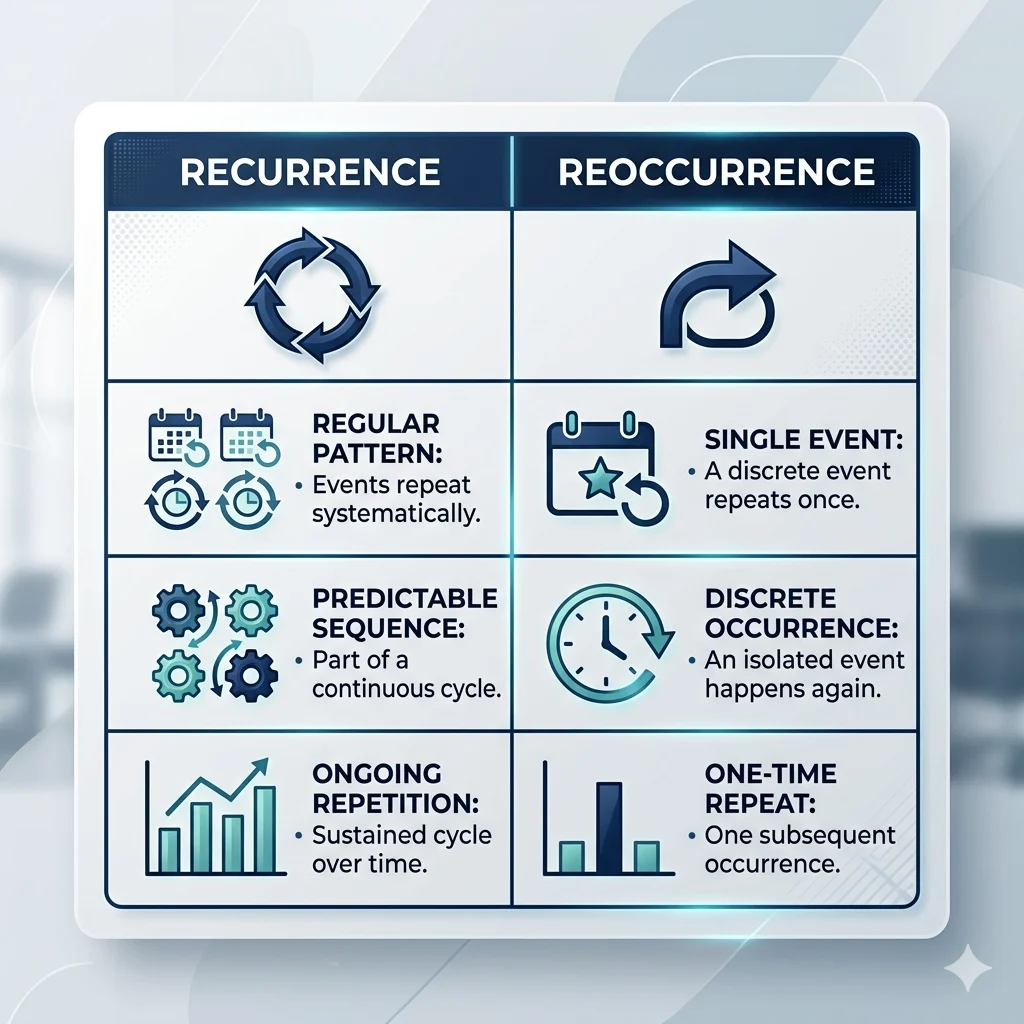
| Aspect | Recurrence | Reoccurrence |
|---|---|---|
| Part of Speech | Noun | Noun |
| Verb Form | Recur | Reoccur |
| Adjective | Recurrent | Reoccurring |
| Key Feature | Pattern, cycle, predictability | Single repeat, randomness |
| Best For | Medical reports, software bugs, business strategy | Casual conversation, emails, one-off events |
| User Intent | Seeking a solution to a systemic problem | Noting a second event |
| Common Search | recurrence or reoccurrence cancer | what is the definition of reoccurrence |
FAQs
1. What’s the difference between reoccurrence and recurrence?
The difference is pattern. Recurrence implies something happens repeatedly or in a cycle. Reoccurrence simply means something happens again, usually just once or occasionally.
2. What is the definition of reoccurrence?
Reoccurrence is the noun form meaning an event that happens again. It focuses on the act of occurring a second (or third) time, but it does not imply that the event is part of a cycle or will keep happening.
3. What does recurrence mean?
Recurrence means something happens again, specifically in a way that is repeated or periodic. It implies a pattern. For example, the recurrence of a headache every afternoon suggests a cycle, not just a one-time return.
4. What is the difference between occurrence and recurrence?
An occurrence is a single event. A recurrence is that event happening again, often repeatedly. If you have one meeting, it is an occurrence. If you have the same meeting every Monday, that is a recurrence.
5. Recurrence or reoccurrence cancer – which is correct?
In medical terminology, recurrence is the correct term. Cancer recurrence refers to the cancer coming back after a period of remission. Doctors use this term because cancer often follows a predictable pattern. Reoccurrence is rarely used in oncology.
6. Is recurrence a word?
Yes, recurrence is a standard English word. It is widely accepted in dictionaries and is used in formal, scientific, and academic writing. It is the more common term compared to reoccurrence.
7. Recurrence or reoccurrence uk – do they spell it differently?
No, the spelling is the same in the UK and the US. However, British English style guides often prefer recurrence for formal publications. The usage rules about pattern versus single event remain the same.
8. Which is correct recurrence or reoccurrence?
Both are correct depending on the context. If you want to emphasize a pattern or cycle, use recurrence. If you simply want to say something happened again without implying it will keep happening, use reoccurrence.
9. What is a recurrence or reoccurrence synonym?
Common synonyms include repetition, return, relapse, repetition, and repeat. However, using recurrence is often more precise in professional contexts because it carries the specific meaning of a repeated pattern.
10. Is it recurrence or reoccurrence in formal writing?
In formal writing, recurrence is preferred. It is more precise and widely accepted in academic, medical, and business contexts.
Conclusion
Choosing between recurrence or reoccurrence comes down to understanding the subtle but important difference between a pattern and a single repeat. Both words describe something happening again, but they serve different purposes. Recurrence is your best choice for professional, medical, and technical writing. It implies a cycle, a return that is expected or happens repeatedly. Reoccurrence is better for casual situations where you just want to say something happened a second time without the weight of a pattern.

Nina Snicker was born to make people laugh — and she takes that mission very seriously. Known for her quick wit and clever takes on everyday life, Nina turns even the dullest moments into hilarious masterpieces. She believes humor is the ultimate life skill — and her jokes prove it. When she’s not writing, you’ll find her laughing at her own punchlines (because someone has to start the applause).