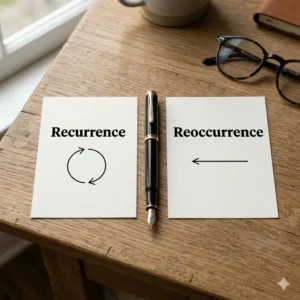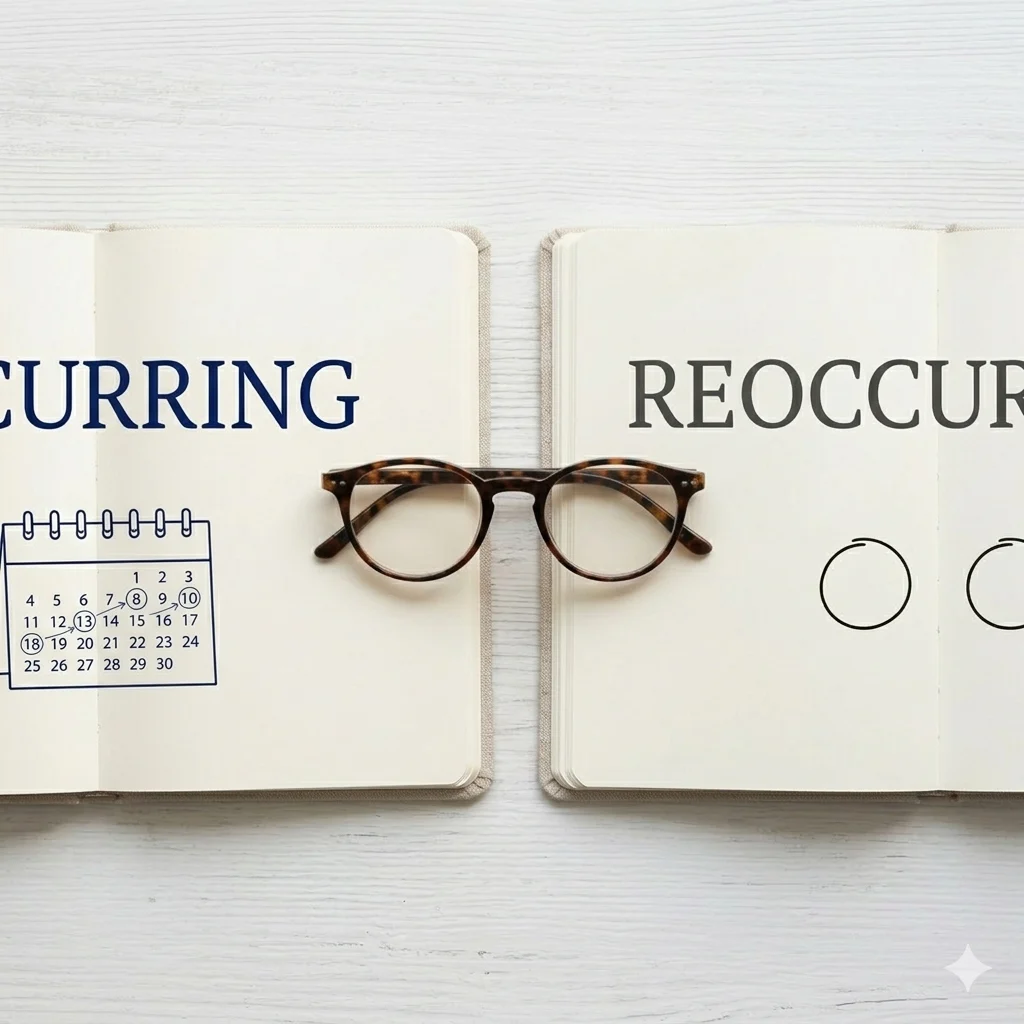
“Recurring occurs at regular intervals; reoccurring happens again without a set schedule.”
Recurring vs Reoccurring: Stop mixing them up and write like a pro! Both words relate to something happening more than once, but the difference is subtle. Recurring describes events that happen repeatedly at regular intervals, like a recurring meeting, weekly class, or subscription payment.
Reoccurring refers to something that happens again without a fixed schedule, like rare rainstorms or a comet appearing in the sky. For example: “She has a recurring headache every Monday” or “He pays a recurring subscription fee each month”, versus “Rainstorms keep reoccurring this season” or “The comet is reoccurring every few decades”.
Many writers mistakenly use reoccurring when they mean recurring — this guide will help you master the correct usage every time and write confidently.
Recurring or Reoccurring meaning
If you need the short answer right now, here it is: The difference lies in the frequency and expectation.
- Recurring refers to something that happens repeatedly, usually at regular intervals or on a predictable schedule. The key idea is that it keeps coming back.
- Example: I have a recurring payment for my Netflix subscription every month.
- Example: She suffers from recurring nightmares about flying.
- Reoccurring refers to something that happens again, but only once more, or sporadically. It is not expected to be a pattern.
- Example: The technical glitch kept reoccurring every time we tried to boot up the system.
- Example: We are worried about the reoccurring conflict between the two departments.
Think of it this way: if it is a planned cycle, use recurring. If it is an unexpected repeat, use reoccurring.
The Origin of Recurring and Reoccurring
To understand why these two words cause so much trouble, we have to look at where they came from. Both words trace their roots back to the Latin word currere, which means “to run.” This is the same root we see in words like “current” (running water) and “course” (a running path).
- Recurring comes from the Latin recurrere. This breaks down to *re-* (meaning “again” or “back”) and currere (“to run”). However, recurrere implied “to run back” or “to return.” In ancient Rome, if something recurred, it was literally running back to a starting point. This idea of “returning to a point” naturally evolved into the modern meaning of something that returns cyclically or periodically.
- Reoccurring is a much more modern construction. It takes the prefix *re-* (“again”) and adds it to the English word “occurring.” Since “occurring” simply means “happening,” putting them together literally means “happening again.”
The spelling differences exist because “recur” is a complete Latin verb that entered English hundreds of years ago, while “reoccur” was formed later by combining English elements. This is why “recurring” dropped the second ‘c’ (making it ‘cur’ instead of ‘occ’) while “reoccurring” keeps the double ‘c’ from “occurring.”

British English vs American English Spelling
Here is some good news: the spelling rules for these words are the same on both sides of the Atlantic. Whether you are writing in London or New York, you spell “recurring” with two ‘r’s? Actually, let’s look at that closely. The confusion often comes from doubling consonants.
When you add -ing to a verb in English, you often double the final consonant if the stress is on the first syllable.
- Occur becomes occurring (double the ‘r’).
- Recur becomes recurring (double the ‘r’).

The spelling of the base words is the same in both dialects. However, the usage of the words can differ slightly in preference, which we will look at in the data section. Here is a comparison table to make it crystal clear:
| Word Form | American English | British English | Example Sentence |
|---|---|---|---|
| Base Verb | Recur | Recur | The problem tends to recur. |
| Present Participle | Recurring | Recurring | We have a recurring meeting. |
| Base Verb | Reoccur | Reoccur | Don’t let this mistake reoccur. |
| Present Participle | Reoccurring | Reoccurring | The error keeps reoccurring. |
| Common Mistake | Reoccuring | Reoccuring | ❌ Incorrect spelling (missing a ‘c’ or ‘r’). |
Which Spelling Should You Use?
Choosing between “recurring” and “reoccurring” is less about your location and more about your audience and the message you want to send.
- For a US Audience: Americans appreciate directness. If you are talking about a billing cycle or a calendar event, “recurring” is the standard and expected term. If you are describing a one-time repeat of an event, “reoccurring” is perfectly acceptable and understood.
- For a UK / Commonwealth Audience: The rules are technically the same. However, British English tends to favor the Latin-rooted “recur” slightly more in formal writing. In academic or professional settings in the UK, “recurring” is almost always the safer, more polished choice.
- For a Global / Business Audience: When writing for an international crowd, clarity is king. Use “recurring” when you want to emphasize a pattern, a schedule, or a cycle. Use “reoccurring” when you want to specifically highlight that something unfortunate (like a mistake or a bug) happened a second time, and you are worried it might happen again, but it isn’t on a schedule. If in doubt, “recurring” is generally the more commonly used and understood word globally.
Common Mistakes with Recurring or Reoccurring
Even native speakers trip up on these words. Here are the most frequent errors and how to fix them.
- The Spelling Trap: “Reoccuring”
This is the most common search query. People want to know is reoccurring a word (yes, it is) but they often misspell it. The correct spelling is reoccurring (with two ‘c’s and two ‘r’s). The incorrect version, “reoccuring,” drops one of the ‘c’s or ‘r’s.- ❌ Incorrect: The virus keeps reoccuring.
- ✅ Correct: The virus keeps reoccurring.
- Using “Recurring” for Everything
Because “recurring” is more popular, people use it even when they mean a one-off repeat. This can confuse the reader into thinking something is a regular pattern when it is not.- ❌ Unclear: We had a recurring issue with the printer yesterday.
- ✅ Better: We had a reoccurring issue with the printer yesterday. (This implies it happened a few times, but isn’t a regular problem).
- Confusing the Meaning in Context
Sometimes the wrong word changes the entire meaning.- ❌ Awkward: She had a reoccurring role on the TV show. (This sounds like she appeared twice, then stopped).
- ✅ Correct: She had a recurring role on the TV show. (This means she appeared in many episodes over time).

Recurring or Reoccurring in Everyday Examples
Seeing these words in action helps solidify the difference. Here is how they look in various forms of writing.
- In Emails (Business Context):
- “Hi Team, just a reminder about our recurring status update every Monday at 10 AM.”
- “I apologize for the inconvenience, but we are investigating a reoccurring error in the login portal that appears after system updates.”
- In News Headlines:
- “City Council Debates Recurring Budget Shortfall for Schools.” (Implying a yearly, ongoing problem).
- “Officials Warn of Reoccurring Flooding in Low-Lying Areas After Heavy Rains.” (Implying floods happen again when it rains hard, but not on a set schedule).
- On Social Media:
- “My recurring thought every Monday: I need more coffee.” (A regular, predictable feeling).
- “This meme keeps reoccurring on my feed and I’m not mad about it.” (It pops up again randomly).
- In Formal Writing (Reports/Academic):
- “The study observed recurring patterns in consumer behavior during the holiday season.”
- “Researchers noted a reoccurring theme in the interview data, where participants mentioned work-life balance.”
Recurring or Reoccurring – Google Trends & Usage Data
If you look at search data, “recurring” is the overwhelming favorite. People search for recurring or reoccurring meaning because they want to know why the less common word exists.
- Global Popularity: “Recurring” is used significantly more often in digital content, business software, and formal writing across the world. It is the default term for anything that happens more than once.
- Contextual Usage: “Reoccurring” sees a spike in usage in technical support forums and medical discussions. For example, people are more likely to search for a recurring or reoccurring dream using “recurring” because dreams often feel like a pattern. However, they might use “reoccurring” for a specific symptom that came back after treatment.
- The Confusion Factor: The high search volume for “recurring or reoccurring” tells us that people encounter the word “reoccurring,” assume it’s a typo, and look it up. The data suggests that while “recurring” is the workhorse, “reoccurring” holds a necessary place in the language for describing specific types of repetitions.
Recurring vs. Reoccurring
For a quick visual guide, here is how the two words stack up against each other.
| Feature | Recurring | Reoccurring |
|---|---|---|
| Core Meaning | Happening repeatedly, often periodically. | Happening again (usually just once more). |
| Implies Pattern | Yes, suggests a cycle or schedule. | No, suggests an isolated or random repeat. |
| Common Synonyms | Cyclical, periodic, habitual, regular. | Repeated, repeat, happening again. |
| Root Word | Latin recurrere (to run back/return). | English *re-* + occur (to happen again). |
| Typical Context | Bills, appointments, dreams, themes. | Errors, glitches, issues, symptoms. |
| Predictability | Expected. | Unexpected. |
Frequently Asked Questions
1. What is the difference between recurring and reoccurring?
The main difference is the expectation of a pattern. Recurring means something happens repeatedly, usually at regular intervals (like a recurring meeting). Reoccurring simply means something happened again, but it does not imply it will keep happening (like a reoccurring problem that popped up twice).
2. Is reoccurring a word?
Yes, absolutely. Is reoccurring a word? It is. While it is less common than “recurring,” it is a valid English word that means “to happen again.” Many dictionaries list it as a variant of “recur,” but with the specific nuance of a simple repetition rather than a cycle.
3. How do you use “recurring” in a sentence?
You use it to describe something that happens over and over, often on a schedule. For example: “I set up a recurring transfer to my savings account every payday.” You can also use it for abstract patterns: “The book has a recurring theme of redemption.”
4. Can you give me an example of a reoccurring dream?
Yes. While people often say recurring or reoccurring dream, if the dream is exactly the same every night, it is technically a recurring dream. However, if you had a strange dream about a tree last month, and then again last night, but not in between, you could call it a reoccurring dream. The first implies a pattern, the second implies a one-time repeat.
5. Which is correct: recurring or reoccuring?
The correct spelling is recurring (for the cyclical meaning) and reoccurring (for the “happen again” meaning). “Reoccuring” (with one ‘c’ or one ‘r’) is always a spelling mistake. If you are asking which word to use, it depends on your meaning. If it happens again and again, use recurring.
6. What is a synonym for recurring?
There are many recurring or reoccurring synonym options depending on context. For recurring, synonyms include: periodic, cyclical, habitual, regular, repeated, and intermittent.
7. What is a synonym for reoccurring?
For reoccurring, synonyms are simpler: happening again, repeated, duplicate, second occurrence. It lacks the “cyclical” synonyms that “recurring” has.
8. Is a recurring payment the same as a reoccurring payment?
In the business world, these are almost always called recurring payments. This is because subscriptions and memberships are based on a predictable cycle (monthly, yearly). “Reoccurring payment” might be used informally to describe a second, unexpected charge, but “recurring” is the industry standard term.
Conclusion
Mastering the difference between “recurring” and “reoccurring” is a simple way to sharpen your writing. The key takeaway is the intent behind the repetition. When you see the prefix *re-*, it always means “again.” The difference lies in the nature of the repetition. Recurring implies a pattern, a cycle, or a schedule. It is the word you use for things you can mark on a calendar. Reoccurring implies a random or unexpected repeat—it happened again, but that is where the certainty ends.

Nina Snicker was born to make people laugh — and she takes that mission very seriously. Known for her quick wit and clever takes on everyday life, Nina turns even the dullest moments into hilarious masterpieces. She believes humor is the ultimate life skill — and her jokes prove it. When she’s not writing, you’ll find her laughing at her own punchlines (because someone has to start the applause).