Have you ever typed “queue the music” only to wonder if it should be “cue the music”? Do you hesitate between “visual queue” and “visual cue”? You’re certainly not alone. The homophones cues and queues create one of English’s most common spelling dilemmas, with thousands searching daily to understand their meaning and correct usage.
This confusion isn’t just academic—it’s practical. Using the wrong spelling can transform a professional email into a confusing message or make a social media post seem uneducated. The core question people want answered is simple: “What’s the difference, and how do I remember it?”
This comprehensive guide will solve that confusion permanently, covering everything from basic definitions to subtle usage cases. Whether you’re writing an email, preparing a presentation, or simply want to communicate clearly, understanding the cues queues meaning will give you confidence in your written English.
Cues or Queues
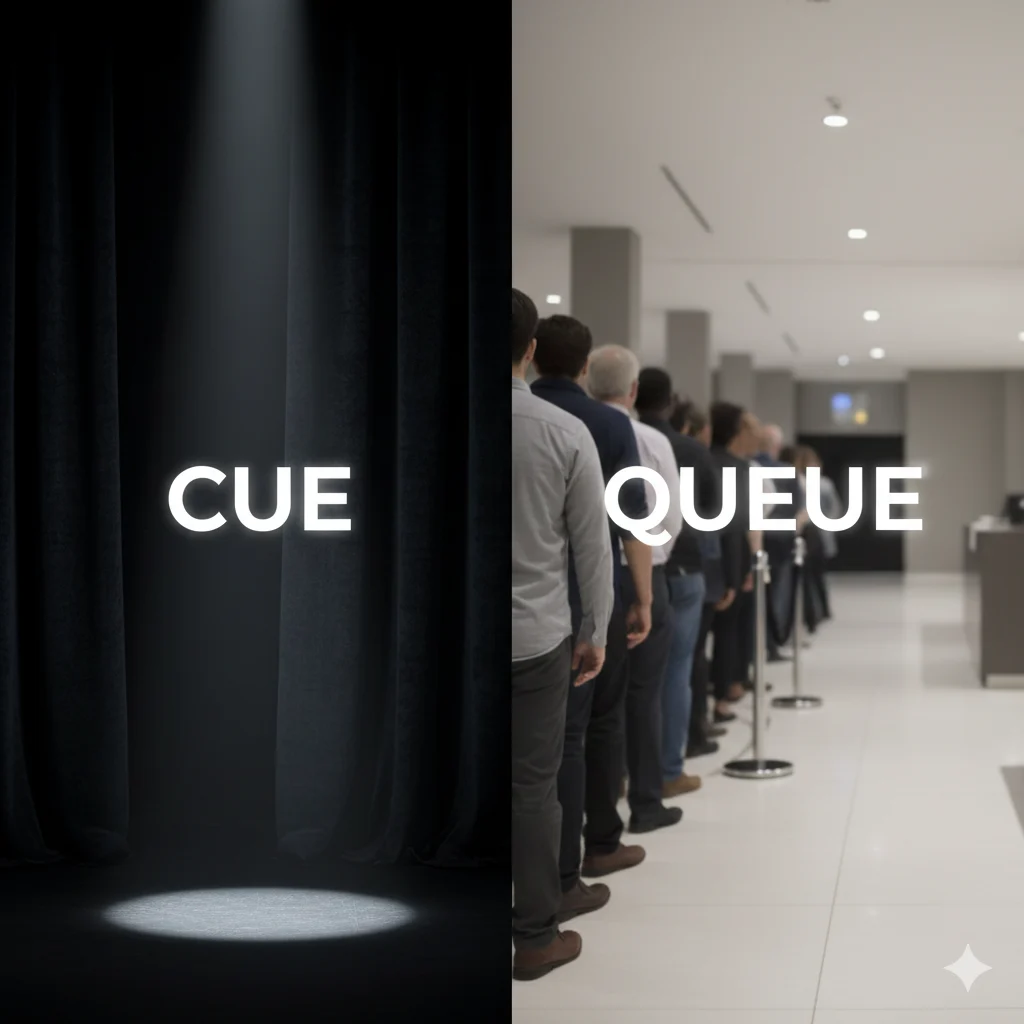
The difference is straightforward but crucial: A “cue” is a signal or prompt. A “queue” is a line or sequence.
Cue (Signal/Prompt):
- “The lighting change was the actor’s cue to exit.”
- “Take his arrival as your cue to begin serving dinner.”
- “This is my cue” meaning it’s your signal to act.
- “Cue the music!” means give the signal to start playing.
Queue (Line/Sequence):
- “We joined the queue outside the theater.”
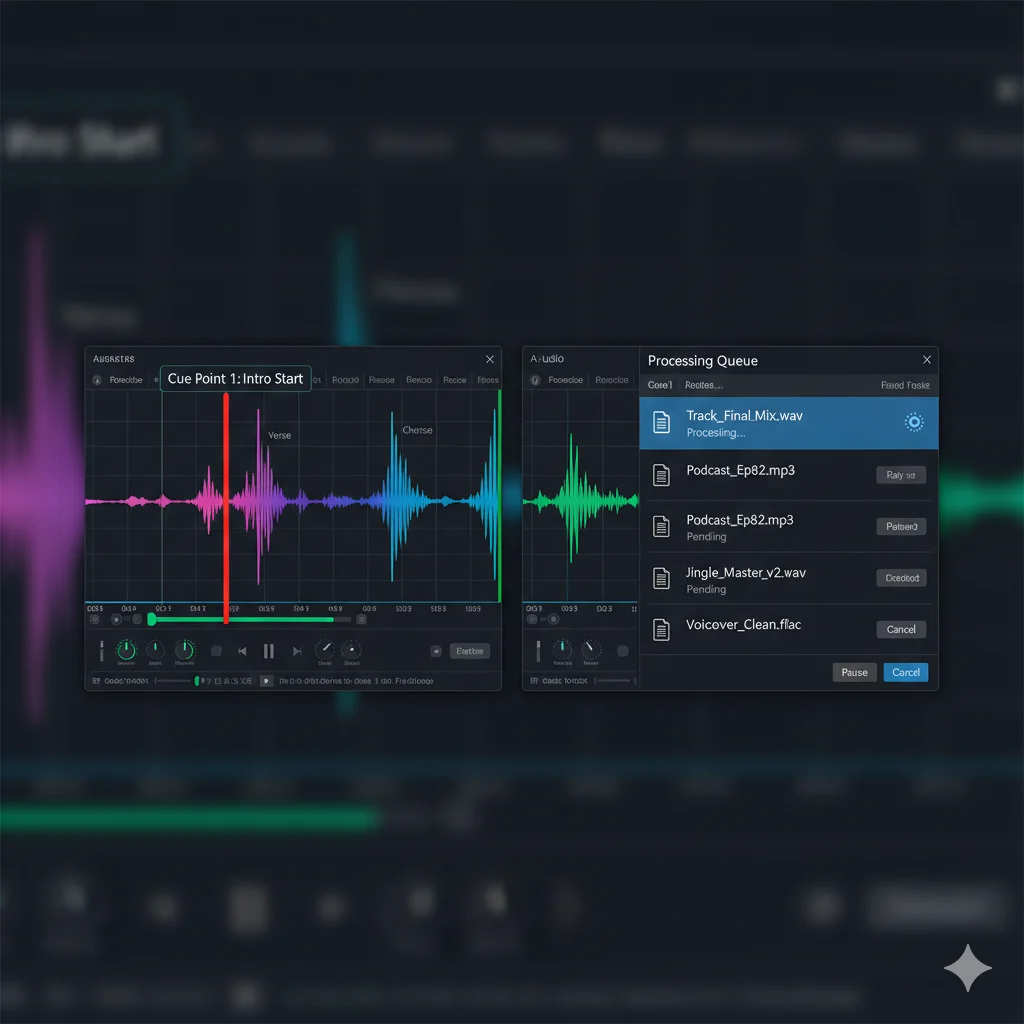
- “Documents are processed in the order they enter the queue.”
- “Queue up” the files means arrange them in sequence.
- In British English, people stand in a queue; Americans might say “line.”
The Origin of Cues or Queues
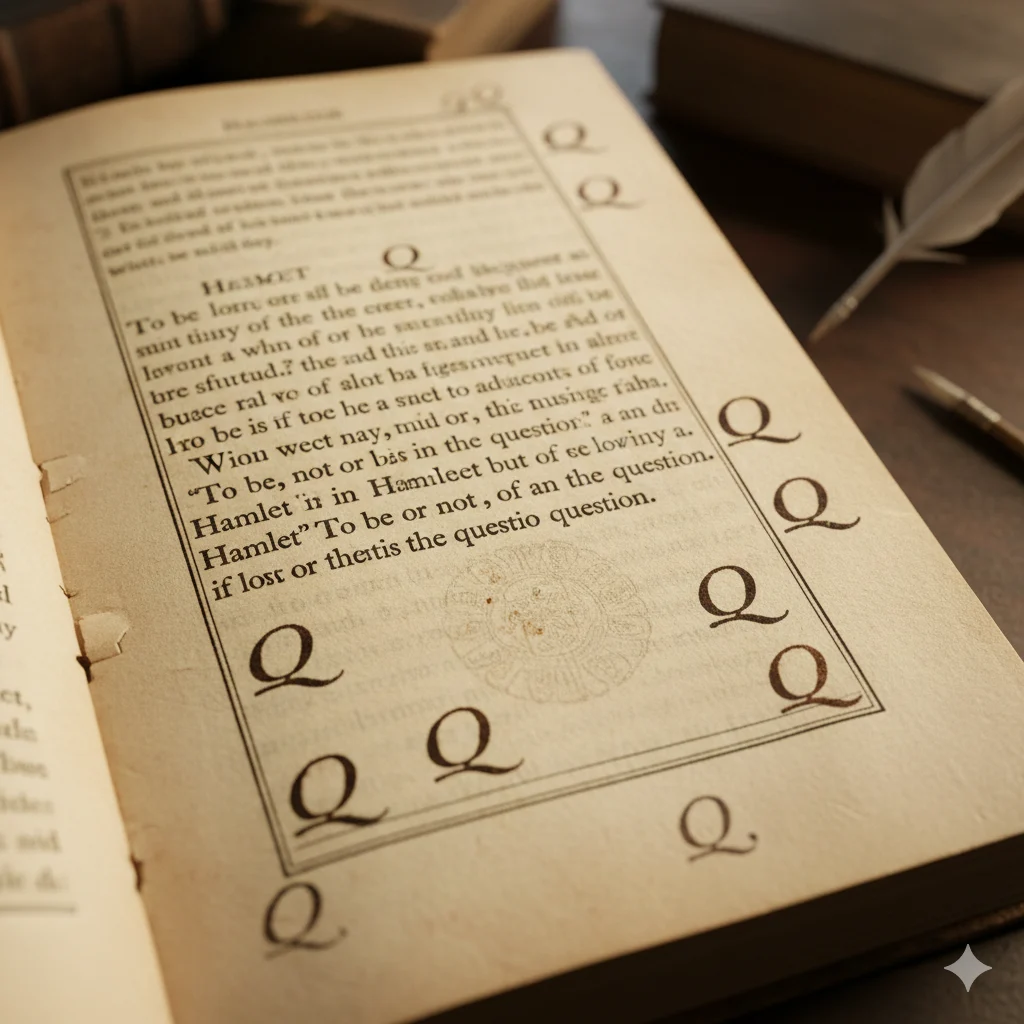
Understanding why these words sound identical requires a trip through linguistic history. Cue likely originated in 16th-century theater from the Latin quando (“when”). Scripts would mark actors’ entrances with the letter Q, which actors read as “cue”—a prompt for when to begin. This theatrical origin explains why we still cue the music or wait for this is my cue moment in conversations.
Queue comes from Old French cue, meaning “tail,” tracing back to Latin cauda. This etymology perfectly captures its meaning: just as a tail follows an animal, a queue represents things arranged one after another. The spelling stabilized with the “-ue” ending, while the pronunciation simplified to match “cue,” creating our modern homophone dilemma. The cue vs queue pronunciation is identical (/kyo͞o/), which explains why even native speakers confuse them in writing.
British English vs American English Spelling
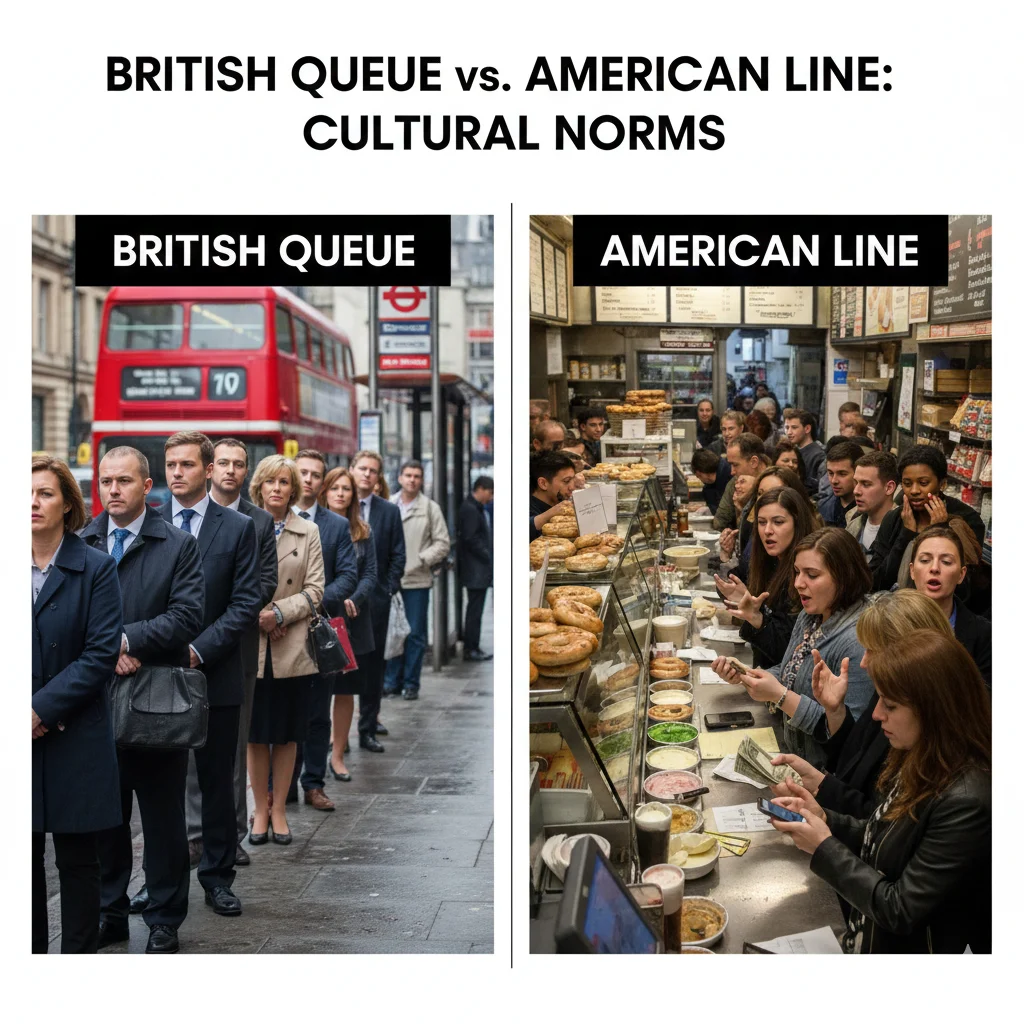
The queue or cue confusion intensifies across different English varieties. While “cue” (signal) is universal, “queue” (line) shows strong regional preferences.
British English enthusiastically uses “queue” for any line—for buses, at shops, in conversation. “Please queue on the right” is standard. Brits would queue up for tickets without a second thought.
American English prefers “line” for physical lines of people. Americans stand “in line” at the grocery store. However, they use “queue” in technical contexts: a printer queue, a message queue in software. An American might say “cue or line?” and choose “line” for everyday use but “queue” for computing.
Key Insight: Both regions use “cue the tears” (signal for tears to start) correctly. No one says “queue the tears” unless they’re making tears wait in line—which creates the humor in this common mistake.
Which Spelling Should You Use?
Your choice depends entirely on your audience and context:
- For American Audiences: Use “cue” for signals. For lines, prefer “line” in casual contexts (“get in line”) but “queue” in technical writing (“job queue,” “message queue”).
- For British/International Audiences: Use “cue” for signals and “queue” for lines naturally. “Join the queue” is expected and correct.
- For Global/Online Content: When meaning “line,” consider using both initially: “Join the queue (line).” For signals, consistently use “cue”—this is universal.
- In Technical Writing: Always use “queue” for data sequences and “cue” for system prompts or triggers.
Common Mistakes with Cues or Queues
These frequent errors illustrate the practical confusion:
- ❌ “Visual Queue” → ✅ “Visual Cue.”
- Mistake: “The green light is a visual queue to proceed.”
- Correction: “The green light is a visual cue.” (It’s a signal you see).
- ❌ “Queue the Music” → ✅ “Cue the Music.”
- Mistake: “DJ, queue the next track!”
- Correction: “DJ, cue the next track!” (Start it, don’t just line it up).
- ❌ “This is my Queue” → ✅ “This is my Cue.”
- Mistake: “Their laughter was my queue to exit.”
- Correction: “Their laughter was my cue to exit.”
- ❌ Confusing Tech Terms:
- Incorrect: “The audio queue is out of sync.”
- Correct: “The audio cue is out of sync.” (If it’s a signal) OR “The audio queue has stalled.” (If it’s a list of files).
Cues or Queues in Everyday Examples
Social Media & Text:
- “And… cue the tears. This reunion gets me every time. 😭” (Correct usage).
- “The download’s stuck in the queue—why is WiFi so slow? 😫”
- “That was definitely my cue to leave the awkward party. ✌️”
Email & Professional:
- “Consider this email your cue to submit the quarterly reports.”
- “Your support ticket is number 15 in the queue.”
- “Please queue up all presentations in the shared folder before Monday.”
Technical Contexts:
- “The system uses audio cues to signal errors.”
- “Messages are stored in a delivery queue until the server connects.”
Everyday Confusion:
- Person A: “Should we queue up or cue up the videos?”
- Person B: “If we’re playing them in order, queue up. If we’re waiting for a signal to start, cue up.”
Cues or Queues – Google Trends & Usage Data
Search data reveals fascinating patterns in the cues queues meaning confusion. Globally, “cue vs queue” searches peak during academic seasons, suggesting students and writers seeking clarification. In the United States, searches for “queue” spike around technology releases and software updates, reflecting its technical usage. Meanwhile, “cue” maintains steady interest year-round, correlating with its broad application in theater, psychology, and everyday language.
Interestingly, searches for “cue the tears or queue the tears” show regional humor—primarily appearing in English-speaking countries where the pun is appreciated. The data confirms that while queue or cue the music remains a common query, understanding the difference has practical importance beyond mere spelling.
Comparison Table: Cues or Queues
| Aspect | CUE | QUEUE |
|---|---|---|
| Primary Meaning | Signal, prompt, hint | Line, sequence, waiting list |
| Example Sentence | “The director gave the cue to start.” | “We stood in the queue for an hour.” |
| Common Phrases | Cue the music, visual cue, this is my cue | Queue up, join the queue, waiting queue |
| Pronunciation | /kyo͞o/ (same as “Q”) | /kyo͞o/ (identical to “cue”) |
| Technical Use | Audio/visual signals in media | Data structures in computing |
| British Preference | Used normally for signals | Preferred word for physical lines |
| American Preference | Used normally for signals | Used mainly in technical contexts |
FAQs: Cues or Queues Answered
Q: What is the actual “cues queues meaning”?
A: They’re homophones with different meanings: “cue” means a signal or prompt; “queue” means a line or sequence.
Q: Which is correct: “queue the music” or “cue the music”?
A: “Cue the music” is correct. It’s the theatrical command meaning “signal for the music to start.”
Q: How do I remember “visual queue” vs “visual cue”?
A: Remember that a cue can be ANY signal—visual or auditory. So it’s always “visual cue.” A “visual queue” would mean you can see a line, which isn’t the intended meaning.
Q: What does “this is my cue” mean in conversation?
A: It means “this is my signal/prompt to do something.” Example: “When they started arguing, I thought ‘this is my cue’ to change the subject.”
Q: Is it “cue the tears” or “queue the tears”?
A: It’s “cue the tears”—meaning it’s the signal for tears to start (like in a dramatic scene). “Queue the tears” would be humorous, suggesting tears lining up.
Q: When should I use “queue up” vs “cue up”?
A: Use “queue up” when arranging things in order (queue up songs in a playlist). Use “cue up” when preparing something to start on signal (cue up the video at the right moment).
Q: In the “cue or line” choice, which is more common?
A: In the US, “line” is far more common for physical lines of people. In the UK, “queue” dominates. For sequences in computing, “queue” is standard everywhere.
Conclusion
Mastering the cues vs queues distinction ultimately comes down to mental imagery. Picture a cue as a subtle signal—a raised eyebrow, a specific word, a stage whisper that prompts action. Picture a queue as an orderly line—people waiting, files processing, data packets transmitting in sequence. When someone says “this is my cue,” they’re recognizing their moment to act. When they complain about a queue, they’re frustrated with waiting.
For clear communication, make “cue” your default for anything signaling action. Reserve “queue” for lines and sequences, being mindful of whether your audience prefers the British or American convention. Remember that “cue the tears” invites emotion, while “queue the tears” creates a funny visual of tears waiting patiently.

Nina Snicker was born to make people laugh — and she takes that mission very seriously. Known for her quick wit and clever takes on everyday life, Nina turns even the dullest moments into hilarious masterpieces. She believes humor is the ultimate life skill — and her jokes prove it. When she’s not writing, you’ll find her laughing at her own punchlines (because someone has to start the applause).