
“Farewell is the correct spelling for saying goodbye, while fairwell is a common misspelling and not a standard English word.”
Have you ever seen the word “fairwell” and wondered if it is correct? The correct spelling is “farewell”, while fairwell is simply a common misspelling.
A farewell is used when someone says goodbye in a formal, emotional, or meaningful way—such as leaving a job, school, event, or group. It often carries feelings of respect, memories, or good wishes for the future.
The word farewell comes from old English and originally meant “travel well” or “go safely,” which is why it is still used today in speeches, parties, and written messages like “farewell party” or “farewell speech.” For example, you can say, “We organized a farewell party for our teacher” or “She gave a heartfelt farewell speech.”
On the other hand, “fairwell” is not a standard English word and is only a spelling error that sometimes appears by mistake.
If you want your writing to look correct, polished, and professional, always use farewell, not fairwell.
Fairwell or Farewell meanings
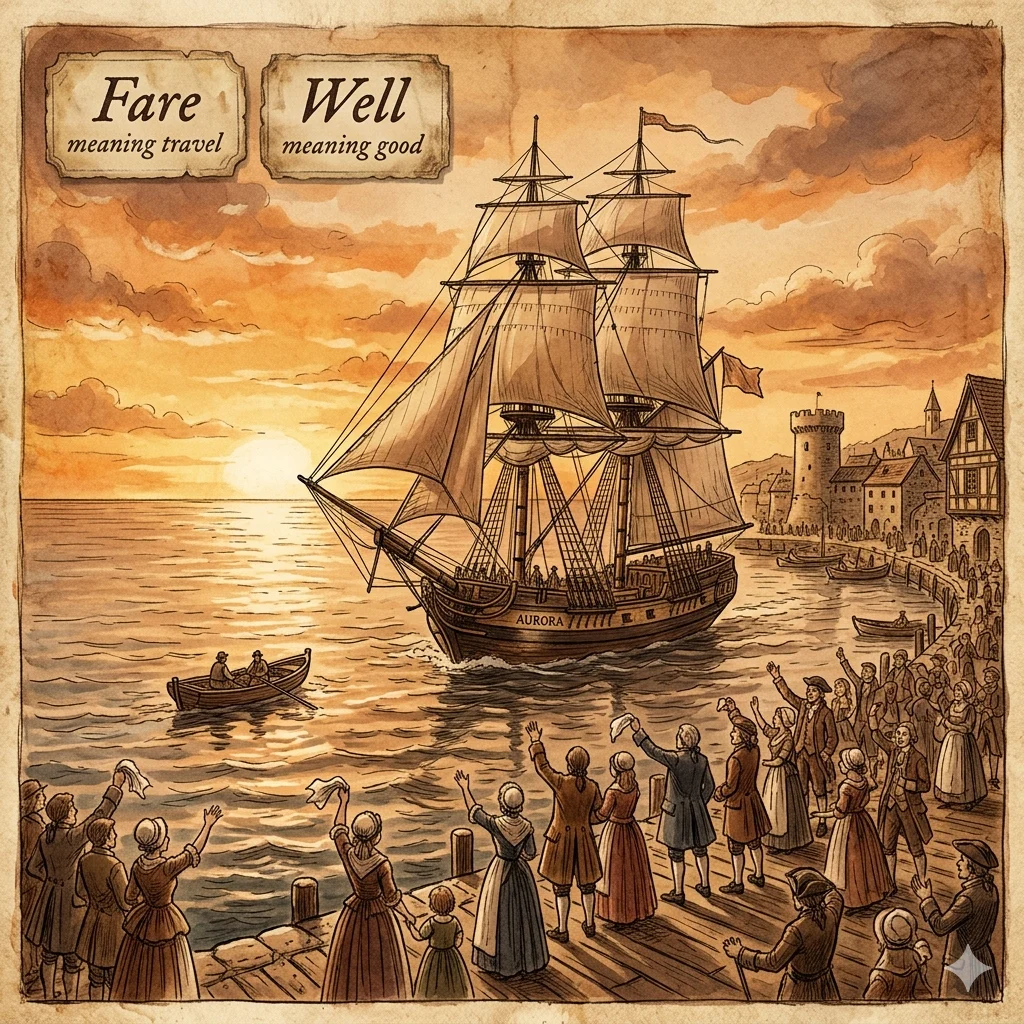
The correct spelling is farewell. “Fairwell” is wrong. Always. Example: “She said farewell to her boss.” If you write “fairwell,” it is a mistake. Think of it like this: “Fare” means travel. “Well” means good. So farewell means “good journey.” “Fair” means beautiful or honest. That does not fit here. So remember: farewell = goodbye. Fairwell = error.
The Origin of Farewell
The word “farewell” is very old. It comes from Old English. Two small words joined together. First, “fare” which means to go on a trip or a journey. Second, “well” which means in a good way. So “fare well” literally meant “travel safely.” People used it when someone was leaving. Over time, it became a way to say goodbye forever or for a long time.
Why do people write “fairwell” by mistake? Because “fair” is a very common word. You see “fair” everywhere. A fair judge. A fair price. A town fair. Your brain knows “fair” very well. So when you hear the sound “fair-well,” your fingers type “fair.” But the correct root is “fare” (travel), not “fair” (beauty). That is the whole history. Simple.
British English vs American English Spelling
Here is good news for you. Both British and American English spell “farewell” the same way. There is no difference. The confusion is not between countries. The confusion is between the correct word “farewell” and the wrong spelling “fairwell.”
But let us see how each country uses it. In British English, “farewell” sounds very old and formal. People in London do not say “farewell” every day. They say “cheers” or “bye.” In American English, “farewell” is also formal. Americans say “see you later” or “take care.” But in writing, both countries use “farewell” the same way.
Here is a simple table.
| Spelling | Correct? | When to use |
|---|---|---|
| Farewell | Yes | Always. For any goodbye, party, message, or quote. |
| Fairwell | No | Never. It is a spelling error. |
That is all. No more confusion.
Which Spelling Should You Use?
You should always use farewell. No exceptions. But let me give you advice for different people.
- If you write for people in the US: Use “farewell.” Your boss and teacher will see “fairwell” as a typo. They will correct you.
- If you write for the UK or Australia or Canada or India: Use “farewell.” The wrong spelling looks bad. It is unprofessional.
- If you write for people who learn English as a second language: Use “farewell.” This is the standard form. Every English course teaches this.
- If you write a text message to your friend: You can still use “farewell” if you want. Or just write “bye.” But never write “fairwell.”
Professional advice: Turn on spell check in your phone and computer. Set it to flag “fairwell” as red. After one week, your fingers will learn the right way.
Common Mistakes with Farewell
People make many mistakes with this word. Let me show you the most common ones.
Mistake 1: Writing “fairwell” instead of “farewell.”
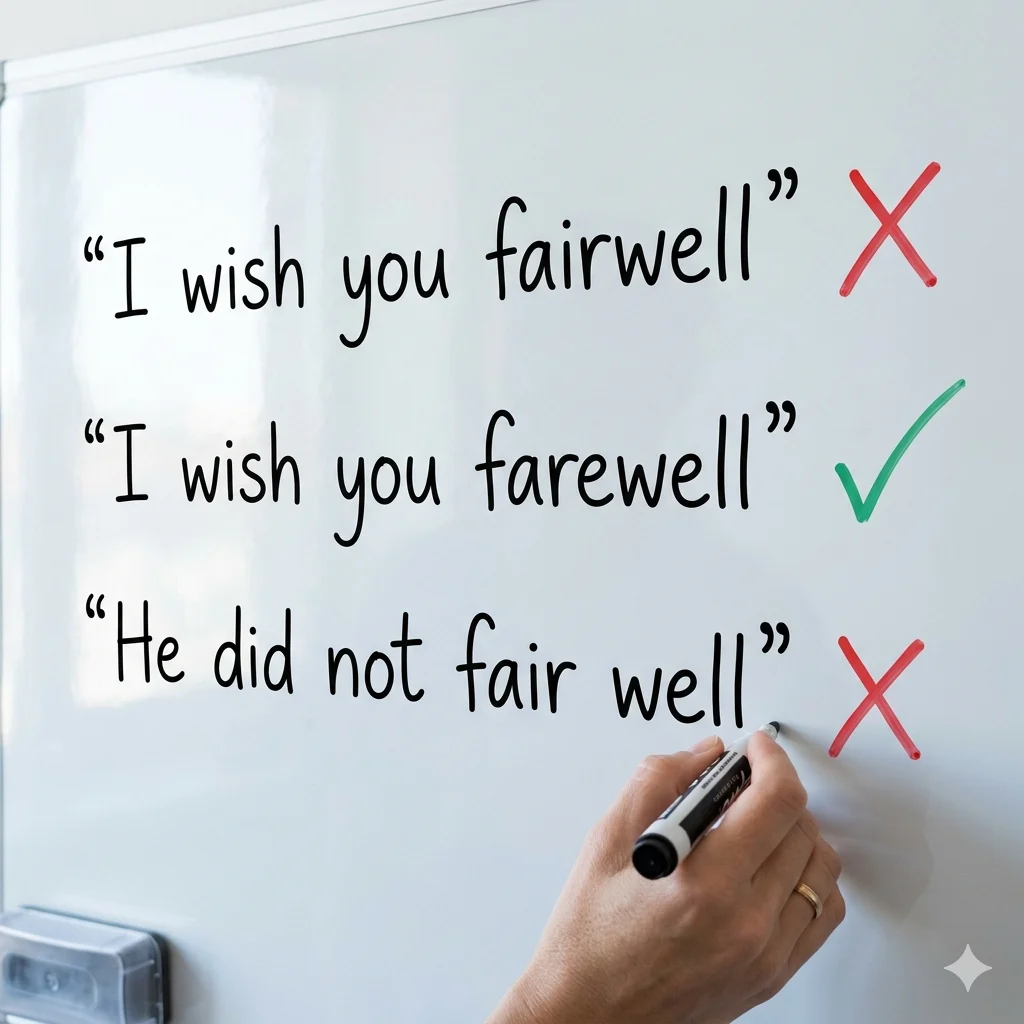
This is the number one mistake. Example: “I wish you fairwell.” This is wrong. Correction: “I wish you farewell.” Always check this.
Mistake 2: Confusing “fare well” (two words) with “farewell” (one word).
Listen carefully. “Fare well” as two words means “to perform well” or “to travel safely.” Example: “You will fare well on your test.” That means you will do well. “Farewell” (one word) means goodbye. So “I hope you fare well at your new job” is correct. But “I came to say fare well” is wrong. You need “farewell.”
Mistake 3: Using “fair well” in any sentence.
“Fair well” is never correct. Never. “Fair” is an adjective (a fair decision) or a noun (a book fair). “Well” is a noun (water well) or adverb (sing well). But “fair well” together has zero meaning. Do not write “He did not fair well.” Write “He did not fare well.”
Mistake 4: Writing “fairwell party” on an invitation.
This happens a lot. People make party invitations and write “fairwell party.” That is wrong. It is always “farewell party.”
Farewell in Everyday Examples
Now let us see “farewell” in real life. I will show you emails, news, social media, and more.
In formal emails:
- “Dear team, please join me in saying farewell to Maria. She is retiring on Friday.”
- “It is time to bid farewell to our old system.”
In news headlines:
- “Fans say farewell to famous actor.”
- “The city bids farewell to its oldest library.”
On social media:
- “Farewell to my travel partner. ✈️”
- “Posting a farewell selfie on my last day.”
Farewell message (for a coworker):
“It is hard to say farewell. Thank you for five great years. You will be missed a lot.”
Farewell quotes (for a card or speech):
- “Farewell! God knows when we shall meet again.” – Shakespeare
- “Farewell, my friend. The road is long, but your heart is true.”
Farewell party (invitation):
“You are invited to a farewell party for John. Friday at 6 PM. Come say goodbye with cake and music.”
Did not fare well (correct use):
“The team did not fare well in the final match.” This means they performed poorly.
“The team did not fair well.” This is wrong. Never write this.
Don’t fare well (correct use):
“If you do not water the plants, they will not fare well.”
“If you do not study, you will not fare well on the exam.”
Fair well in life?
No. The correct phrase is “fare well in life.” Example: “I hope you fare well in life after college.”

Farewell – Google Trends & Usage Data
The word “farewell” is searched the most in English-speaking countries. The top places are the United States, the United Kingdom, Australia, Canada, and India. Searches for “farewell” go up in May and June. Why? Because of graduation season. People say farewell to school. Searches also go up in December. That is when people say goodbye to the old year.
The wrong spelling “fairwell” also gets searches. But very few. Most of those searches come from people who are not sure. Just like you. Now you know the answer.
What do people search for the most? “Farewell quotes” and “farewell message” are searched 10 times more than “farewell party.” This shows people want the right words to say. They want to write a good goodbye. “Did not fare well” is also a common search. That is because people mix up “fare” and “fair” in work reviews. So double-check that phrase when you write an email.
Comparison Table (All Keyword Variations)
| Phrase | Correct? | Meaning |
|---|---|---|
| Farewell | Yes | Goodbye |
| Fairwell | No | Spelling mistake (no meaning) |
| Fare well (two words) | Yes | To perform well or travel safely |
| Fair well (two words) | No | No meaning at all |
| Farewell party | Yes | A party to say goodbye |
| Fairwell party | No | Wrong spelling |
| Did not fare well | Yes | Did not perform well |
| Did not fair well | No | Wrong |
| Don’t fare well | Yes | Do not perform well |
| Don’t fair well | No | Wrong |
| Farewell message | Yes | A goodbye note |
| Farewell quotes | Yes | Famous goodbye lines |
| Fair well in life | No | Wrong (use “fare well in life”) |
| Is it fairwell or farewell | Answer | Farewell is correct |
| Fairwell or farewell in English | Answer | Farewell |
FAQs
1. Which is correct, farewell or fairwell?
Farewell is correct. Fairwell is a spelling error. Always use farewell.
2. What is the meaning of fairwell?
Fairwell has no meaning. It is a mistake. Some people think it means a nice goodbye, but that is wrong. The correct word is farewell.
3. Is it fare well or fair well?
It is “fare well” (two words) meaning to do well or travel safe. “Fair well” is never correct. Example: “You will fare well in your new job.”
4. Is it correct to say farewell?
Yes, it is correct. It means goodbye. It is formal but fine for any situation. You can say it or write it.
5. Fairwell or farewell meaning – what is the difference?
Farewell means goodbye. Fairwell has no meaning because it is not a real word. So there is no difference in meaning. One is right. One is wrong.
6. Fairwell or farewell in English?
In English, the correct spelling is farewell. All dictionaries list farewell. Fairwell is not in any good dictionary.
7. Fair well in life – how to use it?
You write “fare well in life.” Example: “I hope you fare well in life after school.” That means I hope you do well. Do not write “fair well in life.”
8. What is a good farewell message?
“Thank you for everything. I wish you happiness and success. Farewell, my friend.” Keep it short and kind.
9. What are short farewell quotes?
“Farewell, and may the road rise to meet you.” “Farewell is not forever.” “Goodbye for now, not goodbye forever.”
10. How do you spell farewell party?
It is “farewell party.” Two words. First word farewell. Second word party. Example: “We are having a farewell party for Sara.” Never write “fairwell party.”
11. Is it fairwell or farewell party?
It is “farewell party.” Never “fairwell party.” If you write an invitation, check the spelling twice before you print it.
12. Did not fare well in a sentence?
“The business did not fare well during the slow season.” That means the business performed poorly. “The team did not fare well in the rain.”
13. What does “don’t fair well” mean?
Nothing. The correct phrase is “don’t fare well.” Example: “Plants don’t fare well without sunlight.” “Old cars don’t fare well in winter.”
14. Why do people type fairwell?
Because “fair” is a very common word. Their fingers type what they know. But now you know the rule. You will not make that mistake again.
15. Can I use farewell in a text message?
Yes. You can write “Farewell! See you next summer.” It is fine. But most people write “bye” or “take care.” Farewell is more formal.
Conclusion
You now know everything about “fairwell or farewell.” Let me repeat the most important point. The correct word is farewell. It means goodbye. It comes from Old English meaning “travel well.” The wrong spelling “fairwell” happens because “fair” is so common. But it is always an error. Always.
Use “farewell” for goodbye messages. Use “farewell” for party invitations. Use “farewell” for quotes and formal writing. Use “fare well” (two words) when you talk about performing well. Example: “You will fare well.” Never use “fair well.” Never write “fairwell.”
Check your spelling before you send that email. Check it before you print that party invitation. A small change – from “fair” to “fare” – makes you look smart and professional. Now you can write that farewell message with full confidence. You will fare well in all your writing from today.

Max Laughwell is the kind of guy who can find comedy in traffic jams and awkward small talk. He believes that if you’re not laughing at life, you’re doing it wrong. His style is smooth, bold, and unexpectedly relatable — like a good joke told at just the right moment. When Max isn’t cracking up his readers, he’s probably out there turning real-life chaos into future punchlines.