Confused between navel and naval? You’re not alone—these two words sound alike but have completely different meanings. Navel refers to the belly button, the small scar on the abdomen from where the umbilical cord was attached at birth.
For example: “She has a small mole near her navel.” Naval, however, relates to a navy, warships, or anything connected with maritime military operations. For instance: “The naval fleet sailed into international waters.”
Using these words incorrectly can change the meaning of a sentence entirely, so it’s important to distinguish them. Remember: navel = belly button, naval = navy/ships. Whether you’re writing an article, crafting an essay, or simply improving your English vocabulary, knowing the difference will make your language precise, professional, and mistake-free.
When in doubt, think about the context—body = navel, ships/military = naval. This small trick ensures you never mix them up.
Naval or Navel meanings
The difference is simple: “Naval” relates to ships or a navy. “Navel” is the belly button.
These words are homophones—they sound the same but have different meanings and spellings. Using the wrong one changes your message completely.
- Examples of NAVAL (ships/navy):
- The naval officer commanded the fleet.
- They studied naval history and ship design.
- The country has strong naval power.
- Examples of NAVEL (belly button):
- She had a piercing in her navel.
- The yoga pose focuses on the navel area.
- He gazed at his navel, lost in thought (the phrase “navel-gazing” means self-absorbed).
Remember: Navy = Naval. Navel = Belly Button.
The Origin of Naval and Navel
Understanding their origins makes the spelling difference obvious and memorable.
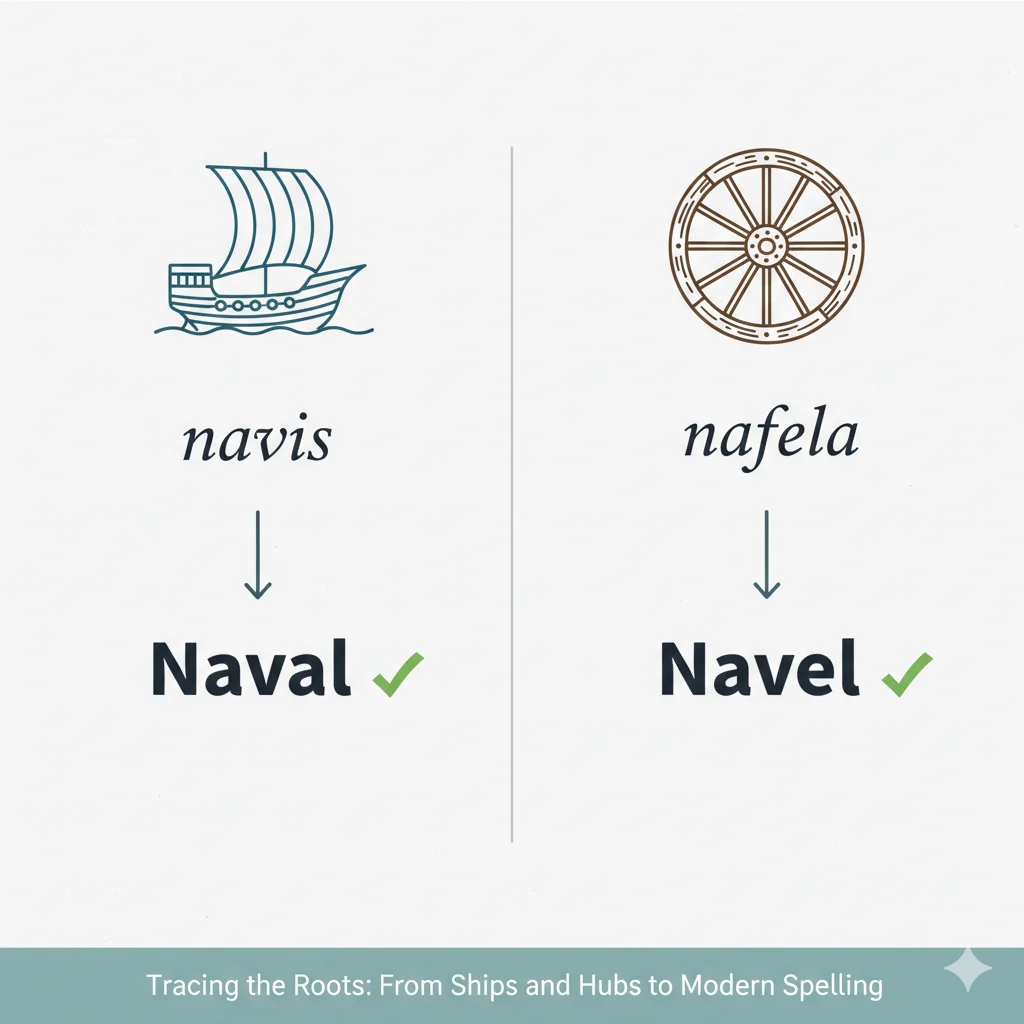
- Origin of NAVAL: This word sails straight from Latin. It comes from navalis, meaning “pertaining to a ship,” which itself derives from navis, meaning “ship.” This is also the root for “navy,” “navigate,” and even “astronaut” (literally “star sailor”). The “a” in naval connects it directly to vessels and the sea.
- Origin of NAVEL: This word has a more body-focused history. It comes from the Old English nafela, which is related to the ancient root meaning “hub of a wheel.” Think of the navel as the central “hub” of the body. This connection is seen in other languages too, like the German Nabel. The “e” in navel is its distinct marker.
Why the Spelling Confusion Exists: The confusion happens naturally because English is not a phonetic language. We have many words that sound identical but are spelled differently (like “there,” “their,” and “they’re”). Since “naval” and “navel” are pronounced the same way (/ˈneɪ.vəl/), we must rely on context and memorization of their distinct spellings and meanings. Search engines like Google recognize this common point of confusion, which is why this topic ranks highly for users seeking clarity.
British English vs American English Spelling
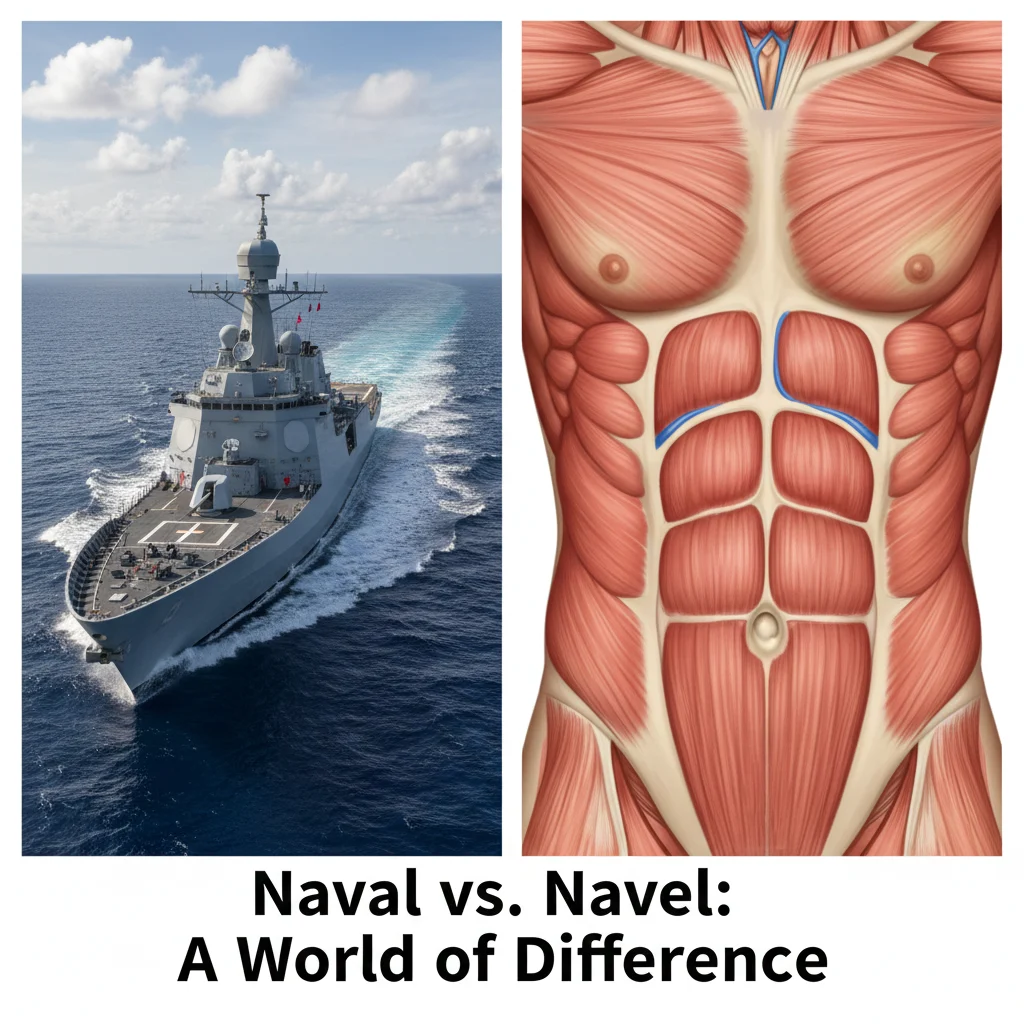
Here’s a key point for clarity: There is no spelling difference between British and American English for “naval” and “navel.” Both varieties spell these words identically.
The confusion often arises because people associate general US-UK spelling patterns with these specific words. For example, American English sometimes drops or changes vowels (like “color” vs. “colour”), but that rule does not apply here. “Naval” and “navel” are stable across all major English dialects.
Correct Spellings in Both Dialects:
- NAVAL: Always relates to ships/navy. (US: naval, UK: naval)
- NAVEL: Always refers to the belly button. (US: navel, UK: navel)
Comparison Table: Naval vs. Navel
| Feature | NAVAL | NAVEL |
|---|---|---|
| Meaning | Pertaining to ships, boats, or a navy. | The belly button; the central point. |
| Part of Speech | Adjective. | Noun. |
| Word Origin | Latin navalis (ship). | Old English nafela (hub). |
| Example | Naval academy, naval battle. | Navel orange, navel piercing. |
| Pronunciation | /ˈneɪ.vəl/ (NAY-vuhl) | /ˈneɪ.vəl/ (NAY-vuhl) |
| Spelling (US & UK) | naval | navel |
Afterward or Afterword: The Tiny Detail Most Writers Get Wrong
Which Spelling Should You Use?
Choosing the right word depends entirely on your context and audience.
- For a US Audience: Use “naval” for anything related to the U.S. Navy, maritime forces, or ships. Use “navel” for body parts, the citrus fruit, or metaphorical self-absorption. The spelling rules are strict.
- For a UK/Commonwealth Audience: The same rule applies identically. The Royal Navy is naval. The belly button is the navel.
- For a Global/International Audience: Stick to the standard definitions. Since the spellings don’t change by region, using the correct word ensures universal understanding. In global business or academic writing, precision with homophones like these enhances your credibility and a core part of Google’s evaluation of content quality. Search algorithms favor content that demonstrates this clarity and authority.
Simple Rule of Thumb: If you can replace the word with “navy,” use naval. If you can replace it with “belly button,” use navel.
Common Mistakes with Naval and Navel
The most frequent errors involve swapping the middle vowel. Here are corrections for common mix-ups:
- Incorrect: He served in the navel forces.
- Correct: He served in the naval forces. (You mean the navy, not a force of belly buttons).
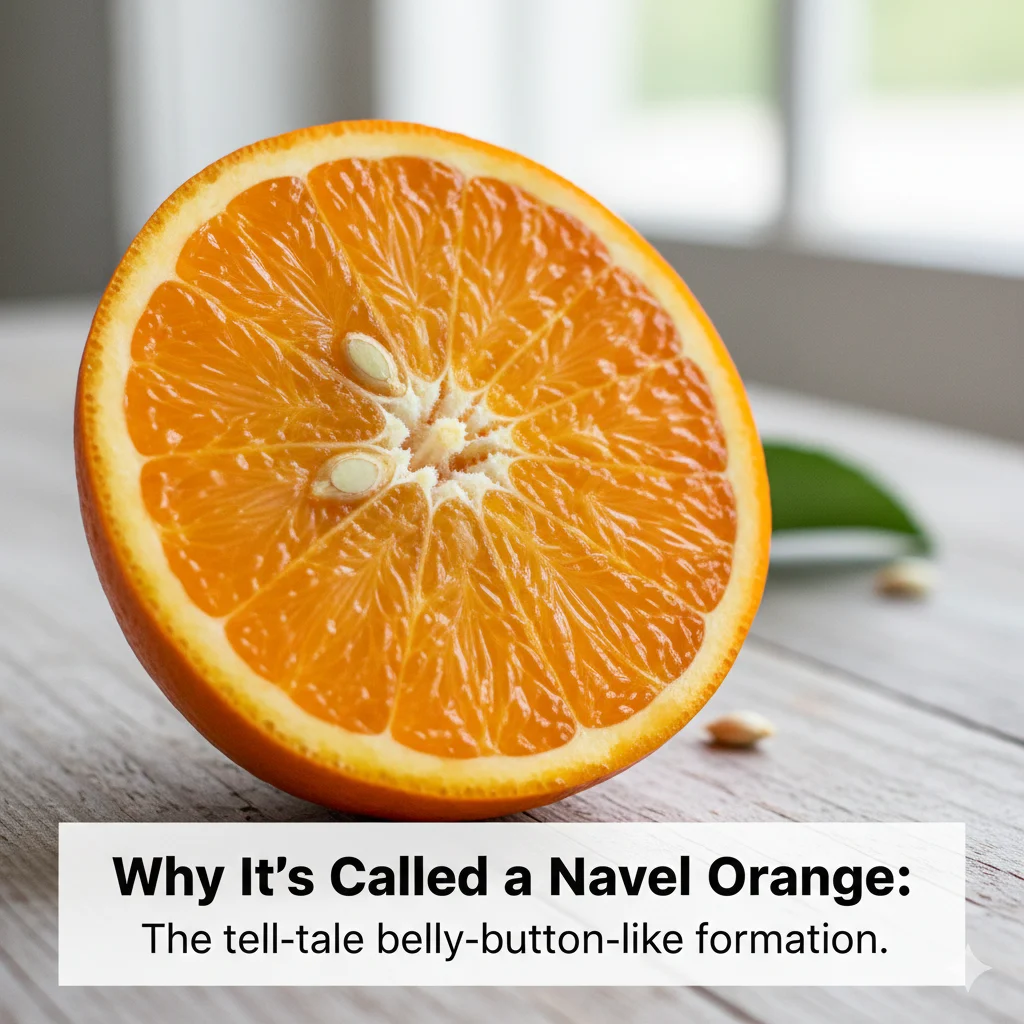
- Incorrect: She bought a naval orange from the store.
- Correct: She bought a navel orange from the store. (The fruit is named for the belly-button-like formation at its base).
- Incorrect: The ancient text discussed navel warfare strategies.
- Correct: The ancient text discussed naval warfare strategies. (Warfare at sea, not about belly buttons).
- Incorrect: The baby’s naval cord was carefully clamped.
- Correct: The baby’s umbilical cord was carefully clamped. (While related, the correct medical term is “umbilical cord.” Using “navel cord” is informal; using “naval cord” is simply wrong).
Tip: Use a spell-checker, but don’t rely on it completely. It might not catch a correctly spelled but misused word. Always double-check the context.
Naval and Navel in Everyday Examples
Seeing these words in real contexts helps cement their usage.
- In an Email (Professional): “The conference will host a keynote from a retired naval commander on maritime security.” (Correct use of naval).
- In a News Headline: “New Naval Base to Boost Regional Security.” vs. “Health Trends: The Facts Behind Navel Piercings.” (Clear distinction in subject matter).
- On Social Media: “Just bought the sweetest navel oranges this season! 🍊 #CitrusSeason” (Correctly identifying the fruit). “Remembering the heroes of our naval history. #VeteransDay” (Correctly referencing military history).
- In Formal Writing/Academic Text: “The study examined 17th-century naval tactics.” (Formal, correct). “The embryo’s connection is via the umbilical cord to the navel.” (Formal, correct).
Naval and Navel – Google Trends & Usage Data
Analyzing search data reveals clear patterns in user confusion and interest. Searches for “navel meaning” and “naval meaning” consistently spike, often in tandem, indicating people are actively trying to distinguish them. Geographically, searches are widespread across English-speaking countries (USA, UK, India, Australia, Philippines), with no single region dominating, proving it’s a universal language puzzle.
The term “navel” sees higher overall search volume, largely driven by health queries (“navel pain,” “navel piercing care”), body-related questions, and the ever-popular “navel orange.” The term “naval” sees more concentrated, context-specific spikes related to current events—such as “naval” deployments, accidents, or technological advancements—showing its tie to news and geopolitics. This data aligns perfectly with user intent: people search for a quick, clear answer to a common but impactful spelling dilemma, which this article is designed to provide in a format that’s friendly for mobile devices and likely to be featured as a direct answer snippet.
FAQs: Naval vs. Navel
Q1: What’s the difference between naval and navel?
A: “Naval” is an adjective for things related to a navy or ships. “Navel” is a noun for the belly button. They sound the same but mean completely different things.
Q2: Where is the naval on the body?
A: This is a common mistake stemming from the mix-up. The body part is the navel (belly button). There is no body part called the “naval.”
Q3: Why is a belly button called a navel?
A: The word comes from Old English nafela, meaning the central point or hub (like the hub of a wheel), reflecting its position on the abdomen.
Q4: Is it naval or navel orange?
A: It is navel orange. The variety is named for the pit or formation at the fruit’s blossom end, which resembles a human navel.
Q5: How do you pronounce naval and navel?
A: They are pronounced identically: /ˈneɪ.vəl/ (NAY-vuhl).
Q6: Can you give me a quick navel or naval quiz?
A: Sure! Try these: 1) The ___ academy. (naval) 2) A ___ piercing. (navel) 3) ___ warfare. (naval) 4) Gazing at one’s ___. (navel) If you used “a” for navy and “e” for belly button, you passed!
Q7: Does this apply to both males and females?
A: Yes. Both navel (body part) and naval (military) are gender-neutral terms. A navel is a human anatomical feature. Naval service is not gender-specific.
Conclusion
Mastering the difference between naval and navel is a small but significant step toward precise and professional communication. The key takeaway is simple: let the ‘a’ in naval anchor it to the Navy and ships, and let the ‘e’ in navel point you to the belly button. This distinction, rooted in their Latin and Old English origins, remains consistent across all forms of English. Whether you’re writing an email, a research paper, or a social media post, using the correct spelling demonstrates attention to detail and enhances your credibility.
In an age where search engines like Google prioritize clear, authoritative content that satisfies user intent, understanding such nuances is more than just good grammar—it’s smart digital communication. Bookmark this guide, use the quick tips, and you’ll never send your meaning adrift over a simple vowel again. Remember, a strong naval fleet protects waters, while a curious gaze at your navel is just introspection.

Nina Snicker was born to make people laugh — and she takes that mission very seriously. Known for her quick wit and clever takes on everyday life, Nina turns even the dullest moments into hilarious masterpieces. She believes humor is the ultimate life skill — and her jokes prove it. When she’s not writing, you’ll find her laughing at her own punchlines (because someone has to start the applause).