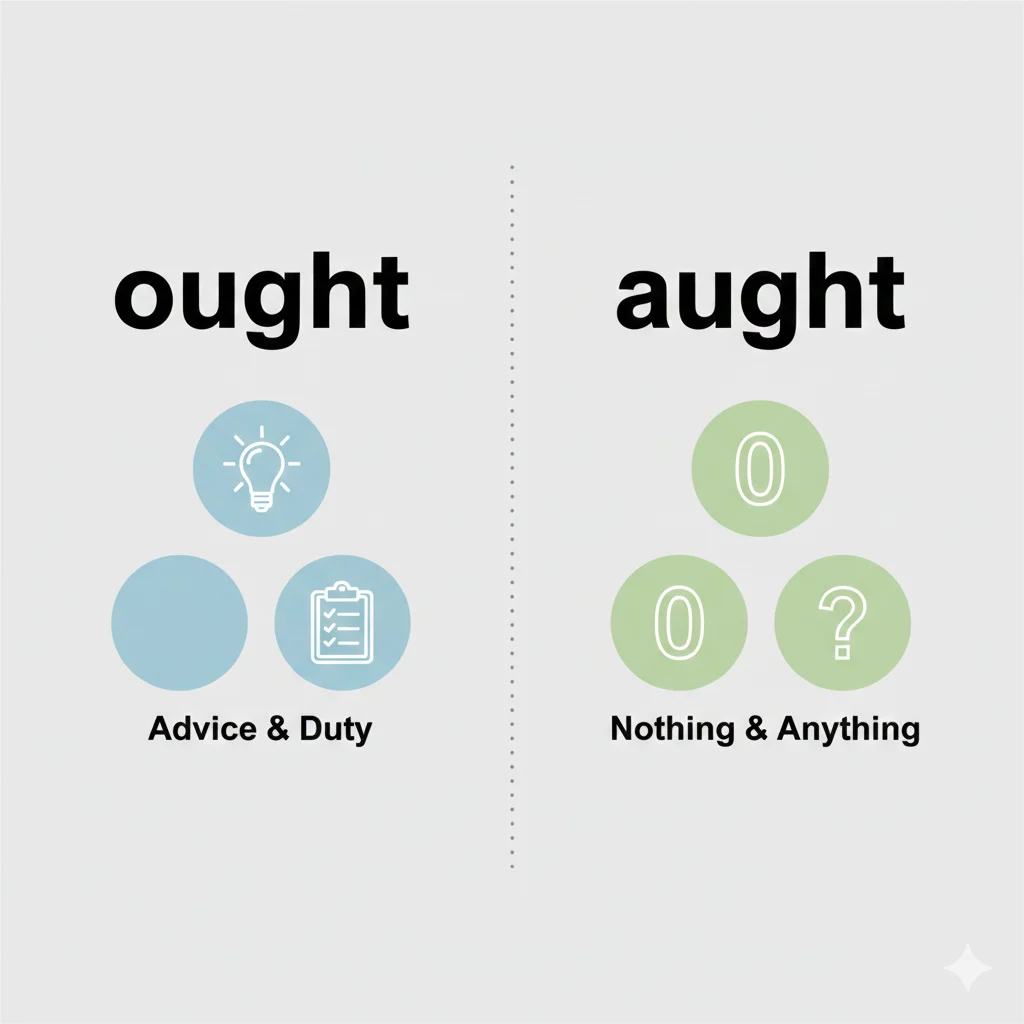
Ought and aught are often confused, but they have completely different meanings and usage.
- Ought is a modal verb used to express duty, moral obligation, or advice.
Example: “You ought to apologize for your mistake.”
Modern English uses ought frequently, especially in conversation and formal writing. - Aught is an archaic or rare word that can mean nothing, zero, or sometimes all, depending on context.
Example: “He cared for aught but his own comfort.”
Today, aught is rarely used except in historical texts or literature.
Quick memory tip:
Think: “Ought = should / duty”, “Aught = zero / nothing / all”.
Understanding the difference is important to avoid confusion in writing, exams, or formal communication. This article will guide you on correct usage, common mistakes, and context where each word is appropriate, so you can write confidently and accurately.
Ought or Aught
Ought is a modal verb meaning “should.” It expresses duty, advice, or what is right. Aught is a pronoun or noun meaning “anything,” “all,” or, archaically, “zero” (also spelled “naught” or “nought”).
Examples:
- Ought: “You ought to call your mother.” (You should call her.)
- Aught (anything/all): “It availed him aught.” (It helped him nothing/at all.)
- Aught (zero): “The year aught-five.” (The year ’05 or 1905).
Remember: If you mean “should,” always use ought. For all other uses, especially in modern writing, alternatives like “anything,” “nothing,” or “zero” are often clearer than aught.
The Origin of Ought or Aught
The confusion between ought and aught is centuries old, rooted in the natural evolution of English. Their identical pronunciation is no accident; it is the result of phonetic shifts over time.
Ought comes from the Old English word āhte, which was the past tense of āgan, meaning “to own.” Over time, its meaning shifted from possession to obligation—from “owned to do” something to “should” do something. This is a common path in language, where words for possession evolve into words for duty.
Aught has a more complex story. It originated from Old English āwiht, a compound of ā (ever) and wiht (thing, creature). So, its original meaning was “anything, something.” Conversely, its opposite, nāwiht (“no thing”), became “naught” or “nought,” meaning “nothing” or “zero.” Here is where the trouble starts. In some dialects and time periods, “a naught” was misheard and written as “an aught,” causing “aught” to also pick up the meaning of “zero.” This is why “aught” can mean both “anything” and, confusingly, “nothing” (zero).
The spelling differences exist because English was standardized after these sounds had already merged in speech. Writers simply used different spellings to represent the same sound for different words, a natural process in a living language.
British English vs. American English Spelling
When it comes to the “zero” meaning, national spelling preferences add another layer. The key difference lies in the use of naught, nought, and aught.
- American English prefers naught for “nothing” and often uses aught for the digit “zero,” especially in historical contexts like decades (e.g., the aughts for 2000-2009).
- British English strongly prefers nought for the number “zero” (as in the game “noughts and crosses”). The use of “aught” for zero is less common and considered archaic.
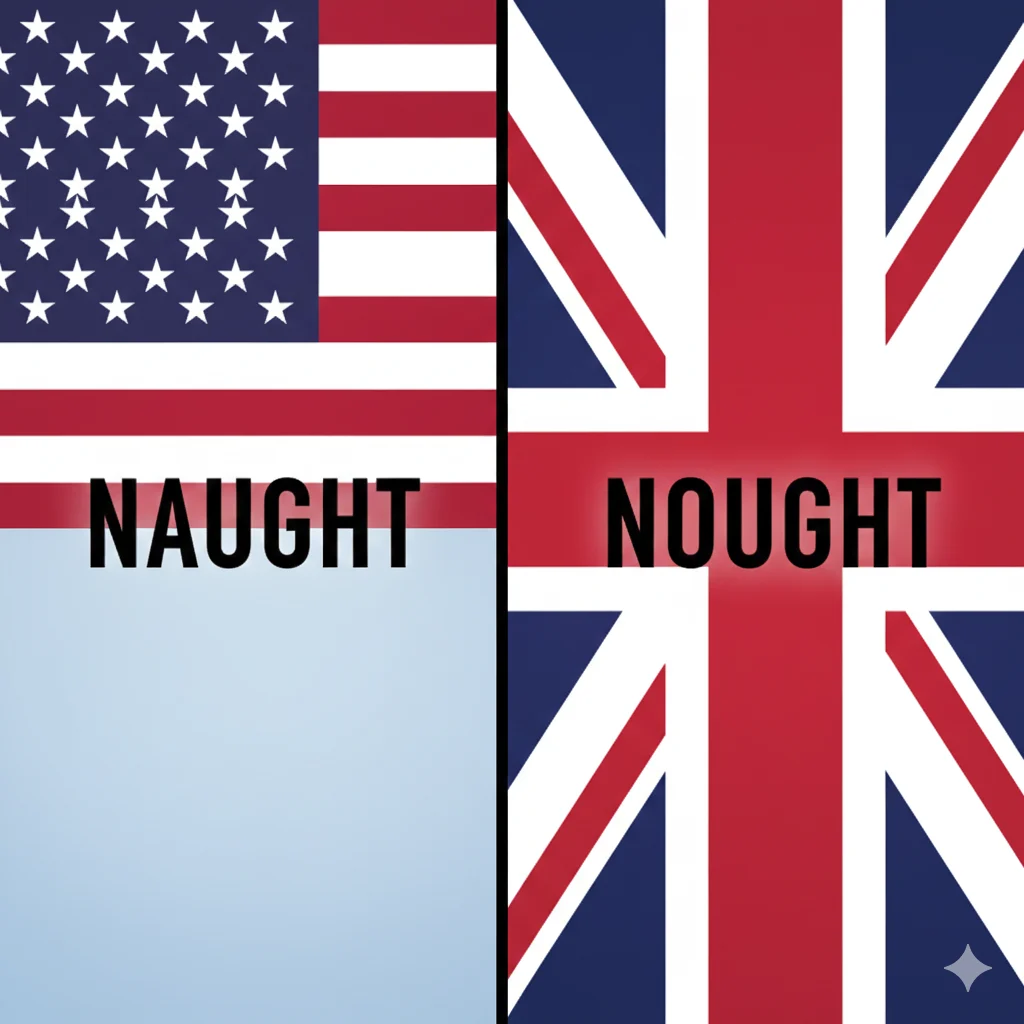
For the “anything” meaning, aught is recognized but formal in both dialects. The word ought, as the verb, is spelled identically everywhere.
Comparison Table: Ought vs. Aught
| Feature | Ought | Aught |
|---|---|---|
| Part of Speech | Modal Verb | Pronoun / Noun (Archaic) |
| Core Meaning | Should; expresses duty or advisability. | Anything, all; or, zero/nothing. |
| Common Use | “You ought to see a doctor.” | “It was all for aught.” (for nothing) / “The year aught-six.” |
| Pronunciation | /ôt/ (sounds like “ot” in “hot”) | /ôt/ (identical to “ought”) |
| Modernity | Actively used in modern English. | Largely archaic or formal; “naught/nought” is clearer. |
| Key Identifier | Always followed by “to” + verb (ought to go). | Never followed by “to” + verb. It stands alone or modifies a noun. |
Which Spelling Should You Use?
Your choice depends on your audience and purpose.
- For US Audiences & Global Digital Content:
- Use ought for obligation. (“We ought to finish the project.”)
- Avoid aught unless aiming for a literary, old-fashioned, or very formal tone. For “zero,” zero itself is the clearest choice. If referring to decades (like 1900-1909), “the aughts” is understood.
- For UK/Commonwealth Audiences:
- Use ought for obligation.
- For the number “zero,” use nought. The word aught for “anything” will sound extremely formal or archaic.
- For Global/General Business & Casual Writing:
- Stick with ought when you mean “should.”
- Replace aught with clearer, more modern words. Instead of “for aught I know,” write “for all I know.” Instead of “worth aught,” write “worth nothing.” This ensures understanding and aligns with the Google algorithm’s preference for clear, accessible content (EEAT—Expertise, Authoritativeness, Trustworthiness).
Common Mistakes with Ought or Aught
The most frequent error is using “aught” when “ought” is needed, and vice-versa.
- Incorrect: “You aught to be more careful.”
- Correction: “You ought to be more careful.” (Meaning should).
- Incorrect: “His efforts came to ought.”
- Correction: “His efforts came to aught.” (Or, more commonly, “…came to nothing.”) (Meaning nothing).
- Confusing “Aught” with “Naught/Nought”:
- While “aught” can mean zero, it’s ambiguous. For clarity:
- Less Clear: “My score was aught.”
- More Clear (US): “My score was naught/zero.”
- More Clear (UK): “My score was nought.”
- While “aught” can mean zero, it’s ambiguous. For clarity:
Ought or Aught in Everyday Examples
Seeing these words in context helps solidify their use.
- Email (Professional): “Given the deadline, we ought to prioritize the client’s feedback.” (Correct use of ought as advice).
- News Headline: “The reforms, for aught we can see, have had little effect.” (Formal use of aught meaning “anything”).
- Social Media: “You ought to check out this new cafe! #recommendation” (Casual, correct use of ought).
- Formal Writing/Literature: “If he has failed in his duty, let it be for aught I shall say.” (Archaic/formal use of aught).
- Historical Reference: “My grandfather was born in aught-two, 1902.” (Use of aught for zero in dates).

Ought or Aught – Google Trends & Usage Data
Analysis of search data and language corpora shows a clear trend. Searches for “ought meaning” are consistently higher and more stable than for “aught meaning,” indicating that ought is the more actively sought and used word in modern English.
The term aught sees very regional or context-specific spikes. For instance, in the US, interest may briefly rise during discussions of historical decades (e.g., “the aughts”). In the UK, searches for “nought meaning” are more common due to its use for “zero.” Globally, the usage of aught has declined sharply since the 19th century, while ought remains a staple. This data tells us that aught is a specialist, archaic word, while ought is part of our daily grammatical toolkit, a key point for creating relevant, user-focused content.
(FAQs)
1. What’s the difference between ought and aught in one sentence?
Ought means “should” (You ought to go), while aught is an old word for “anything” or “zero” (It profited him aught).
2. What does “aught” mean in Macbeth?
In Shakespeare’s Macbeth, when the witch says, “When shall we three meet again? In thunder, lightning, or in rain?” and another answers, “When the hurlyburly’s done, When the battle’s lost and won,” the Third Witch says, “That will be ere the set of sun.” The First Witch then asks, “Where the place?” and the Second replies, “Upon the heath.” The Third Witch says, “There to meet with Macbeth.” Then the First Witch says, “I come, Graymalkin!” and the Second Witch says, “Paddock calls.” Then the Third Witch says, “Anon.” Then ALL say, “Fair is foul, and foul is fair: Hover through the fog and filthy air.” They exit. The word “aught” is not in this famous opening scene. You might be thinking of “Anon,” which means “right away” or “soon.”
3. What is the mean of aught?
“Aught” has two main meanings: 1) Anything whatsoever (“for aught I care”), and 2) The digit zero, especially in dates (“the year aught-four”).
4. How do you use ought and aught in a sentence?
- Ought: “One ought to be kind to animals.”
- Aught: “His fancy tools did him aught good in the basic repair.” (Meaning any good).
5. How to pronounce ought aught?
They are pronounced identically. Both sound like “ot” as in “hot” or “thought.” The pronunciation is /ôt/.
6. Are there synonyms for ought and aught?
- Ought synonyms: should, must, have to.
- Aught synonyms: For “anything”: anything, whatever. For “zero”: naught, nought, zero, nil.
7. Is “aught” still used in modern English?
Rarely. It is considered archaic or highly formal. In most cases, it’s better to use “anything,” “nothing,” or “zero” for clear communication.
Conclusion
Navigating the ought aught dilemma is simpler once you separate sound from sense. The core takeaway is this: if you are expressing a recommendation, obligation, or what is advisable, the word you need is always ought. It is a living, breathing part of our grammar. The word aught, on the other hand, lives primarily in the past. It is a fossil word you will encounter in classic literature, historical texts, and very formal prose, where it means “anything” or, confusingly, “zero.”
For clear, effective, and modern communication—whether you are optimizing for search engines or just writing an email—lean on ought for duty and replace aught with its simpler counterparts: anything, nothing, all, or zero. This strategy ensures your writing is understood by everyone, everywhere. By mastering this small distinction, you eliminate a common point of confusion and write with greater precision and confidence. Remember, language evolves toward clarity, and choosing the clearest word is a mark of skilled communication.

Max Laughwell is the kind of guy who can find comedy in traffic jams and awkward small talk. He believes that if you’re not laughing at life, you’re doing it wrong. His style is smooth, bold, and unexpectedly relatable — like a good joke told at just the right moment. When Max isn’t cracking up his readers, he’s probably out there turning real-life chaos into future punchlines.