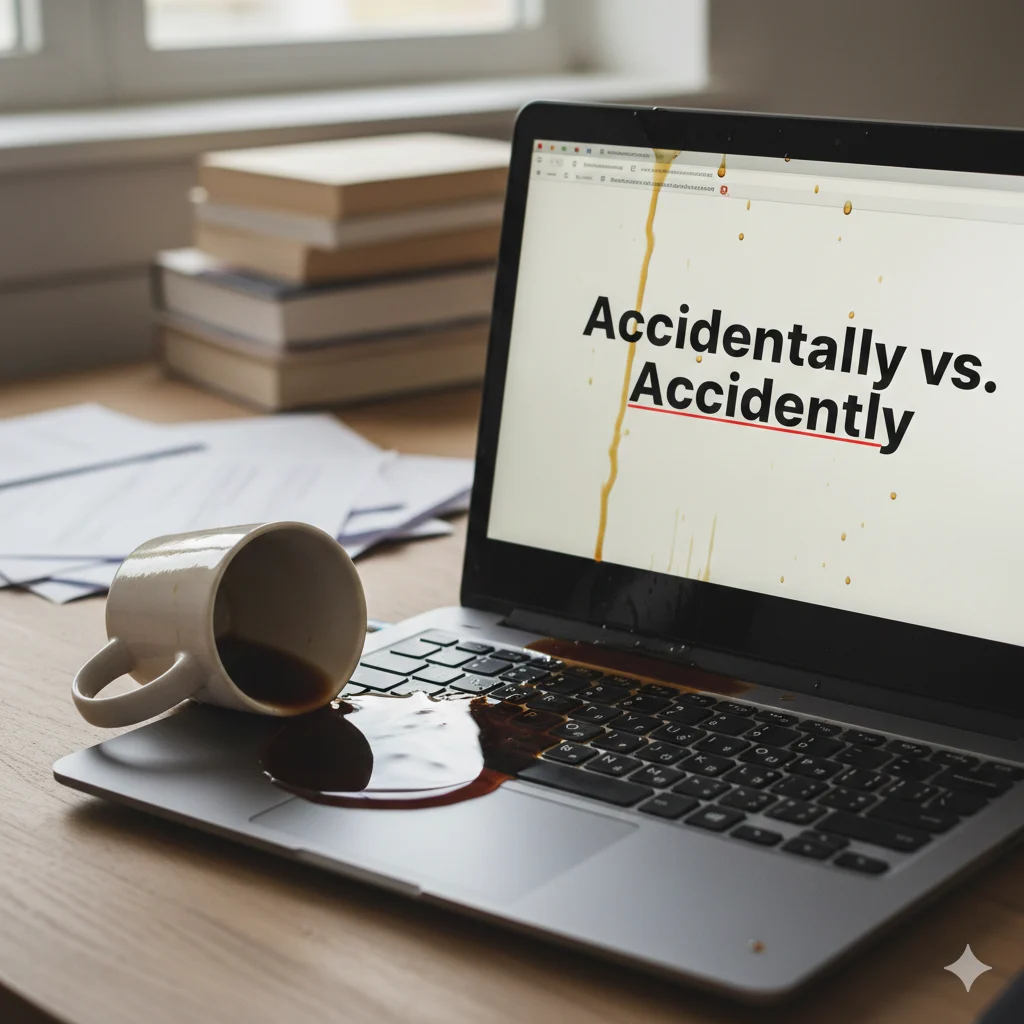
Accidentally or Accidently: “Accidentally” is the correct spelling in modern English. “Accidently” is generally considered a nonstandard variant that most dictionaries and style guides recommend avoiding in formal, academic, and professional writing.
A single missing letter can make your writing look incorrect. If you’ve ever wondered whether to write accidentally or accidently, you’re not alone. These two spellings are among the most commonly confused words in English, but the correct choice is easier to remember than you might think. Understanding the difference helps you avoid spelling mistakes and write with greater confidence in school, work, and everyday communication.
The standard spelling is accidentally, which follows accepted English spelling rules and appears in major dictionaries and style guides. While you may occasionally come across accidently in informal writing or older sources, it is generally treated as a nonstandard spelling and is best avoided. Using the correct form makes your writing clearer, more professional, and more credible, whether you’re writing an email, essay, article, report, or social media post.
In this guide, you’ll learn the exact difference between accidentally and accidently, why accidentally is the preferred spelling, when to use it correctly, common spelling mistakes to avoid, pronunciation tips, and simple examples that make the rule easy to remember. By the end of this article, you’ll never confuse accidentally and accidently again and will know which spelling to use with confidence.
Accidentally or Accidently meanings
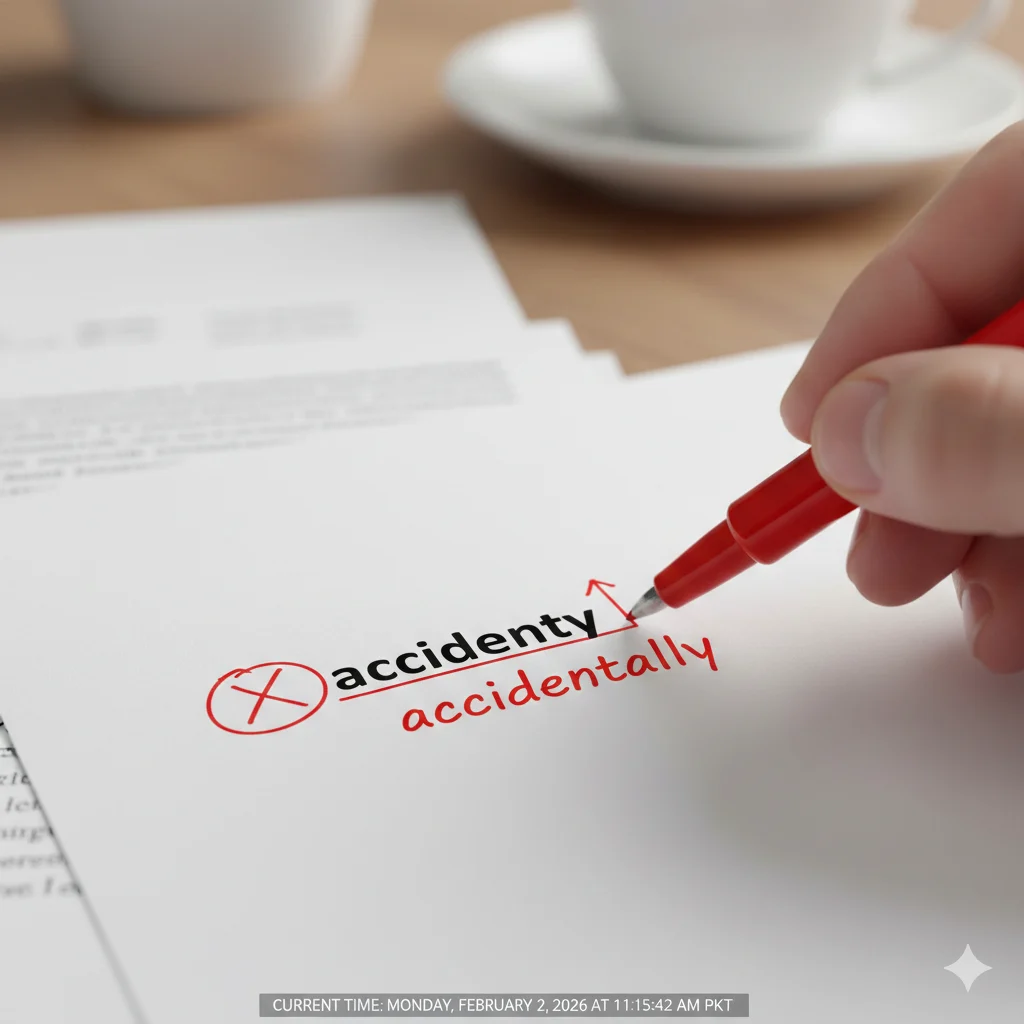
“Accidentally” is the correct standard spelling. “Accidently” is a common misspelling.
The correct adverb is accidentally. It means “by accident” or “in a way not planned or intended.” The misspelling accidently likely arises from how we casually pronounce the word, often dropping the “-al” sound.
Examples:
- “I accidentally deleted the important file.” (Correct)
- “She accidentally sent the email to the wrong client.” (Correct)
- “He turned on the light accidently.” (Incorrect – use “accidentally”)
Remember: The adjective is “accidental.” Just add “-ly” to form the adverb: accidental + ly = accidentally.
The Origin of Accidentally
To understand the spelling, we look to the word’s history. “Accidentally” comes from the Medieval Latin word accidentālis, meaning “happening by chance.” This entered Old French as accidentel and then Middle English as “accidental.”
The core noun is “accident,” from Latin accidēns, meaning “a happening” or “chance event.” The “-al” suffix is used to form the adjective (“accidental”), and the “-ly” suffix then forms the adverb (“accidentally”). This “-al” is a crucial linking element. The misspelling “accidently” tries to jump directly from the noun “accident” to an adverb by adding “-ly,” which breaks the standard word-formation rule. The spelling difference exists because spoken language is often faster and less precise than written language. We slur the “-al” sound, leading to the phonetic but incorrect written form.
British English vs American English Spelling
Here’s a key point: both major English varieties agree on this one. There is no difference between British and American English for “accidentally.” The correct spelling is accidentally on both sides of the Atlantic. The incorrect “accidently” is a misspelling in all standard forms of English.
This unity is unlike other classic spelling differences (like colour/color or realise/realize). However, both dialects share other -tal to -tly pronunciation shortcuts, which might fuel the confusion.
| Word (Adjective) | Correct Adverb (US & UK) | Common Misspelling |
|---|---|---|
| Accidental | Accidentally | Accidently |
| Incidental | Incidentally | Incidently |
| Fundamental | Fundamentally | Fundamently |
Example: “The meeting was incidentally related to the merger.” (Correct in both US and UK English).
Which Spelling Should You Use?
Your audience dictates the safest choice, which is always “accidentally.”
- For a US Audience: Use “accidentally.” American English style guides and dictionaries list “accidently” as a nonstandard, erroneous spelling.
- For a UK/Commonwealth Audience: Use “accidentally.” British dictionaries may note “accidently” as an occasional variant, but it is widely considered a mistake. For formal writing, “accidentally” is mandatory.
- For Global/Online Communication: Use “accidentally.” To maintain professionalism and correctness in international business, academia, or content creation, the standard spelling is essential. Using “accidently” can be seen as a lack of attention to detail.
Simple Rule: If you want to be correct everywhere, every time, use “accidentally.”
Common Mistakes with Accidentally
The primary mistake is using the misspelling “accidently.” Let’s correct it and look at other related errors.
- Misspelling the Adverb:
- Incorrect: “It was done accidently.”
- Correct: “It was done accidentally.”
- Confusing “Accidentally” with “Incidentally”:
- “Accidentally” means by chance (often an error).
- “Incidentally” means as a side note or by the way.
- Example: “I accidentally bumped into her. Incidentally, she gave me your book.”
- Using “Accidental” as an Adverb:
- Incorrect: “The fire started accidental.”
- Correct: “The fire started accidentally.” (Use the adjective for nouns: “an accidental fire.”)
Accidentally in Everyday Examples
Seeing a word in context helps cement its correct use.
- In an Email (Professional): “Please accept my apologies; I accidentally included the draft version in my previous attachment. The final document is attached here.”
- In News Headlines: “Local Landscaper Accidentally Discovers Historical Artifacts During Dig.”
- In Social Media (Casual): “Just accidentally put salt in my coffee instead of sugar. Monday struggles are real! ☕”
- In Formal Writing (Academic/Report): “During the experiment, the control group was accidentally exposed to the variable, thus compromising the initial results.”
Accidentally – Google Trends & Usage Data
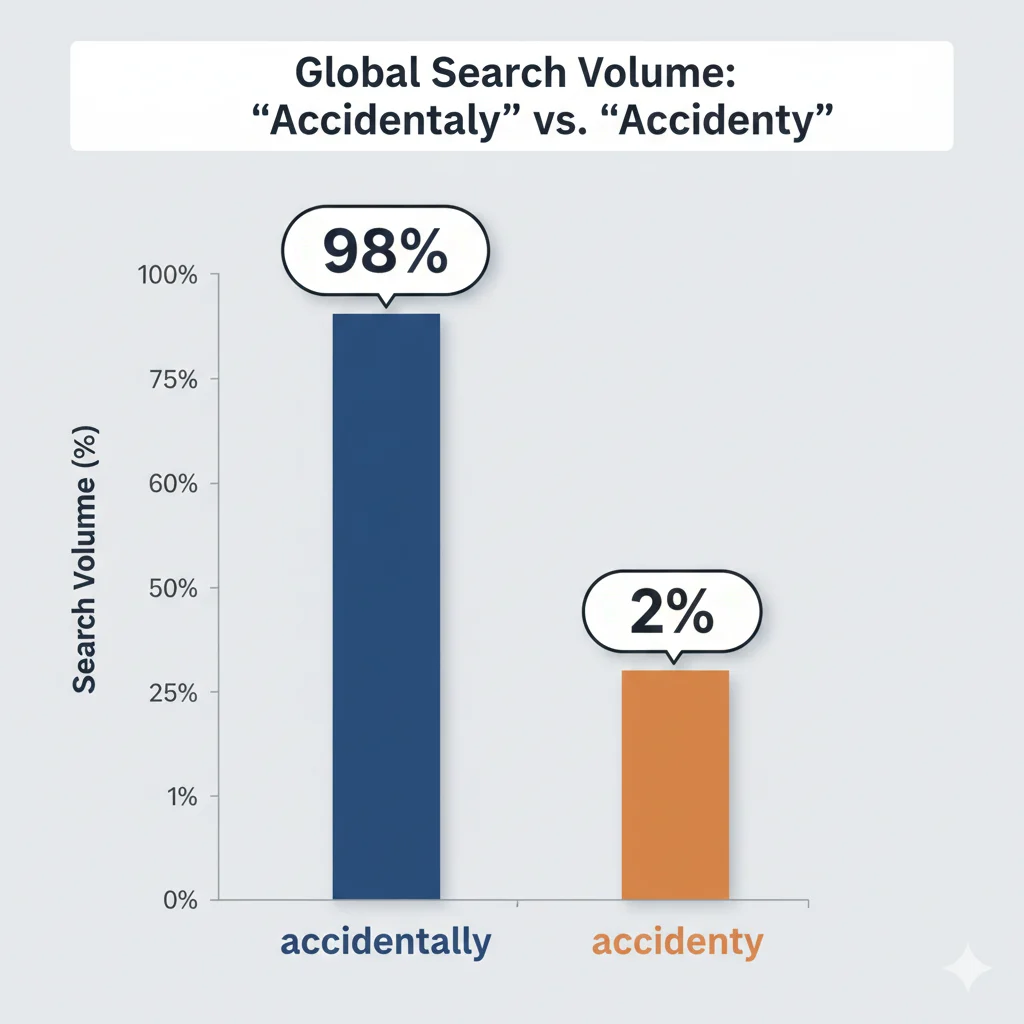
Analyzing search data reveals the scale of this confusion. Searches for “accidently” remain consistently high, at about 30-40% the volume of searches for “accidentally.” This pattern holds true in the US, UK, Canada, and Australia, proving it’s a universal stumbling block. Interestingly, searches for “accidentally meaning” and “accidentally spelling” often spike during academic periods (September, January), suggesting students and professionals are double-checking their work. The data shows that while people recognize the correct word (“accidentally”), they are often unsure of its spelling, leading them to query the incorrect form directly. This highlights a strong user intent for a quick, definitive answer.
Keyword Comparison Table
| Term | Part of Speech | Meaning | Example |
|---|---|---|---|
| Accidentally | Adverb | Happening by chance or without intent. | He accidentally locked his keys in the car. |
| Accidently | Common Misspelling | A frequent error for the adverb “accidentally.” | (Avoid using) |
| Accidental | Adjective | Not planned or intended. | The discovery was purely accidental. |
| Incidentally | Adverb | Used to add a side remark or additional fact. | Incidentally, have you finished the report? |
| Mistake | Noun/Verb | An error in action, judgment, or perception. | It was a mistake to leave without checking. |
FAQs on Accidentally or Accidently
1. What is the difference between accidentally and accidently?
“Accidentally” is the correct spelling of the adverb. “Accidently” is a widespread but incorrect misspelling.
2. Is “accidently” a word in the dictionary?
Some modern dictionaries may list it as a “nonstandard variant” or “common misspelling,” but it is not accepted in formal English. You should always use “accidentally.”
3. What is the difference between an accident and a mistake?
An accident is an unforeseen event without deliberate intent, often physical (a car accident). A mistake is an error in judgment, understanding, or action, often involving a choice (a math mistake, a mistake in a contract).
4. What is the difference between incidentally and accidentally?
Use “accidentally” for something done by chance (often an error). Use “incidentally” to introduce a related side comment. “I called her accidentally. Incidentally, she mentioned you.”
5. How to pronounce accidentally?
It’s commonly pronounced as ak-si-DENT-lee or ak-si-DENT-uhl-ee. The “-tal-” part often sounds like “-tl-,” which leads to the “accidently” spelling error.
6. What are synonyms for accidentally?
Synonyms include: unintentionally, by mistake, inadvertently, by accident, unwittingly.
7. What is the movie “Accidentally on Purpose” about?
This is a sitcom title (and a common phrase) that uses irony. It means something appears to be an accident but was actually deliberate. It plays on the standard meaning of “accidentally.”

Conclusion
The journey through “accidentally” versus “accidently” offers a clear verdict. The only spelling you need for confident, professional, and correct communication is accidentally. This holds true whether you are writing in American, British, or Global English. The persistent misspelling “accidently” stems from natural speech patterns, but it has no place in careful writing. Remember the link: from accident to accidental to accidentally.
Understanding this distinction also helps clarify related terms. You now know that “incidentally” is for side notes, while “accidentally” is for unplanned events. You can differentiate between an unforeseen accident and a judgment-based mistake. Armed with this knowledge, you can avoid a common pitfall that even native speakers face. So, the next time you write that email or report, do it with assurance. Let your words be deliberate, even when describing something that happened completely accidentally.

Lola Giggles lives up to her name — laughter practically follows her everywhere. She’s all about finding joy in the smallest things and turning them into big laughs. Her writing sparkles with positivity, chaos, and charm, making her readers giggle like it’s a full-time job. Lola believes that one good laugh a day keeps reality away — and she’s here to deliver yours.