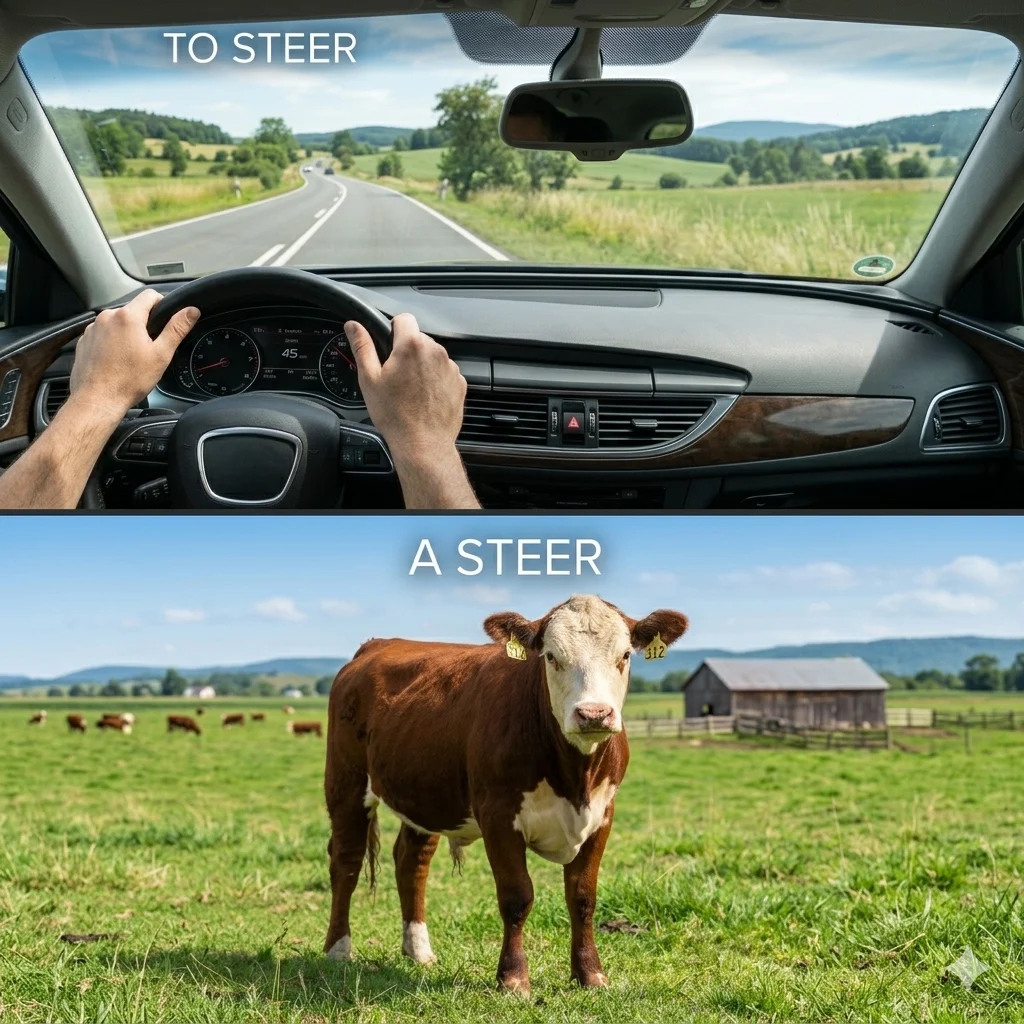
“Steer means to guide or control something; stear is a misspelling—remember the driver mnemonic to always write steer correctly.”
Stuck between “stear” and “steer”? Don’t let a typo drive you aggravate—here’s the fix!Steer is the correct English word, meaning to guide, direct, or control the movement of something, whether it’s a car, a team, or even a conversation.
For example: “She had to steer the car carefully through the narrow road”, “He had to steer the team through a tough project”, or “Steer your discussion carefully to avoid misunderstandings.”
On the other hand, stear is not a standard English word and is often just a misspelling (sometimes confused with stearic, which relates to fat in chemistry).
Understanding this difference is essential for writing accurately, avoiding mistakes, and sounding professional in every context. This guide will help you use ‘steer’ confidently every time and never mix it up with ‘stear’.
Steer meaning
The quick answer is simple: the correct spelling is almost always “steer.”
“Steer” is a versatile word with two primary meanings:
To guide or direct: This is the most common usage. It means to control the direction of something, like a vehicle, or to guide a conversation or project.
Example: “Please steer the car towards the next exit.”
Example: “As the manager, she tries to steer the team away from unnecessary risks.”
A male bovine: In agriculture, a “steer” is a young, castrated male cow, typically raised for beef.
Example: “The rancher has a herd of fifty steers.”
On the other hand, “stear” is not a standard English word. It is a common misspelling of “steer.” If you use “stear” in your writing, it will be flagged as an error by spell checkers.
The Origin of Steer
Understanding where a word comes from can help cement its correct spelling in your mind. The verb “steer” has deep roots in the English language. It comes from the Old English word stīeran, which means “to guide, direct, or govern.” This word can be traced even further back to the Proto-Germanic steurjanan, which also gives us the German word steuern (to steer) and the Dutch sturen (to send/guide). For over a thousand years, the “ee” spelling has been consistent.
The noun “steer,” referring to a young bull, has a different origin. It comes from the Old English stēor, which is related to the German Stier (bull). While the meanings are unrelated, the spelling has remained the same for centuries.
So, why does “stear” appear? It’s likely a simple phonetic error. The “ee” sound in “steer” can sometimes be represented by “ea” in other English words (like “fear” or “dear”), leading people to incorrectly apply that pattern.
British English vs American English Spelling
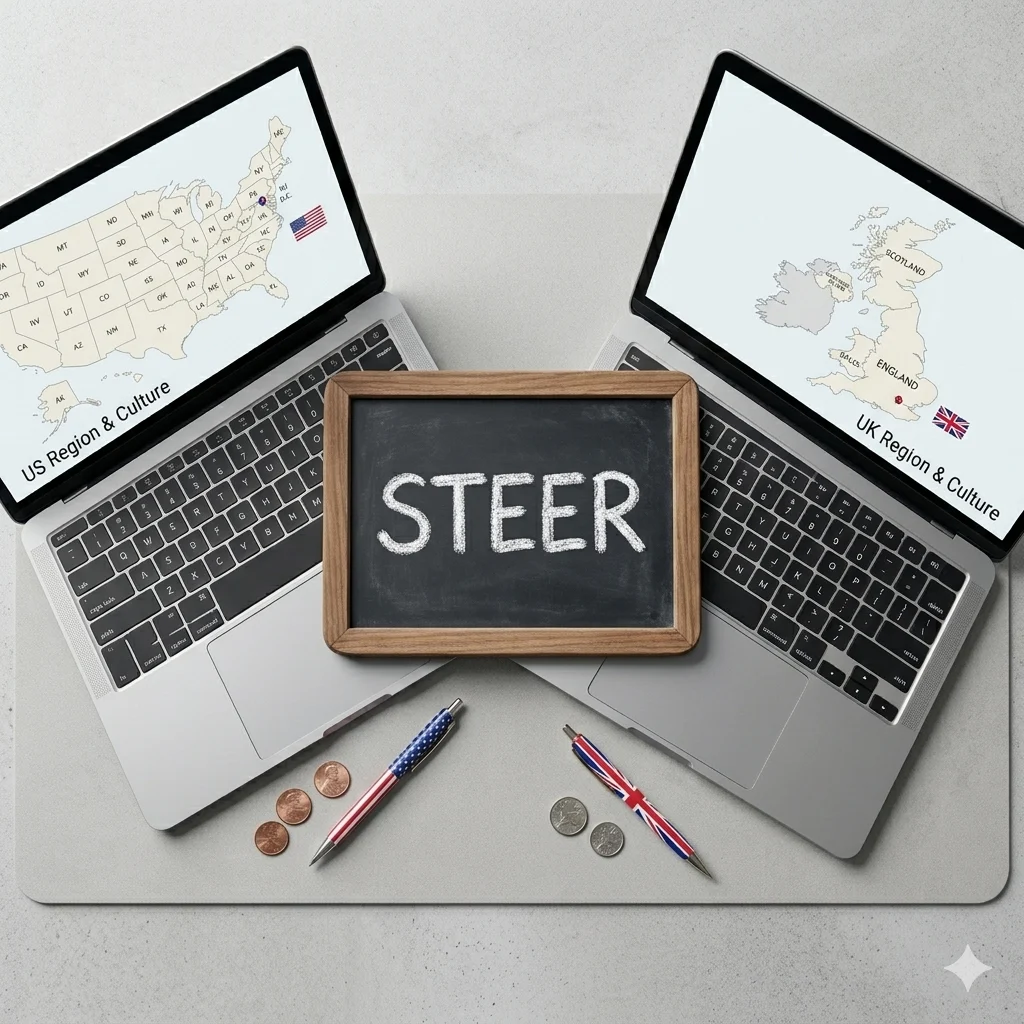
This is one case where there is no transatlantic divide. Both American and British English agree completely: the correct spelling is steer.
Here is a simple table to illustrate the consistency:
Word Form
American English
British English
Example Sentence
Verb (to guide)
steer
steer
You need to steer the boat carefully.
Noun (young bull)
steer
steer
The steer grazed in the field.
Incorrect Spelling
stear
stear
(This is wrong in both dialects)
The spelling “stear” is not accepted in any standard form of English. Whether you are writing for a US-based audience or a UK-based one, always use “steer.”
Given that “stear” is incorrect, your choice is simple. Always use steer.
For a US Audience: Use “steer.”
For a UK or Commonwealth Audience: Use “steer.”
For a Global Audience: Use “steer.”
There are no special cases or regional exceptions. Steer is the only standard spelling. The word “stear” does not appear in dictionaries as a valid alternative. What is the meaning of the word stear? In short, it has no standard meaning. If you see it, it is almost certainly a typo for “steer.”
Common Mistakes with Steer
The most frequent error is substituting “a” for the second “e.” Let’s look at how to avoid this and other related mix-ups.
Mistake 1: Using “stear” as a verb.
Incorrect: “I need to stear the project in a new direction.”
Correct: “I need to steer the project in a new direction.”
Mistake 2: Using “stear” as a noun for an animal.
Incorrect: “The farmer bought a new stear at the market.”
Correct: “The farmer bought a new steer at the market.”
Mistake 3: Confusing it with “steel” or “steep.”
Sometimes, autocorrect might not catch “stear” and instead change it to a completely different word. Always double-check your context.
Mistake 4: Misunderstanding the meaning of “steer.”
Remember, steer meaning is about direction or a specific type of cattle. It is not related to “stare” (to look intently).
Is steer a car or stear a car? You steer a car. “Steer” is the verb that describes the action of turning the steering wheel to control the car’s direction.
Seeing how “steer” is used in different contexts can solidify your understanding. It’s a common word in both casual and formal writing.
In an Email:
“Hi Team, let’s steer our efforts toward the new marketing campaign. I want to make sure we steer clear of any topics that might be controversial.”
In a News Headline:
“Central Bank Attempts to Steer Economy Away from Recession”
On Social Media:
“Trying to steer my friends towards the best taco place in town. 🌮 #Foodie”
In Formal Writing:
“The chairman was able to steer the committee towards a unanimous decision after hours of deliberation.”
In a General Conversation:
“Can you give me a steer on which way to go?” (Here, “steer” is used as a noun meaning advice or guidance). “Watch out for that steer in the road!” (Referring to the animal).
Steer – Google Trends & Usage Data
If we were to look at data from tools like Google Trends, the pattern is crystal clear. The search term “steer” consistently appears as a common word. The search for “stear or steer” spikes occasionally, which shows that people are actively seeking to resolve this exact spelling confusion. This confirms that while most people know the word “steer,” many are unsure enough about the spelling to look it up.
Geographically, “steer” is searched for frequently in English-speaking countries like the United States, the United Kingdom, Canada, and Australia, primarily for its meaning related to driving and guidance. In regions with large agricultural sectors, searches for “steer” (the animal) are also very common.
Here is a final comparison to show the correct usage against the common error:
Correct Spelling (Steer)
Incorrect Spelling (Stear)
To guide or control movement.
No standard meaning.
A type of cattle.
A common typo.
Example: He knows how to steer.
Example: He knows how to stear. (Wrong)
Example: That is a prize-winning steer.
Example: That is a prize-winning stear. (Wrong)
(FAQs)
1. What is the difference between steer and stear? “Steer” is the correct English word meaning to guide or a young bull. “Stear” is not a recognized word in standard English and is simply a common misspelling of “steer.”
2. What is a stear? What is a stear? In the English language, “stear” is not a word with a definition. If you come across it, it is a typographical error for the word “steer.”
3. Is it steer a car or stear a car? The correct phrase is to steer a car. You use the steering wheel to steer the vehicle.
4. Is stear a word? No, is stear a word in the dictionary? Generally, no. Standard English dictionaries do not list “stear.” The correct spelling is “steer” for all meanings.
5. What does it mean to steer someone in the right direction? To steer someone in the right direction is an idiom meaning to give them helpful advice or guidance to help them achieve a goal or find a solution. The correct spelling in this phrase is always “steer.”
6. Steer vs bull: what’s the difference? A steer is a male bovine that has been castrated, usually raised for beef. A bull is an intact male bovine, used for breeding. Both are male cattle, but their roles and temperaments are very different.
7. What are some synonyms for steer (the verb)? Some common steer or steer synonyms include: guide, direct, lead, pilot, navigate, drive, and conduct.
8. Can you give me a steer or stear example? Certainly! Here is a steer or steer example: “Because of the fog, the captain had to steer the ship using only radar.” Using “stear” in this sentence would be incorrect.
Conclusion:
In the journey of English spelling, the road is sometimes confusing, but the path between “stear or steer” is straightforward. We have seen that steer is the only correct and accepted spelling. Whether you are using it as a verb to describe guiding a car, a project, or a conversation, or as a noun to talk about a young bull, “steer” is your word. Its history spans over a thousand years, and its usage is consistent across all major forms of English, from the US to the UK.
The confusion with “stear” is a common trap, but now you have the knowledge to avoid it. Remember, “stear” is a ghost word—it looks like it might be real, but it carries no meaning and has no place in proper writing. By mastering this simple distinction, you add a layer of polish and professionalism to your communication. So, the next time you need to talk about direction, guidance, or cattle, confidently use “steer” and know that your spelling is right on track.
Max Laughwell is the kind of guy who can find comedy in traffic jams and awkward small talk. He believes that if you’re not laughing at life, you’re doing it wrong. His style is smooth, bold, and unexpectedly relatable — like a good joke told at just the right moment. When Max isn’t cracking up his readers, he’s probably out there turning real-life chaos into future punchlines.
Hi, I’m Ethan Richards, the creator of this site dedicated to captions. My goal is to provide you with creative, impactful captions to make every moment stand out!