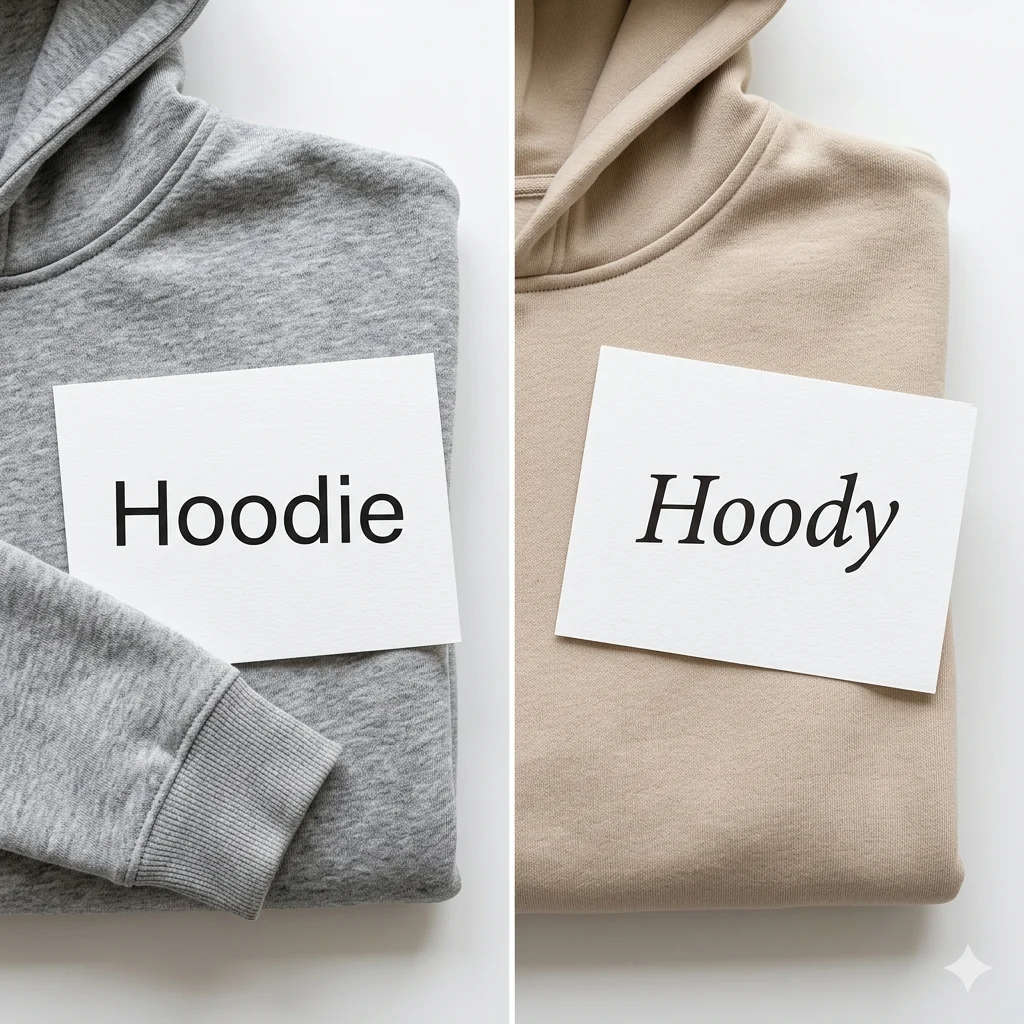
“‘Hoodie’ is the standard and most widely accepted spelling for a hooded sweatshirt, while ‘hoody’ is an informal and less common variant used in casual writing.”
Wondering whether “hoodie” or “hoody” is the correct spelling? Both words refer to the same casual garment—a sweatshirt with a hood—but in modern English, “hoodie” is the standard and most widely accepted spelling used in dictionaries, professional writing, and everyday communication.
“Hoody” is an informal and less common variant that may appear in casual contexts, but it is not the preferred form for formal, academic, or published content.
For clarity and consistency in writing, it’s best to use “hoodie” in most situations. For example, you would say: “I bought a new hoodie for winter.” This ensures your writing aligns with standard English usage and avoids confusion.
Hoodie or Hoody meanings
Hoodie is the standard and most widely accepted spelling in modern English. If you are writing for a global audience, an American publication, or a fashion blog, this is the version you should use.
- Example: “I threw on my favorite hoodie before heading out to the store.”
- Example: The company launched a new line of sustainable cotton hoodies.
While “hoody” is not grammatically incorrect, it is considered a variant spelling. You will occasionally see it, particularly in British English publications or specific brand names, but “hoodie” dominates in dictionaries, news articles, and online searches.
The Origin of the Hoodie
To understand the spelling confusion, we have to look at where the garment and its name came from. The clothing item we know today originated in the 1930s. The sportswear brand Champion is credited with creating the first hooded sweatshirt to keep athletes warm on the sidelines. However, the name “hoodie” didn’t become popular until much later.
In the 1970s and 80s, the garment became a cultural symbol, adopted by hip-hop artists in New York City and skateboarders in California. This cemented its place in streetwear fashion. The name is a simple derivation of the word hood—the defining feature of the shirt. In English, when we add a ‘y’ or ‘ie’ to a word, it often creates a diminutive or an informal version (like “dog” becoming “doggy” or “dear” becoming “darling”). Because the word “hood” ends with a ‘d’, we have two natural-sounding options: hoody and hoodie. Both emerged organically, leading to the spelling war we see today.

British English vs American English Spelling
The primary reason for the “hoodie or hoody” debate lies in the subtle differences between American and British spelling conventions. While neither country is 100% exclusive in its usage, clear trends exist.
American English strongly prefers the “-ie” ending. This follows a pattern seen in other informal words like “foodie,” “roomie,” and “bestie.” The “-ie” spelling looks familiar and friendly to the American eye.
British English is slightly more divided. Historically, the “-y” ending was more common for such derivations. You might see “hoody” in older texts or specific publications like The Guardian or The BBC. However, the global influence of American media and the internet has made “hoodie” increasingly dominant in the UK as well, especially among younger generations.
Here is a simple table to compare the usage:
| Spelling | Primary Region | Common Usage | Example Context |
|---|---|---|---|
| Hoodie | United States, Canada, Global (Online) | Standard spelling for retail, fashion blogs, social media. | “Check out this vintage hoodie I found at the thrift store.” |
| Hoody | United Kingdom (Less common now) | Occasionally used in print journalism or as a stylistic choice for brands. | “The teenager was wearing a grey hoody.” |

While this table shows the trend, it is important to remember that “hoodie” is understood everywhere. If you use “hoody” in the US, people might think it is a typo. If you use “hoodie” in the UK, everyone will know exactly what you mean.
Which Spelling Should You Use?
Choosing between “hoodie” and “hoody” depends entirely on your audience and the context of your writing. Here is a professional guideline to help you decide:
- For a US Audience: Always use hoodie. This is the default spelling in American English for e-commerce, blogging, and casual writing. If you search for “Hoodie for men” or “Hoodie for women” on US-based sites like Amazon, you will overwhelmingly see “hoodie.”
- For a UK or Commonwealth Audience: You are safer using hoodie. While “hoody” exists, it is falling out of favor. Using “hoodie” makes your content look modern and aligned with global standards. It avoids the risk of looking outdated.
- For a Global Audience (Online): Definitely use hoodie. It is the most searchable term and the standard spelling used by major international brands. Using “hoody” could reduce your SEO visibility, as most people type “hoodie” into search engines like Google.
- For Brand or Product Names: Check your specific branding guidelines. If you are naming a product, “Hoodie” is the safer, more recognizable choice. For example, “Classic Zip-Up Hoodie” is clearer than “Classic Zip-Up Hoody.”
Common Mistakes with the Keyword
Even when people know the correct word, they often make mistakes in grammar, context, or spelling. Here are the most frequent errors to avoid:
- The Spelling Swap: The most common error is inconsistency. Do not write “hoodie” in one sentence and “hoody” in the next. Pick one and stick with it.
- Incorrect Pluralization: The plural of hoodie is hoodies. It is not “hoodys” or “hoodies'” (unless you are showing possession).
- Incorrect: “The store has a sale on hoodys.”
- Correct: “The store has a sale on hoodies.”
- Mispronunciation Leading to Misspelling: The pronunciation is the same for both spellings: HUD-ee.
- Question: Hoody or Hoodie pronunciation?
- Answer: They are pronounced exactly the same way. You do not change the sound based on the spelling.
- Confusing it with other words: Sometimes people confuse it with “hood” (the part of the car or the jacket). Remember, the “ie” or “y” turns the object (hood) into the garment (hoodie).

Hoodie in Everyday Examples
Seeing how the word is used in different contexts can help solidify the correct spelling for your needs. Here are real-world examples:
- In an Email: “Hey team, just a reminder that we can wear jeans and a company hoodie for the casual Friday event.”
- In a News Headline: “Local Charity Drive Collects Over 500 Hoodies for the experiencing This Winter.”
- On Social Media (Instagram): “Cozy vibes only today. This oversized hoodie is my whole personality. #OOTD #Fashion”
- In a Formal Product Description: “This premium cotton hoodie features a double-lined hood, a kangaroo pocket, and ribbed cuffs for a comfortable, durable fit.”
- In a Discussion Forum: “I’m trying to find the best hoodie for tall guys. Does anyone have recommendations? I searched on Reddit for ‘hoodie or hoody’ and found a lot of debates.”
Hoodie – Google Trends & Usage Data
Data from search engines confirms the dominance of “hoodie.” When you look at global search data, “hoodie” is searched for hundreds of thousands of times more per month than “hoody.”
- Global Popularity: “Hoodie” is the clear winner in almost every English-speaking country, including the United States, Canada, Australia, and the United Kingdom.
- Context for “Hoody”: The “hoody” spelling sees slightly more relative usage in the UK, but it is still a fraction of the searches for “hoodie.” It often appears in searches for specific items like a “hoody jacket” or “boys hoody,” but even these product searches are shifting.
- Related Queries: Data shows that people who search for the spelling also frequently search for specific types, such as “Zip up hoodie,” which is the correct term for a What is a hoodie with a zipper called—it’s a zip-up hoodie, as opposed to a pullover hoodie. Other popular searches include “Hoodie for girls,” “Hoodie for women,” and “Hoodie for men.” This data confirms that most users default to the ‘-ie’ spelling when looking for products.
(FAQs)
Here are answers to the most common questions people have about this topic:
Is it spelled hoodie or hoody?
Both spellings are technically acceptable, but hoodie is the standard, modern, and most popular spelling worldwide. It is the version you should use in almost all situations.
Is hoodie IE or Y?
In the dominant and correct modern spelling, it is IE (hoodie). The ‘Y’ version (hoody) is a less common variant.
What do the British call a hoodie?
Most British people call it a hoodie. While “hoody” was once more common in UK English, the Americanized “hoodie” has taken over as the standard term, especially among younger generations and in online retail.
Is “hoody” a word?
Yes, “hoody” is a word and is recognized by dictionaries as a variant spelling of hoodie. However, it is considered less common. You might see it in older British publications, but it is falling out of regular use.
What does “hoody” mean?
“Hoody” means the exact same thing as “hoodie”: a casual sweatshirt or jacket with a hood. There is no difference in meaning, only a difference in spelling.
What is a hoodie with a zipper called?
A hoodie with a zipper is called a zip-up hoodie or a full-zip hoodie. The type without a zipper that you pull over your head is called a pullover hoodie.
What is a Hoodie in Creepypasta?
In Creepypasta (internet horror stories), “Hoodie” often refers to a character from the popular “Marble Hornets” series, which is tied to the Slender Man mythos. The character is named after the hooded sweatshirt he wears. This is a proper noun, so the spelling “Hoodie” is fixed.
Should I use “hoodie” for girls’ and women’s clothing?
Yes. Whether you are writing a product description for Hoodie for girls or Hoodie for women, the spelling “hoodie” is the industry standard and will help your products appear in more search results.
Conclusion
The debate between “hoodie” and “hoody” is a classic example of English language evolution. While both spellings have historical roots, the modern landscape is clear. Hoodie is the dominant, preferred, and most professional spelling for virtually all contexts.
Whether you are writing a product description for a zip-up hoodie, posting on social media, or writing an article, “hoodie” is your safest and most effective choice. It aligns with global search trends, satisfies user intent, and ensures your writing looks current and credible. For a UK audience, it is just as acceptable, effectively making “hoody” a relic of the past. So, the next time you go to type this word, remember the power of the “ie”—it’s the spelling the world is wearing.

Chuck Winkman is a master of wordplay and timing — the kind of writer who can make even grammar funny. His humor dances between clever and ridiculous, and his jokes always hit with a mix of intellect and silliness. Chuck’s goal? To make the world laugh one pun at a time. If sarcasm had a superhero, it would definitely wear a cape named Chuck Winkman.