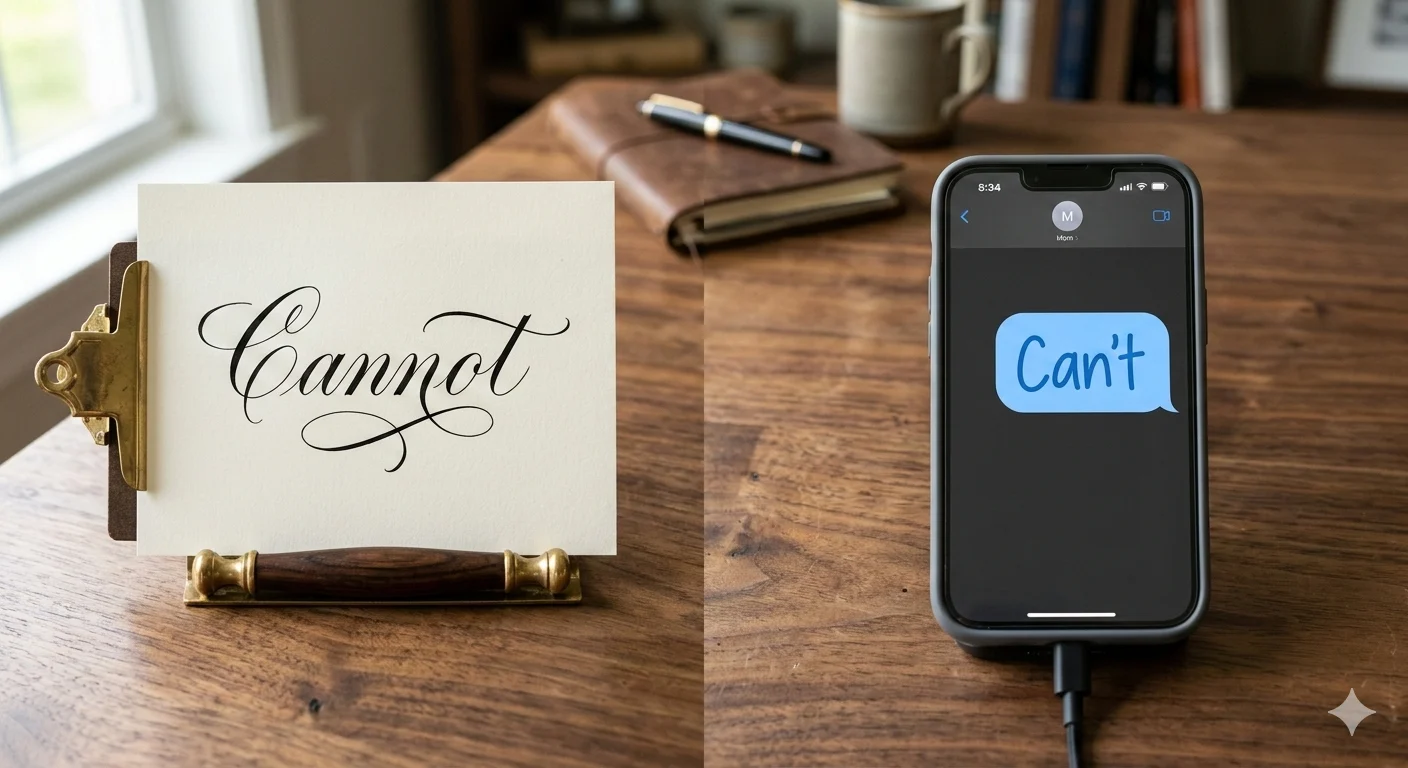
“Cannot and can’t both mean ‘not able to,’ but ‘cannot’ is more formal while ‘can’t’ is the common contraction used in everyday English.”
Should you write “cannot” or “can’t”? Many English learners and writers often feel confused about cannot or can’t and which one is correct to use. The truth is that cannot and can’t have the same meaning—they both show that something is not possible or someone is not able to do something.
The difference mainly comes down to tone and formality. Cannot is typically used in formal writing such as academic work, professional emails, or official documents, while can’t is a shorter contraction that is widely used in casual conversations and informal writing.
For example:
- I cannot attend the meeting today.
- I can’t attend the meeting today.
Both sentences mean the same thing, but the level of formality is slightly different. Understanding cannot or can’t helps you choose the right form depending on the situation and makes your writing sound more natural and appropriate. In this article, you’ll learn the difference between cannot and can’t, when to use each form, and simple examples that make the rule easy to understand.
Cannot or Can’t meanings
The quick answer is simple: both “cannot” and “can’t” are correct, but they are used in different situations.
- Cannot: This is the formal version. You should use it in official documents, academic essays, and professional business letters. For example: “The company cannot accept returns without a receipt.”
- Can’t: This is the contraction, short for “cannot.” It is informal and is the preferred choice for everyday conversation, text messages, and social media. For example: “I can’t go to the party tonight.”
The choice depends entirely on the tone you want to set. If you are writing something serious, choose “cannot.” If you are speaking to a friend, “can’t” is the natural way to go.
The Origin of Cannot
To understand why we have two words, it helps to look at the history. The word “cannot” is a classic example of linguistic evolution through usage.
Originally, in Early Modern English (the language of Shakespeare), people wrote “can not” as two separate words. However, because these two words were used together so frequently in speech, they began to merge in writing. By the 17th and 18th centuries, “cannot” had become the standard compound form in most published texts. It was simply faster and more efficient to write it as one word.
The spelling difference is purely practical. While most other auxiliary verbs remain as two words (like “will not” or “have not”), “cannot” fused together early on. The contraction “can’t” appeared around the same time, born from the need to mimic spoken language. It is a shortened form where the letters “no” are replaced with an apostrophe.

British English vs American English Spelling
When it comes to the specific debate of cannot or cannot, there is no spelling difference. Both American and British English agree that the standard negative form of “can” is the single word “cannot.”
However, the difference lies in the usage of can not (two words). While generally considered incorrect, there is one specific situation where “can not” is acceptable. You use it when “not” is part of another structure, like the “not only… but also” construction.
| Form | British English Usage | American English Usage | Example |
|---|---|---|---|
| Cannot | Standard and preferred in all formal writing. | Standard and preferred in all formal writing. | “The defendant cannot be reached for comment.” |
| Can’t | Extremely common in speech and informal writing. | Extremely common in speech and informal writing. | “I can’t believe it’s already Friday.” |
| Can not | Rare. Only used for emphasis or specific constructions. | Rare. Only used for emphasis or specific constructions. | “You can not only win, but you can also set a record.” (Emphasis) |
As you can see, the table confirms that the core choice is not between countries, but between formality levels. Whether you are in the UK or the US, you will use “cannot” for a report and “can’t” for a text.
Which Spelling Should You Use?
Deciding whether to use “cannot” or “can’t” depends heavily on your audience and the medium you are writing for. Here is a simple guide:
- For US Audiences: American English is slightly more tolerant of contractions in medium-formality writing, such as blog posts or internal company emails. However, for academic or legal writing, you must use “cannot.”
- For UK/Commonwealth Audiences: British English tends to be a bit more formal in writing. While “can’t” is fine for personal communication, you are safer using “cannot” for any official business.
- For Global Audiences: If you are writing for an international crowd, especially in a professional context like a business proposal, always default to “cannot.” It is universally understood as correct and avoids any perception of being too casual.
- For Creative Writing: Use “can’t” in dialogue. It makes the character sound realistic. Use “cannot” in the narrative if the voice is formal.
Common Mistakes with Cannot and Can’t
Even native speakers make mistakes with these words. Here are the most frequent errors to watch out for:
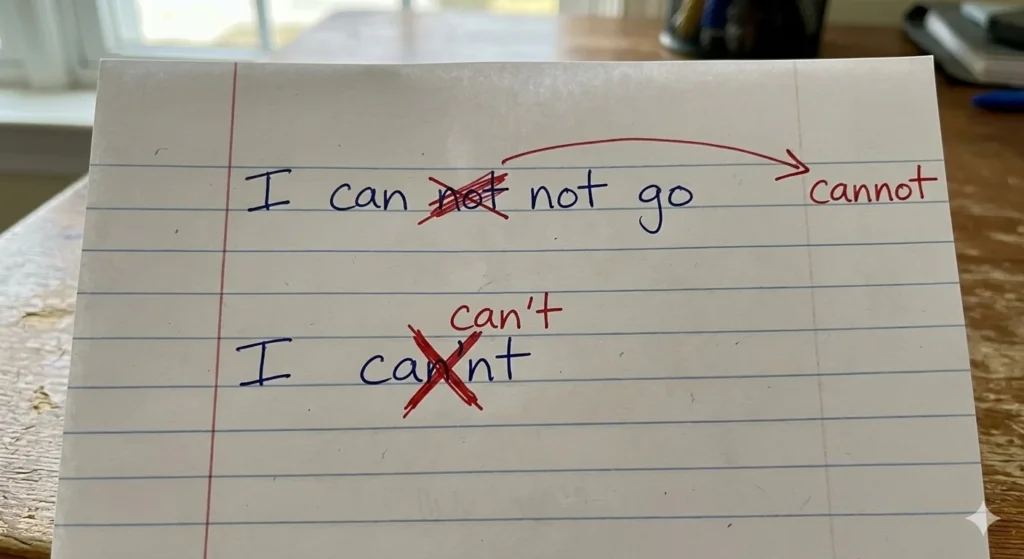
- Using “Can not” Incorrectly: The biggest mistake is writing “can not” when you mean “cannot.”
- Incorrect: “I can not go to the store.”
- Correct: “I cannot go to the store.” (unless you are emphasizing that you have a choice not to go, which is rare).
- Misplacing the Apostrophe in “Can’t”: An apostrophe replaces missing letters. In “can’t,” the missing letters are “no.” A common error is writing “ca’nt” or “cant.”
- Incorrect: “I ca’nt believe it.”
- Correct: “I can’t believe it.”
- Confusing “Can’t” with “Cant”: “Cant” (without an apostrophe) is a real word, but it has a different meaning. It refers to hypocritical and sanctimonious talk, or a slope.
- Example of cant: “The politician’s speech was full of religious cant.”
- Overusing Contractions in Formal Writing: While “can’t” is perfect for emails to colleagues, using it in a thesis or a cover letter can make you look unprofessional.
Cannot and Can’t in Everyday Examples
Seeing these words in context is the best way to understand their proper use. Here is how they appear in different writing scenarios.
In Formal Writing (Academic/News):
- “The study concludes that we cannot ignore the impact of climate change.”
- “The CEO stated that the company cannot guarantee job security during the merger.”
In Social Media (Informal):
- “I can’t even deal with this right now.”
- “You can’t be serious! That’s hilarious.”
- “OMG, I cannot wait for the weekend!”
In Business Emails:
- To a client (Formal): “Unfortunately, we cannot offer a refund after 30 days.”
- To a coworker (Informal): “I can’t make the 10 AM meeting. Can we reschedule?”
In Text Messages:
- “I can’t find my keys. Help!”
- “Why can’t you just tell me now?”

Cannot vs. Can’t – Usage Data
If you look at global search data and writing trends, you will notice a clear pattern regarding cannot or can’t popularity. In published writing indexed by Google, “cannot” appears more frequently in formal contexts. However, in spoken English and informal digital communication (like tweets and Reddit posts), “can’t” is overwhelmingly more common.
The choice is highly contextual by country as well. In the United States, there is a more relaxed approach to contractions in digital media. In the United Kingdom, traditional publications like The Guardian or The BBC still lean heavily towards “cannot” for online articles to maintain an air of authority and formality. If you are writing for a global audience, your best bet is to use “cannot” for information that must be taken seriously, and “can’t” for engagement and conversational pieces.
(FAQs)
1. Which is correct, cannot or cannot?
Both are correct. The first “cannot” is the standard spelling. There is no alternative spelling. If you meant to ask about “cannot” vs “can not,” then “cannot” is the correct standard form, while “can not” is only used in specific grammatical constructions.
2. Is the word “cannot” correct?
Yes, absolutely. “Cannot” is the standard and correct way to write the negative form of “can” in modern English. It is used in everything from legal documents to novels.
3. Can we say “cannot”?
Yes, we can say it, though it often sounds very formal or emphatic in speech. In casual conversation, most native speakers will use the contraction “can’t.” For example, you would usually say “I can’t hear you” rather than “I cannot hear you,” unless you are trying to be very clear or dramatic.
4. When to use can or cannot?
Use “can” to express ability or possibility (e.g., “I can swim”). Use “cannot” to express the lack of ability or a prohibition (e.g., “I cannot swim” or “You cannot enter this room”). The choice defines the positive or negative state.
5. What is the difference between cannot or can’t?
The difference is formality and usage. “Cannot” is one word used in formal writing. “Can’t” is a contraction (a shortened form) used in informal writing and speech. They mean the exact same thing.
6. Can I use “cannot” in academic writing?
Yes, you should use “cannot” in academic writing. Contractions like “can’t” are generally discouraged in essays, research papers, and theses because they are considered too casual.
7. What does “cannot wait” mean?
“I cannot wait” or “I can’t wait” is an idiom that means you are very excited about a future event. For example: “I cannot wait for my vacation!” It implies that waiting is difficult because you are so eager.
8. Is it “cannot” or “can not” in UK English?
In UK English, “cannot” is the standard form. The two-word version “can not” is rarely used and generally considered a mistake unless you are specifically emphasizing the “not” in a sentence.
9. Why do we say “can’t” instead of “cannot”?
We say “can’t” in conversation because it is faster and easier. Language evolves for efficiency, and contractions help the flow of speech. Saying “cannot” every time would make dialogue sound stiff and unnatural.
Conclusion
So, when you are stuck on cannot or can’t, just think about the situation. Remember that “cannot” is the reliable, formal workhorse of the English language. It is professional, clear, and never wrong in serious writing. On the other hand, “can’t” is your friendly, casual partner. It is what you use when you are texting friends or writing a fun blog post.
The key takeaway is that context is everything. Don’t stress about mixing them up; just be consistent with the tone of your document. By avoiding the common mistake of splitting them into “can not” unnecessarily, you are already ahead of the game. Whether you choose the formal path of “cannot” or the relaxed route of “can’t”, you now have the knowledge to make the right choice every time.

Max Laughwell is the kind of guy who can find comedy in traffic jams and awkward small talk. He believes that if you’re not laughing at life, you’re doing it wrong. His style is smooth, bold, and unexpectedly relatable — like a good joke told at just the right moment. When Max isn’t cracking up his readers, he’s probably out there turning real-life chaos into future punchlines.